



The cooling system includes: cooling jacket (in the cylinder block and in the cylinder head), radiator, coolant pump, thermostat, cooling fan, connecting hoses and other elements.
The coolant, heated in the cooling jacket, is pumped into the radiator by a pump, where it is cooled by a fan and the oncoming air flow that occurs when the car is moving. The coolant then returns to the cooling jacket by a pump and cools the engine. The cooling jacket is a network of channels for the passage of liquid. These channels are formed by the spaces between the cylinder liners in the cylinder block and communicate with the channels in the block head. The movement of the liquid is organized in such a way as to ensure the most effective cooling of those engine elements that are heated the most during its operation.
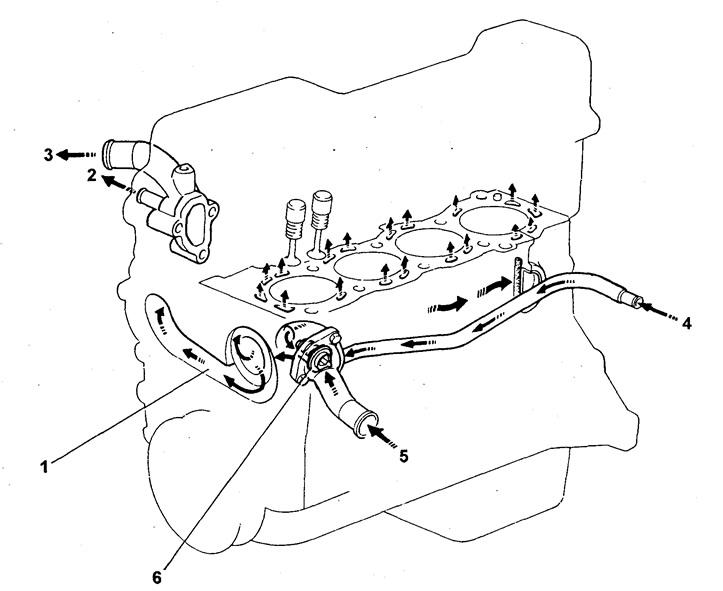
Schematic diagram of the cooling system,
1 - coolant pump,
2 - to the heater,
3 - to the radiator,
4 - from the heater,
5 - from the radiator,
6 - thermostat.
Radiator
The radiator is located in the front part of the car and is designed to cool the liquid coming from the cooling jacket. The radiator consists of right and left tanks and a radiator core. The right tank contains an inlet pipe through which the coolant comes from the cooling jacket. It also has a drain cock through which the coolant is removed. The radiator core has many finned tubes through which the coolant flows from the right tank to the left. Thus, the coolant, heated when passing through the cooling jacket, is cooled in the radiator by the air flow forced by the electric fan and the oncoming air flow that occurs when the car is moving. Models with automatic transmission have a special cooler for the automatic transmission working fluid, which is located in the left tank of the radiator.
The text is quoted from the source website: ToyotaMAN
Radiator cap
Radiator cap - sealing type; it must seal the radiator and withstand the increased pressure that occurs as a result of the thermal expansion of the coolant. The increased pressure in the radiator prevents the coolant from boiling even at temperatures above 100°C. The radiator cap has a steam ("relief") valve and an air valve ("vacuum valve"). At a coolant temperature of 110-120°C, the excess pressure inside the radiator caused by the thermal expansion of the liquid reaches 0.3-1.0 kg/cm² or 30-100 kPa. If this limit is exceeded, the steam valve opens under the action of the pressure, and the steam escapes into the atmosphere through the steam pipe. The air valve opens under the action of the vacuum that forms inside the radiator after the engine is stopped and the coolant temperature drops.
Expansion tank The expansion tank is designed for the excess volume of coolant, which is obtained as a result of its volumetric expansion when heated. When the temperature of the coolant drops, it returns from the expansion tank to the radiator; this way, the radiator is always filled with coolant, and unnecessary losses are prevented. To make sure that you need to top up the coolant, check the level in the expansion tank.
Coolant pump
The coolant pump provides forced circulation of coolant through the cooling system. It is mounted at the front of the engine on the timing chain cover and is driven by the crankshaft via a V-belt drive.
Thermostat
The thermostat has a wax bypass valve and is installed on the inlet pipe of the cooling circuit. The thermostat has an automatic valve controlled depending on the coolant temperature. This valve closes when the coolant temperature drops, and thus prevents the liquid from circulating through the engine, accelerating the process of its warming up. At the same time, since the bypass valve is open, the coolant circulates only inside the engine (on the small circuit of the cooling system). When the coolant temperature rises, the automatic thermostat valve opens and the bypass valve closes, allowing coolant to circulate through the radiator. The wax filler inside the thermostat's power element expands when heated and cools when cooled. The heating of the wax filler in the power element creates a force that overcomes the force of the spring, which holds the valve closed; this opens the automatic valve. When the wax filler cools, it contracts and the spring force closes the automatic valve. In these engine models, the thermostat maintains the operating temperature of the coolant at about 82°C.