



Contents: Anchor ↓ Collector ↓ Stator ↓ Brushes ↓ Brush springs ↓ Brush holder ↓ Overrunning clutch and gears ↓ Bearings ↓ Traction relay ↓
Anchor
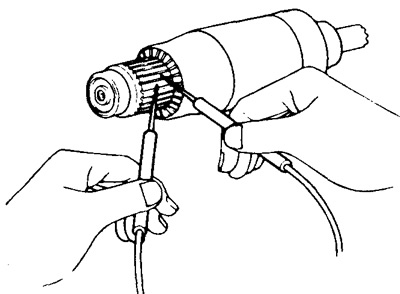
1. Check for a short circuit between the armature winding sections by measuring the resistance between the commutator plates. If there is a short circuit between the plates, replace the armature.
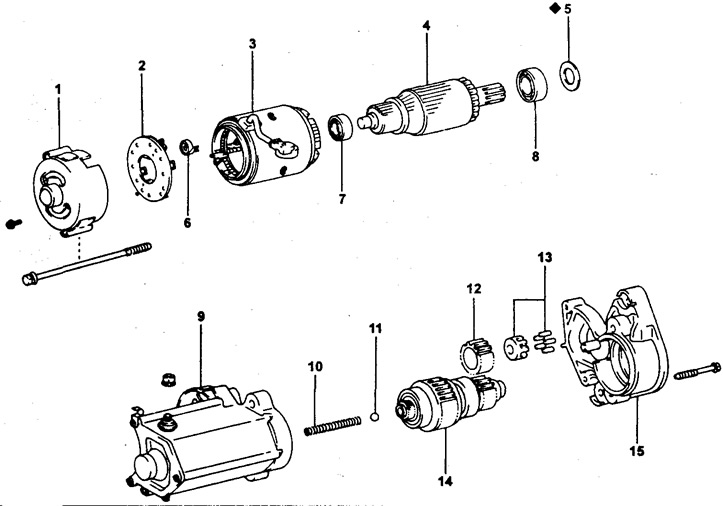
1.0 kW starter parts.
1 - cover from the collector side,
2 - brush holder,
3 - stator,
4 - anchor,
5 - felt pad,
6 - brush spring,
7 - front bearing,
8 - rear bearing,
9 - traction relay,
10 - return spring,
11 - steel ball,
12 - parasitic gear,
13 - bearing,
14 - overrunning clutch,
15 - drive side cover,
♦ - parts that cannot be reused.
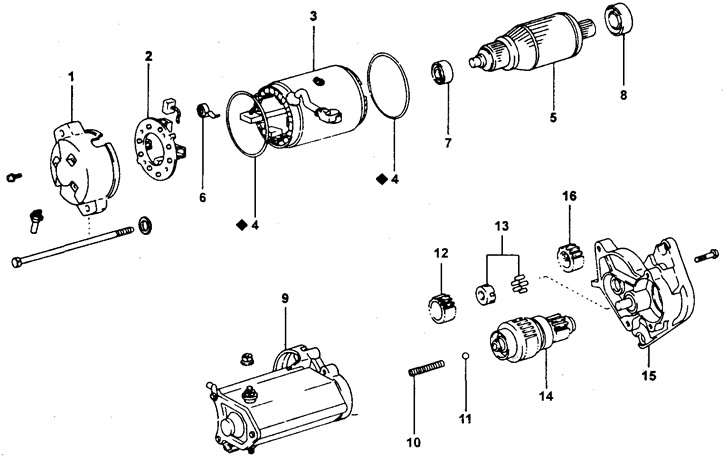
1.4 kW starter parts.
1 - cover from the collector side,
2 - brush holder,
3 - stator,
4 - O-ring sealing gasket,
5 - anchor,
6 - brush spring,
7 - front bearing,
8 - rear bearing,
9 - traction relay,
10 - return spring,
11 - steel ball,
12 - parasitic gear,
13 - bearing,
14 - overrunning clutch,
15 - drive side cover
16 - gear,
♦ - parts that cannot be reused
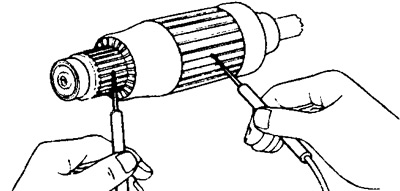
2. Check whether the armature winding is shorted to ground by measuring the resistance between the collector plates and the armature core. The resistance should tend to infinity. Otherwise, replace the armature.
[The information was taken from a web portal: www.TOYOTAMAN.ru]
Collector
1. Clean dirty or burnt surfaces with #400 sandpaper or turn them on a lathe.
2. Check the collector runout.
- Maximum permissible radial runout no more than 0.05 mm
3. Measure the diameter of the manifold.
- Nominal diameter - 30 mm
- Minimum allowable - 29 mm
If the diameter is less than the minimum value, replace the anchor.
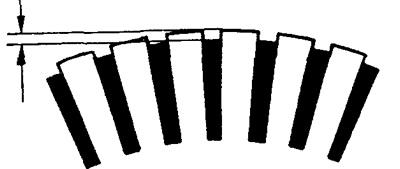
4. Check the collector fins by ensuring that the spaces between the fins are free of foreign material and dirt and by measuring the height of the fin protrusion.
- The nominal height of the collector lamellas (plates) protrusion is 0.6 mm
- The minimum height of the collector lamellas (plates) protrusion is 0.2 mm
Otherwise, deepen the grooves.
Stator
1. Check for a break in the stator winding circuit by measuring the resistance between the stator winding wire terminal and the brush. If the resistance approaches infinity, replace the stator.
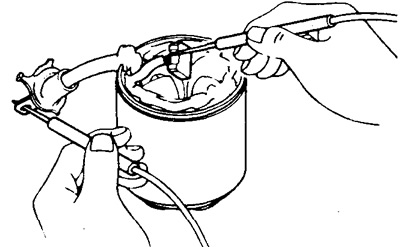
2. Check for a short circuit of the stator winding to ground by measuring the resistance between the stator winding (brush) and the housing. If there is continuity, replace the stator.
Brushes
Use a caliper to measure the height of the brushes.
Brush height:
for a starter with a power of 1.0 kW:
- nominal - 13.5 mm
- minimum allowable - 8.5 mm
for a starter with a power of 1.4 kW:
- nominal - 15.5 mm
- minimum allowable - 10.0 mm
If the measurement results are outside the specified limits, replace the brushes.
Brush springs
Use a dynamometer to measure the tension of the spring at the moment it breaks away from the brush.
- The minimum permissible tension is 1.79-2.41 kgf (18-24 N).
Note: the measurement is taken at the moment the spring breaks away from the brush. If the tension does not correspond to the specified values, replace the springs.
Brush holder
Using an ohmmeter, measure the resistance between the positive and negative brush holders. If there is continuity, (the circuit is closed) replace or repair brush holders.
Overrunning clutch and gears
1. Check the pinion gear teeth, idler gear teeth and the entire overrunning clutch assembly for wear or damage. Replace any worn or damaged gears, also checking the flywheel ring gear.
2. Check the overrunning clutch pinion gear by turning it clockwise. Make sure it rotates freely.
Replace the overrunning clutch assembly if necessary.
Bearings
1. Check the bearings by rotating each bearing by hand while pressing it axially. If there is resistance to rotation or the bearing is seized, replace it.
2. When replacing bearings, use suitable tools.
Traction relay
1. Check the pull-in winding by measuring the resistance between the starter terminal "50" and terminal "C" with an ohmmeter. If the resistance tends to infinity (the circuit is open), replace the traction relay.
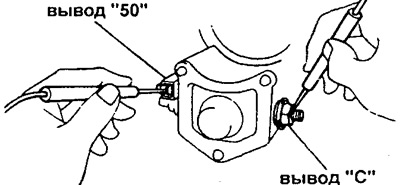
2. Check the holding winding by measuring the resistance between the starter terminal "50" and the traction relay housing using an ohmmeter. If the resistance tends to infinity (the circuit is open), replace the traction relay.