
- The air filter must be installed.
- The engine must be at operating temperature.
- All fuel system wires and lines must be connected.
- All electrical energy consumers must be turned off.
- All vacuum hoses must be connected correctly.
- All electrical connectors of the fuel injection device must be correctly connected.
- The ignition timing must be set.
- The gearbox must be in neutral.
Make the adjustment as follows:
- Warm up the engine to operating temperature.
- For idle speed, perfect closing of the additional air valve plays an important role. If the engine is not idling well, the first thing you should check is the valve. To do this, carry out the following work:
— Disconnect the air filter hose from the throttle body.
— Start the engine and close the auxiliary air valve channel with your finger, as shown in Figure 140. The speed should drop by no more than 100 rpm. Otherwise, replace the valve.
— Reconnect the air filter hose.
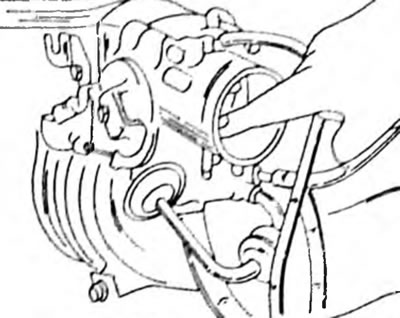
Pic. 140. Closing the auxiliary air valve channel in the throttle body
- Start the engine again and take idle speed readings. They should be 800±50 rpm on a 1.6 liter engine or 700±50 rpm on a 2.0 liter engine. Otherwise, rotate the adjustment screw in the throttle body. On a 1.6 liter engine it is located in the location shown in Figure 141; on a 2.0 liter engine it is located in the location shown in Figure 142.
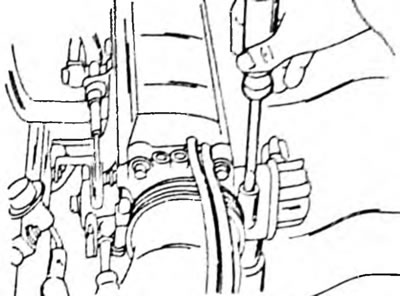
Pic. 141. Adjusting the idle speed on the fuel injection device of the 1.6 liter engine.
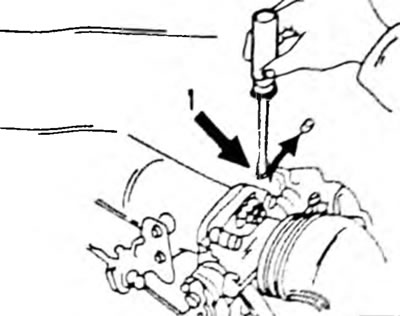
Fig. 142. Adjusting the idle speed on the fuel injection device of a 2.0 liter engine without a catalyst. Adjustment is made with a screw (1).
Adjustment of CO content on 1.6 liter engines without a catalyst is carried out as follows:
- Connect the CO meter according to the manufacturer's operating instructions, start the engine and run for approximately 90 seconds at 2500 rpm.
- Insert the measuring probe of the device for measuring CO content no less than 60 cm into the exhaust pipe and take readings 1-3 minutes after accelerating the engine. The reading should be 1.5±0.5%.
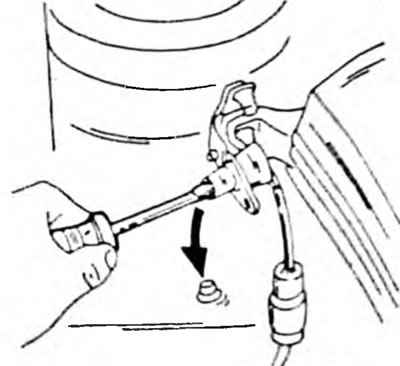
- If the reading does not correspond to the specified value, remove the rubber plug in Figure 143 (only on cars without a catalyst) and adjust the mixture composition using variable resistance. The resistance screw can only move 3/4 of a turn. The engine should idle normally. If this does not happen, there are other faults.
- Take idle speed readings again and adjust if necessary. In this case, also adjust the CO content.
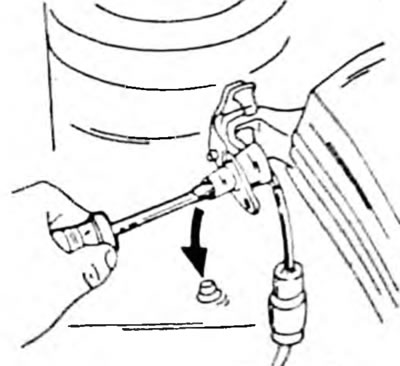
Pic. 143. Adjustment of CO content using variable resistance (1.6 l engine).
Adjustment of CO content on 2.0 liter engines without a catalyst is carried out as follows:
- Connect the device for measuring CO content in accordance with the manufacturer's operating instructions.
- Jumper terminals E and T1 on the inside of the small socket shown in Figure 144.
Pic. 144. Insert jumper (2) into both test socket terminals shown (1)
- Start the engine and let it run for approximately 90 seconds at 2500 rpm.
- Insert the measuring probe of the device for measuring CO content no less than 40 cm into the exhaust pipe and take readings 1-3 minutes after accelerating the engine. The reading should be 1.5±0.5%.
- If the reading does not correspond to the set value, remove the rubber plug in Figure 145 and adjust the mixture composition using the variable । resistance. The resistance screw can only move 3/4 of a turn. The engine should idle normally. Otherwise, there are other reasons.
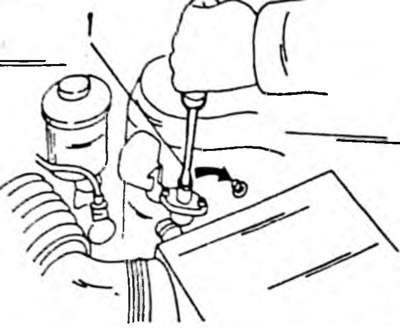
Pic. 145. Adjustment screw (1) to adjust the CO value on a 2.0 liter engine without a catalyst.
- Check the idle speed again and, if necessary, make the necessary adjustments. If this does not lead to success, contact a TOYOTA service center where the entire system can be checked.