



The racks are connected via ball joints to the transverse steering rods. The latter transmit the force via the joints and steering knuckles to the front wheels.
The steering racks should move easily, but without play. The rack drive does not require maintenance. It is only necessary to monitor the condition of the sealing cuffs.
Depending on the car model or version, the steering may have a hydraulic booster. The purpose of the hydraulic booster is to reduce the effort required to turn the steering wheel by the driver. The hydraulic booster consists of an oil pump, a tank and oil lines. The oil pump drives the engine through a V-belt. The pump sucks oil from the tank and delivers it under high pressure to the valve body. The valves are located in the steering mechanism and are mechanically connected to the steering wheel shaft. The valves deliver oil, depending on the turn of the steering wheel, to the corresponding cavity of the working cylinder. In the cylinder, the oil acts on the piston of the toothed rack, steering rods. At the same time, the piston squeezes oil from the working cavity of the cylinder through the return oil line into the tank.
Note: Always install new self-locking nuts. Welding and other work involving deformation of steering gear components is not permitted. Repair work with the steering requires a certain amount of experience. Therefore, it is recommended to carry it out in a specialized workshop.
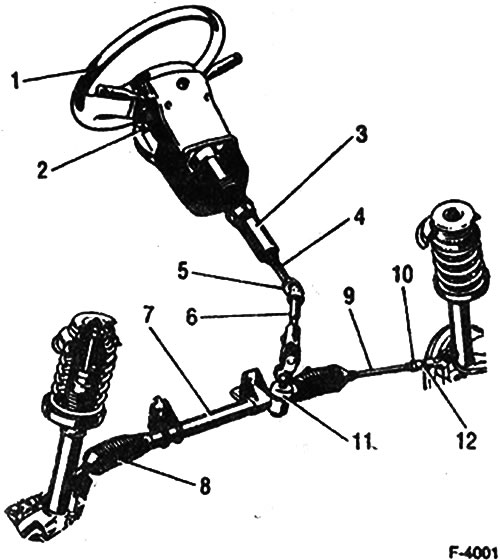
1 - steering wheel
2 - ignition switch lock
3 - casing
4 - steering wheel shaft
5 - cardan joint
6 - intermediate shaft
7 - steering gear housing
8 - protective cover
9 - Transverse steering rod
10 - lock nut
11 - steering mechanism
12 - steering rod end
(The full article is posted on the website: ToyotaMAN)