



Contents: Toe-in. Camber. Lateral and…↓ Adjustment ↓
Optimal driving characteristics and minimal wear of the car tires are achieved with correct installation of wheels. In case of incorrect and worn tires, instability of the car when driving straight and poor control on turns, it is necessary to contact a specialized workshop to conduct optical measurements of the chassis.
Optical measurements require special equipment. Only the basic concepts related to the measurement process and adjustment parameters are described here.
Toe-in. Camber. Lateral and longitudinal tilt of the steering axis
Toe-in is the difference in distance between the rear and front edges of the wheels at the axle level and measured transversely. As a rule, the front wheels have a positive toe-in, which prevents the wheels from diverging due to their camber and rolling resistance when moving in a straight line. The cause of wheel divergence is also play in the wheel hub bearings, suspension and steering rod joints. Toe-in of the front wheels compensates for their tendency to diverge.
Wheel camber and lateral tilt of the steering axis reduce the transmission of shocks to the steering and reduce wheel friction when cornering.
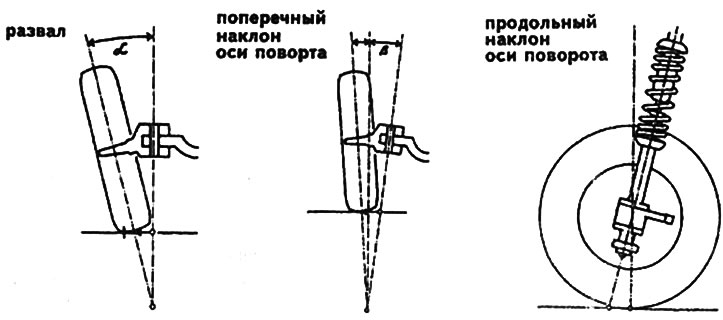
Camber is the angle of deviation of the wheel plane from the vertical. As a result of camber, the wheels are inclined. In particular, with negative camber, the distance between the wheels at the points where they rest on the ground is greater than at the top.
The transverse tilt of the steering axis is the angle between the axis of the steering knuckle and the vertical in the transverse direction of the vehicle.
Due to the presence of wheel camber and transverse tilt of the steering axis, the points of contact of the wheels with the road surface become closer to the axis of the steering knuckle. This maintains a small value of the steering gear rolling arm. The smaller it is, the less the resistance to turning. At the same time, the transmission of road surface impacts to the steering mechanism is weakened.
The longitudinal tilt of the steering axis is the angle between the axis of the steering knuckle and the vertical in the longitudinal direction of the vehicle. A small longitudinal tilt angle reduces the stability of the vehicle when driving on bad roads or with a crosswind and makes it difficult to return the steering control to its initial position. At the same time, an excessively large longitudinal tilt increases the force applied to the steering wheel.
The longitudinal and transverse tilt of the steering axes and the camber of the wheels of the TOYOTA COROLLA are not adjusted, but only monitored. Deviation of the specified values from the specified ones indicates the presence of damage to the suspension or wear of parts.
Adjustment
To perform geometric control of the vehicle chassis, an equipped pit or lift is required. To perform this operation, the following conditions must be met:
- The tire pressure must be at the required level
- The fuel tank must be full, but the car must be without passengers and driver
- The vehicle's suspension must be settled by applying force from top to bottom
- The steering wheel should be in the middle position ("straight")
- The steering wheel play must be within the tolerance limits (steering wheel rim play no more than 30 mm)
- The play in the suspension and wheel hub bearings must be within the tolerance limits.
- The radial and axial runout of the wheel disks must not exceed 1 mm
- Clearance (ground clearance) must match the specified value