



Contents: Draining the coolant ↓ Filling with coolant ↓
Draining the coolant
Remove the expansion tank cap.
Warning! Do not remove the radiator cap if the engine and radiator are hot, otherwise you may get burned. Hot coolant and steam may escape from the radiator.
Remove the radiator and engine drain plugs and drain the coolant.
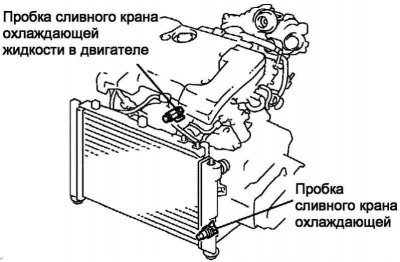
Fig. 2.402. Radiator components
Tighten the drain cock plugs (fig. 2.402).
Tightening torque: 13 Nm for engine drain cock plug.
Filling with coolant
Open the air release valve A.
Fill the cooling system with coolant up to the B mark (fig. 2.402).
Filling volume: 7.4 l.
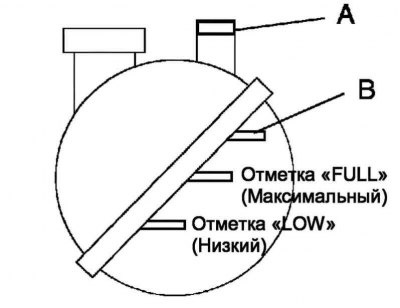
Fig. 2.403. Expansion tank components
Caution: Using an unsuitable coolant may cause damage to the engine cooling system.
Warning: Use only coolant "Toyota Super Long Life Coolant" or other antifreeze of similar quality based on ethylene glycol, free of silicates, amines, nitrites and borates, with an extended replacement period, manufactured using hybrid organic acid technology (extended life coolant made with hybrid organic acid technology is a combination of low phosphates and organic acids).
Attention! "Toyota Super Long Life Coolant" is a mixture of 50% coolant concentrate and 50% distilled water. This coolant does not freeze at temperatures down to -35°C.
Visually check the coolant level in the radiator by squeezing the inlet and outlet hoses with your hand several times. If the coolant level drops, you need to add coolant.
Note: It is not allowed to pour plain water into the cooling system.
Tighten the air release valve A.
Install the expansion tank cap.
Start and warm up the engine.
Caution! Warm up the engine at 2000 rpm or more. Warm up the engine until the thermostat opens and the radiator reservoir becomes hot.
Alternately maintain the engine speed at 3000 min⁻¹ for 5 s and idle speed for 45 s.
Perform the above operation for 7 minutes or more.
After the engine has cooled down, make sure the coolant level is between the "LOW" and "FULL" marks.
Fill the radiator with coolant and connect a cooling system pressure tester and radiator cap tester to the filler neck instead of the cap.
Apply pressure of 137 kPa and make sure that the pressure does not decrease.