
Company Honda Company Ford Company Skoda Company Kia Company Mazda Company Mercedes Company Renault
English Русский
Български
Беларускі
Український
Српски
Hrvatski
Română
Polski
Slovenský
Magyar
Bookmark Articles Sitemap Contacts
ToyotaMan.ru


Camry Corolla Corona Carina Land Cruiser Highlander 4Runner RAV4 Others
Cruiser 100 (1998-2007) Cruiser 60/80 (1980-1997, petrol) Cruiser 70 (1985-1996, diesel)

Checking the condition of the cooling system components [Toyota Land Cruiser J100]

  • Main
  • Land Cruiser
  • J100 (1998-2007)
  • General information
  • Maintenance
  • Checking the condition of the cooling system components
0
A wide range of engine failures are associated with a malfunction of the cooling system. On models equipped with AT, this system also provides ATF cooling, thereby maintaining the most favorable conditions for transmission operation.

Checking the condition of the cooling system components should be done after the power unit has completely cooled down (not less than three hours after the engine has been stopped).

Caution! Never remove the radiator filler cap when the engine is hot!


1. Remove the radiator cap by first turning it to the left until it stops. If you hear a hissing sound, indicating excess pressure in the system, wait until it stops, then press the cap down with your palm and continue turning it to the left until it is completely released. Thoroughly rinse the cap inside and out with clean water. Also rinse the radiator filler neck. All traces of corrosion must be completely removed from the surfaces being cleaned. The coolant in the system should be relatively transparent. If the liquid is rust-colored, the system must be flushed and filled with a fresh mixture (see section Cooling system maintenance). If the fluid level does not reach the top, add a little of the required mixture to the radiator (see section Checking fluid levels).
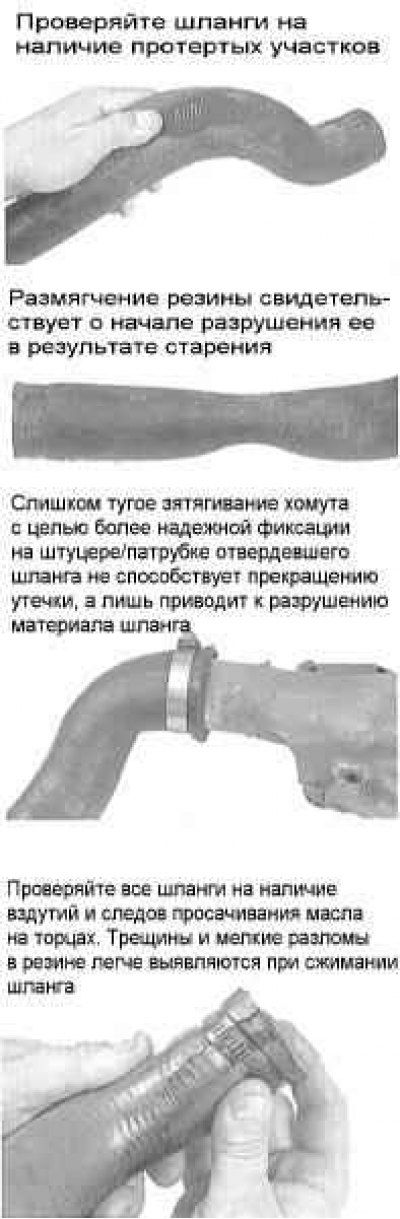


2. Carefully inspect the upper and lower radiator hoses, as well as the smaller diameter cabin heating system hoses located between the power unit and the engine compartment bulkhead. Check the hoses along their entire length and replace defective components if cracks, swellings or signs of material aging are detected (refer to the accompanying illustration). Small cracks are usually easier to see when you squeeze the hose. Regardless of condition, hoses should be replaced approximately every two years.


3. Check that all hoses are securely fastened to their fittings/pipes. Coolant leaks usually appear as rusty or white streaks on the surfaces surrounding their source. If the hoses are secured to the fittings/pipes with twist-type clamps, it would be wise to replace them with more reliable worm or screw-type clamps.

4. Using compressed air or a soft brush, remove old leaves, insect remains and other debris from the gaps between the radiator heat exchanger plates. Try not to damage the soft heat exchanger plates or cut your fingers on their sharp edges.

5. Every other check, and at the first sign of a malfunction in the cooling system, perform a pressure test of the radiator cap. If you do not have the appropriate equipment at hand, contact a service station for assistance.

(The publication is taken from the website: ToyotaMan)
This article is available at: russian, bulgarian, belarusian, ukrainian, serbian, croatian, romanian, polish, slovak, hungarian
The article material has been checked: Evdokimov Evgeniy
Share information:
◀ Previous
Cruiser 100: Maintenance
Next ▶

Checking, servicing and charging the battery
Changing engine oil and oil filter
Checking the power steering fluid level
Checking the automatic transmission fluid level
Checking the condition of the tires and their inflation pressure
Checking the condition and replacing the hoses located in the engine…
Checking the condition and replacing the windshield wipers
Wheel rotation (rearrangement)
Checking the condition of the suspension and steering components
Lubrication of chassis components
Similar articles on other Toyota models

➥ Checking the cooling system Toyota Camry XV20 (1996-2001)
➥ Checking the cooling system for leaks Toyota Corolla E80 (1983-1990)
➥ Checking the electrical components of the control system… Toyota Corona T190 (1992-1997)
➥ Checking the fuel heating system components Toyota Carina T190 (1992-1996)
➥ Checking the cooling system (every 8000 km or 6 months) Toyota Highlander 1 (2000-2007, petrol)
➥ Checking the cooling system Toyota 4Runner N120 (1989-1995)
Link in different formats to this article
Comments and feedback from visitors
No comments yet


Add two numbers 34 + 50


Cruiser 100 (1998-2007) 
  • General information
  • Introduction to the guide
  • Controls and instruments
  • Maintenance
  • Power unit
  • Petrol engines
  • Diesel engines
  • Cooling and heating
  • Power and exhaust systems
  • Engine electrical equipment
  • Engine management systems
  • Transmission
  • Automatic gearbox
  • Transmission line
  • Chassis, running gear
  • Brake system
  • Car suspension
  • Steering
  • Body and interior
  • Exterior (external elements)
  • Interior (internal elements)
  • Doors, locks and windows
  • Electrical equipment
  • Equipment and devices
  • Electrical circuits
Cruiser 60/80 (1980-1997, petrol) 
  • General information
  • User manual
  • Maintenance
  • Power unit
  • Petrol engines 2F and 3F-E
  • Petrol engines 1FZ-FE
  • Engine overhaul
  • Engine electrical equipment
  • Cooling and heating
  • Fuel system (carburetor)
  • Fuel system (injector)
  • Toxicity reduction system
  • Transmission
  • Car gearbox
  • Clutch
  • Transfer case
  • Drive shafts and axles
  • Chassis, running gear
  • Brake system
  • Car suspension
  • Steering
  • Body and interior
  • Exterior and interior
  • Doors, locks and windows
  • Electrical equipment
  • Equipment and devices
  • Electrical circuits
Cruiser 70 (1985-1996, diesel) 
  • General information
  • User manual
  • Maintenance
  • Power unit
  • Engine adjustment
  • Engine repair
  • Fuel system
  • Control system
  • Turbocharging system
  • Cooling and lubrication system
  • Charge and start system
  • Transmission
  • Clutch
  • Mechanical gearbox
  • Automatic gearbox
  • Transfer case
  • Chassis, running gear
  • Car suspension
  • Brake system
  • Steering
  • Body and interior
  • Body elements
  • Heating and air conditioning
  • Electrical equipment
  • Equipment and devices
  • Electrical circuits
ToyotaMan.ru © 2018–2026 • Mobile version • Interesting about Toyota • Administration • Sitemap: EN BG BY UA RS HR RO PL SK HU • Search system • Bookmark
Camry Vista-V40 • Camry XV10 • Camry XV20 • Camry XV30 • Corolla Verso-AR10 • Corolla E80 • Corona T190 • Carina T170 • Carina T190 • Land Cruiser J70 (diesel) • Land Cruiser J60 (petrol) • Land Cruiser J100 • Highlander XU20 (petrol) • 4Runner N120 • RAV4 XA10 • RAV4 XA20 • Duet M100 • Dyna Y50 •
We require cookies to enable some interactive features. Is that ok with you?