
Company Honda Company Ford Company Skoda Company Kia Company Mazda Company Mercedes Company Renault
English Русский
Български
Беларускі
Український
Српски
Hrvatski
Română
Polski
Slovenský
Magyar
Bookmark Articles Sitemap Contacts
ToyotaMan.ru


Camry Corolla Corona Carina Land Cruiser Highlander 4Runner RAV4 Others
Cruiser 100 (1998-2007) Cruiser 60/80 (1980-1997, petrol) Cruiser 70 (1985-1996, diesel)

Rear Crankshaft Oil Seal — Replacement [Toyota Land Cruiser J60]

  • Main
  • Land Cruiser
  • J60 (1980-1997)
  • Power unit
  • Petrol engines 1FZ-FE
  • Rear Crankshaft Oil Seal — Replacement
0
1. Remove the gearbox (transmission). Remove the back plate.


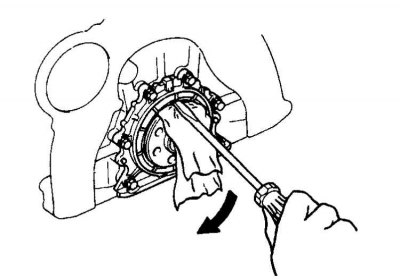
2. The seal can be removed without dismantling the oil pan or removing the seal holder. However, this method is not recommended, since the seal is installed in the holder with great tension, and therefore the seal can be damaged either in the holder itself or during installation. If you still want to try, then use a screwdriver to remove the old seal.

3. Lubricate the crankshaft journal and the working edges of the new oil seal with universal grease and carefully install the oil seal in place. The working edge of the oil seal is very hard, so when installing it on the crankshaft, push the oil seal carefully, using a smooth object. Press the oil seal into place with light blows. Do not apply sharp blows, otherwise the oil seal may be damaged.

4. The method described below is recommended, but this requires opening the seal at the rear of the pan and removing the seal retainer.

5. Remove the two rearmost bolts of the pan that are screwed into the holder. Use a spatula to open the seal between the rear of the pan and the seal holder.


6. Unscrew the bolts, remove the holder and remove the remains of the gasket. Remove the seal from the split plane of the pan.

Attention! Cover the open part of the tray with a clean rag to prevent any sealant residue from getting in when fastening the tray during assembly.
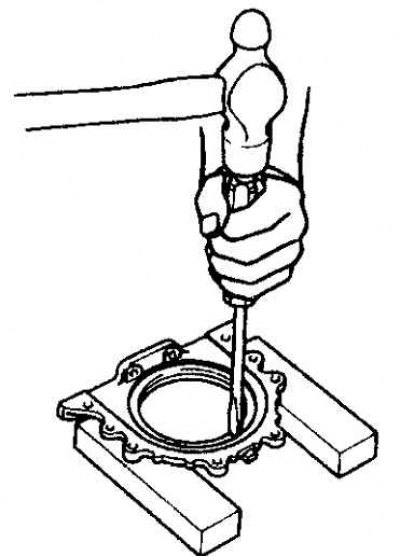


7. Place the holder with the seal on two wooden blocks and knock out the seal from the back side with a screwdriver.
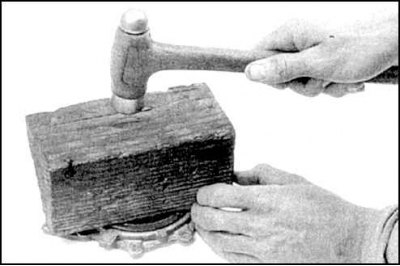


8. Press the new seal into the holder using a hammer and a wooden spacer.

9. Lubricate the working edges of the new oil seal and the crankshaft journal with multi-purpose grease. Install the new oil seal retainer gasket on the cylinder block. Apply a bead of RTV sealant to the exposed portion of the oil pan, especially to the plane adjacent to the cylinder block.


10. Carefully place the oil seal with the holder on the crankshaft journal.

11. Tighten the holder bolts to the specified torque.

12. Then assembly is carried out in reverse order.
This article is available at: russian, bulgarian, belarusian, ukrainian, serbian, croatian, romanian, polish, slovak, hungarian
The article material has been checked: Evdokimov Evgeniy
Share information:
◀ Previous
Cruiser 60/80: Petrol engines 1FZ-FE
Next ▶

Flywheel (torque converter drive disk)
Oil pump — removal, inspection and installation
Oil pan — removal and installation
Front Crankshaft Oil Seal — Replacement
Camshaft Chain Cover — Removal, Inspection and Installation
Suspension and Engine Parts — Checking and Replacing
Starter motor — removal, inspection and installation
Similar articles on other Toyota models

➥ Rear Crankshaft Oil Seal — Replacement Toyota Camry XV20 (1996-2001)
➥ Replacing the rear crankshaft oil seal Toyota Corolla Verso 3 (2004-2009)
➥ Rear Crankshaft Oil Seal — Replacement Toyota 4Runner N120 (1989-1995)
➥ Rear crankshaft oil seal Toyota RAV 4 XA10 (1994-2000)
➥ Replacing the rear crankshaft oil seal Toyota Duet (1998-2004)
➥ Replacing the output shaft seal (rear wheel drive) (A540N) Toyota Corona T190 (1992-1997)
Link in different formats to this article
Comments and feedback from visitors
No comments yet


Add two numbers 16 + 28


Cruiser 100 (1998-2007) 
  • General information
  • Introduction to the guide
  • Controls and instruments
  • Maintenance
  • Power unit
  • Petrol engines
  • Diesel engines
  • Cooling and heating
  • Power and exhaust systems
  • Engine electrical equipment
  • Engine management systems
  • Transmission
  • Automatic gearbox
  • Transmission line
  • Chassis, running gear
  • Brake system
  • Car suspension
  • Steering
  • Body and interior
  • Exterior (external elements)
  • Interior (internal elements)
  • Doors, locks and windows
  • Electrical equipment
  • Equipment and devices
  • Electrical circuits
Cruiser 60/80 (1980-1997, petrol) 
  • General information
  • User manual
  • Maintenance
  • Power unit
  • Petrol engines 2F and 3F-E
  • Petrol engines 1FZ-FE
  • Engine overhaul
  • Engine electrical equipment
  • Cooling and heating
  • Fuel system (carburetor)
  • Fuel system (injector)
  • Toxicity reduction system
  • Transmission
  • Car gearbox
  • Clutch
  • Transfer case
  • Drive shafts and axles
  • Chassis, running gear
  • Brake system
  • Car suspension
  • Steering
  • Body and interior
  • Exterior and interior
  • Doors, locks and windows
  • Electrical equipment
  • Equipment and devices
  • Electrical circuits
Cruiser 70 (1985-1996, diesel) 
  • General information
  • User manual
  • Maintenance
  • Power unit
  • Engine adjustment
  • Engine repair
  • Fuel system
  • Control system
  • Turbocharging system
  • Cooling and lubrication system
  • Charge and start system
  • Transmission
  • Clutch
  • Mechanical gearbox
  • Automatic gearbox
  • Transfer case
  • Chassis, running gear
  • Car suspension
  • Brake system
  • Steering
  • Body and interior
  • Body elements
  • Heating and air conditioning
  • Electrical equipment
  • Equipment and devices
  • Electrical circuits
ToyotaMan.ru © 2018–2026 • Mobile version • Interesting about Toyota • Administration • Sitemap: EN BG BY UA RS HR RO PL SK HU • Search system • Bookmark
Camry Vista-V40 • Camry XV10 • Camry XV20 • Camry XV30 • Corolla Verso-AR10 • Corolla E80 • Corona T190 • Carina T170 • Carina T190 • Land Cruiser J70 (diesel) • Land Cruiser J60 (petrol) • Land Cruiser J100 • Highlander XU20 (petrol) • 4Runner N120 • RAV4 XA10 • RAV4 XA20 • Duet M100 • Dyna Y50 •
We require cookies to enable some interactive features. Is that ok with you?