Contents: Checking the anchor ↓ Checking the collector ↓ Stator check ↓ Checking the brushes ↓ Checking the brush holder ↓ Checking the brush springs ↓ Replacing the drive side cover…↓ Checking the carrier and bearings…↓ Checking and replacing the starter…↓ Checking the overrunning clutch and…↓ Checking the traction relay ↓
Checking the anchor
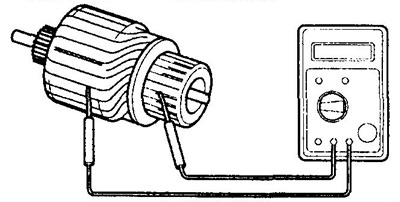
1. Using an ohmmeter, check for conductivity between the collector lamellas. If not, replace the anchor.
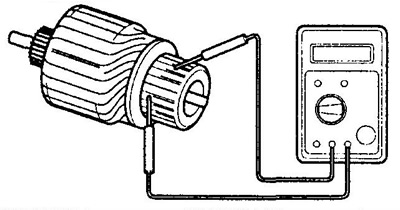
2. Check if the armature winding is shorted to ground.
Using an ohmmeter, check for conductivity between the commutator lamellas and the anchor core. If not, replace the anchor.
Checking the collector
1. Inspect the working surfaces of the collector lamellas; if they are dirty or burnt, clean the working surfaces with #400 sandpaper or turn the collector on a lathe.
2. Mount the anchor on the prisms and measure the collector runout.
Maximum permissible radial runout of the collector:
- type 1 - 0.40 mm
- type 2 - 0.05 mm
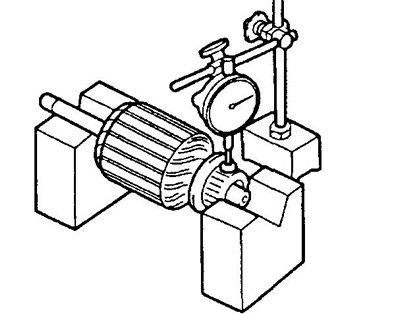
If the runout exceeds the specified value, then turn the commutator on a lathe.
3. Using a caliper, measure the diameter of the manifold.
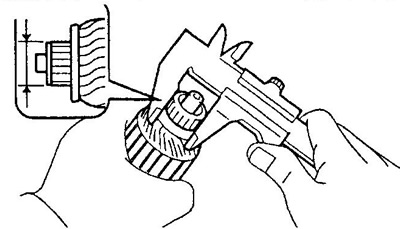
- Nominal collector diameter - 28 mm
- The minimum permissible collector diameter is 27 mm
If the collector diameter is less than the minimum allowable, replace the starter anchor.
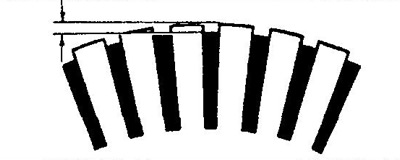
4. Make sure that the grooves between the collector lamellas are free of dirt and foreign particles.
- The nominal value of the collector lamella protrusion is 0.6 mm
- The minimum permissible protrusion of the lamellas is 0.2 mm
Stator check
1. Using an ohmmeter, make sure there is conductivity between the wires (brushes).
- type 1 - 4 wires
- type 2 - 2 wires
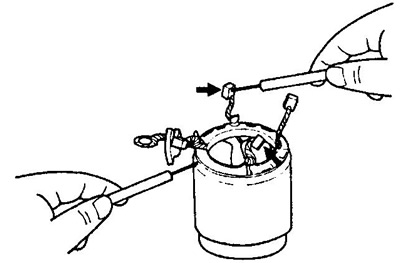
2. (Type 1) Check that there is conductivity between the brush on the excitation winding side and the ground (stator) as shown in the figure.
If there is no conductivity, replace the stator.
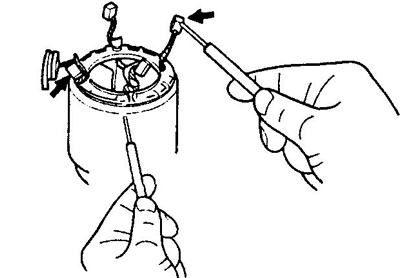
3. (Type 1) Check that there is no conductivity between the excitation winding and the ground (stator) as shown in the figure.
If there is no conductivity, replace the stator.
4. (Type 2) Check that there is no conductivity between the brush and the stator housing.
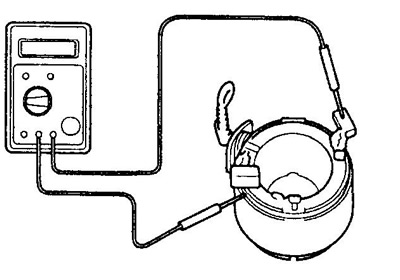
5. (Type 2) Check for conductivity between the brushes.
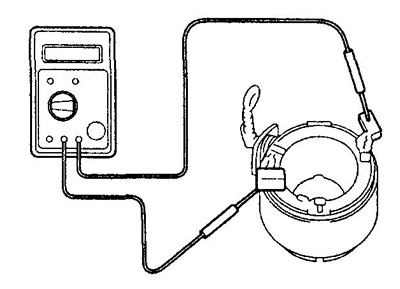
6. (Type 2) Check for continuity between the brushes and terminal "C".
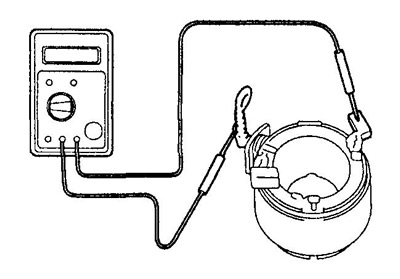
Checking the brushes
Use a caliper to measure the height of the brushes.
Nominal brush height:
- type 1 - 10.0 mm
- type 2 - 14.0 mm
Minimum allowable brush height:
- type 1 - 6 m
- type 2 - 9 mm
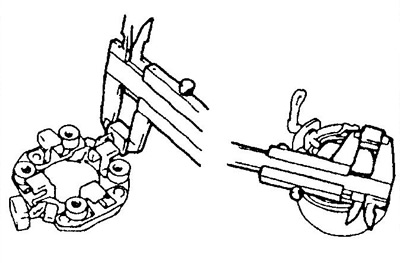
If the brush height is less than the minimum allowable value, replace the brushes and adjust with sandpaper.
Checking the brush holder
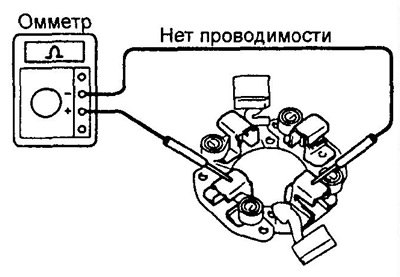
Check the insulation of the brush holder. Use an ohmmeter to ensure there is no conductivity between the positive and negative brush holders. If there is, replace the brush holder.
Checking the brush springs
Using a spring balance, measure the tension of the brush springs at the moment they break away from the brush.
- Nominal force of brush springs - 14-18 N
- Minimum force of brush springs is 9 N
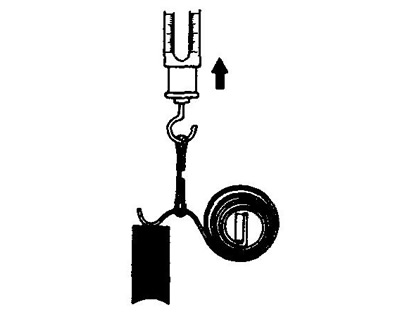
If the spring force is less than the minimum value, replace the brush springs.
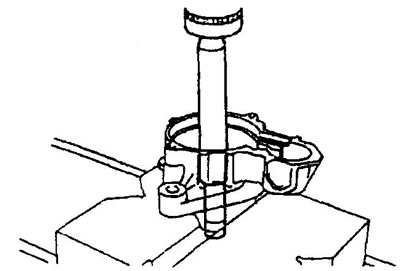
Replacing the drive side cover bearing
1. Using a special tool, press out the bearing.
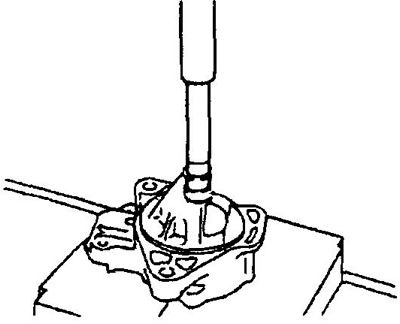
2. Press in the new bearing.
Checking the carrier and bearings (type 2)
1. Check the planet carrier and bearings.
a) Using a micrometer, measure the outside diameter of the carrier seating surface for the bearing.
- Nominal diameter - 14.980 - 15.000 mm
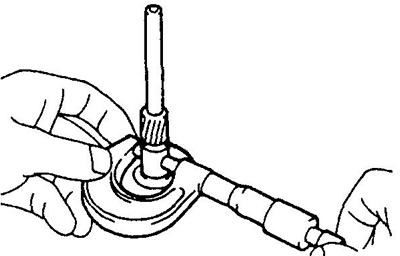
b) Measure the inner diameter of the bearing.
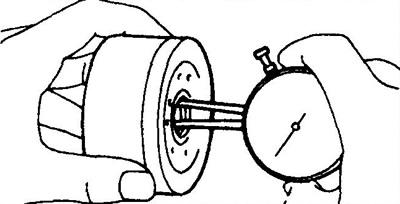
c) Calculate the clearance between the bearing and the planet carrier by subtracting the diameter of the planet carrier axle from the inner diameter of the bearing.
Gap:
- nominal - 0.03 mm
- maximum - 0.10 mm
If the gap exceeds the maximum value, replace the planet carrier and bearing.
2. Replace the bearing if necessary.
a) Using a puller, remove the bearing.
b) Using a press and a mandrel, press in a new bearing.
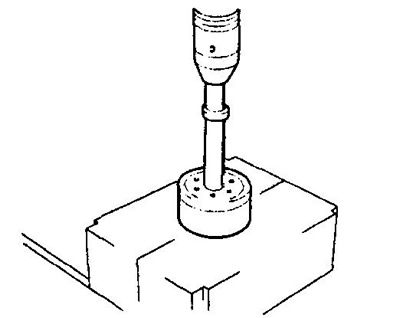
Note: The bearing must be pressed in so that its edge does not reach the edge of the central bearing by 0.05 mm.
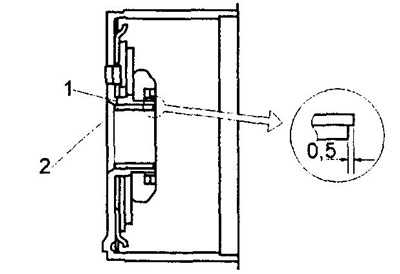
1 - central bearing,
2 - bearing.
3. Check the satellite clearance.
a) Measure the inner diameter "a" of the satellite hole.
b) Measure the diameter of the satellite axle.
c) Calculate the gap.
- Nominal clearance - 0.03 mm
- Maximum clearance - 0.10 mm
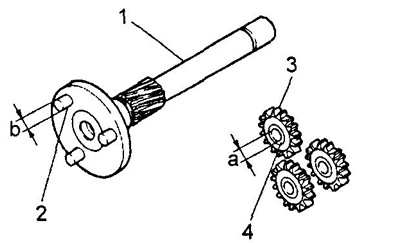
1 - driver,
2 - satellite axis,
3 - satellite,
4 - bushing.
Checking and replacing the starter cover bearing
1. Measure the inner diameter of the bearing.
2. Measure the armature shaft diameter.
- Nominal diameter - 7 mm
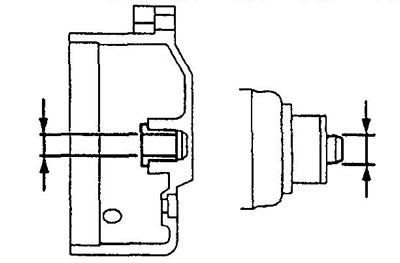
3. Calculate the clearance between the shaft and the bearing.
- Nominal clearance - 0.03 mm
- Maximum clearance - 0.10 mm
4. Replace the bearing if necessary.
a) Using a special tool, remove the bearing as shown in the figure.
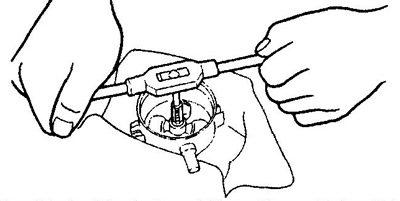
b) Press in the new bearing.
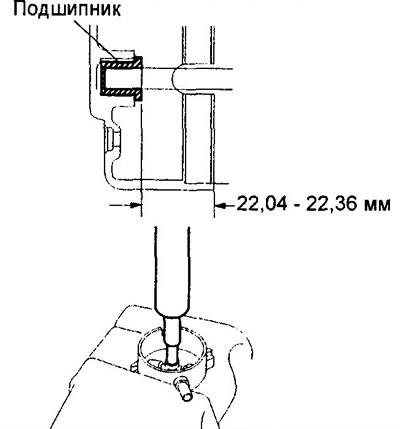
Checking the overrunning clutch and gears
1. Inspect the working surfaces of the teeth for excessive wear or chips.
If there is wear or damage, replace the gears.
If there are any scoring or chips on the surfaces of the overrunning clutch gear teeth, check the working surfaces of the flywheel ring gear teeth.
2. Check the overrunning clutch.
Make sure the drive gear rotates freely in one direction but does not rotate in the other direction.
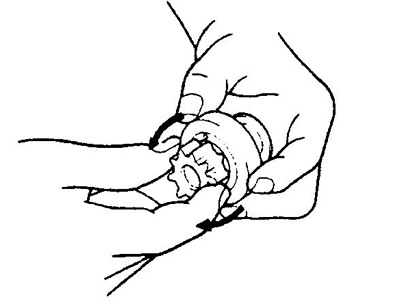
If the conditions are not met, replace the overrunning clutch.
Checking the traction relay
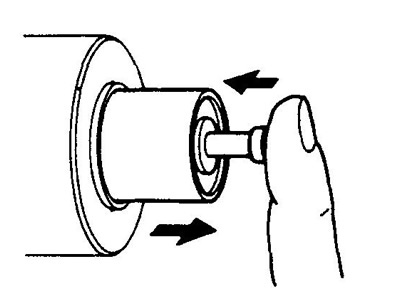
1. Press the traction relay rod and release it. The rod should immediately return back.
2. Checking the pull-in winding of the traction relay.
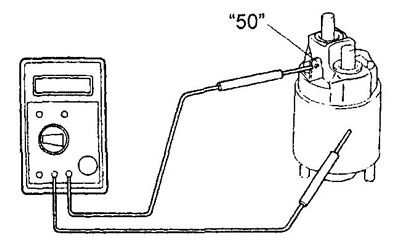
Using an ohmmeter, check for continuity between the starter terminals "50" and "C".
Otherwise, replace the traction relay.
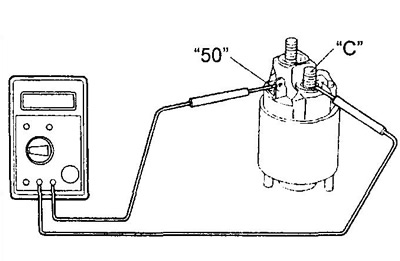
3. Checking the holding winding.
Using an ohmmeter, make sure there is no conductivity between the starter terminal "50" and the body.
Otherwise, replace the traction relay.