
Company Honda Company Ford Company Skoda Company Kia Company Mazda Company Mercedes Company Renault
English Русский
Български
Беларускі
Український
Српски
Hrvatski
Română
Polski
Slovenský
Magyar
Bookmark Articles Sitemap Contacts
ToyotaMan.ru


Camry Corolla Corona Carina Land Cruiser Highlander 4Runner RAV4 Others
Duet (1998-2004) Dyna Y50/Y60 (1984-1995)

Road test [Toyota Duet M100]

  • Main
  • Toyota
  • Duet (1998-2004)
  • Transmission
  • Automatic gearbox
  • Road test
0
Note: Before starting the test, warm up the automatic transmission fluid to a temperature of 70-80°C.


Test on "D" range

Move the selector to the "D" range and press the accelerator pedal all the way down.

1. Check for the presence of 1→2, 2→3 and 3→4 switching and that the switching moments correspond to the values given in the "Switching moments" table.

Note: The torque converter lock-up will not engage when the brake pedal is depressed and the coolant temperature is below 50°C.


2. Check for any jolting or slipping of the friction control elements when shifting 1→2, 2→3 and 3→4.

3. While driving in third or fourth gear in the "D" range, check for any extraneous noise or vibration.

Caution: This check must be carried out very carefully, since the appearance of noise and vibration may be caused by imbalance of the propeller shaft, differential, torque converter, etc.


4. Check the operation of the forced downshifting (kick-down), 2→1, 3→2, 4→3 and the correspondence of the switching moments to the values given in the table "Switching moments".

5. Check that there is no jolting or slipping in the transmission controls when forced downshifting.

Checking the operation of the torque converter lock-up

1. When driving in upshift at a steady speed, locking should occur at the speed specified in the table "Shift Moments".

2. Press the accelerator pedal slightly: the rotation speed should not change abruptly. If there is a abrupt change, then there is no blockage.

Check on range "2"

Move the selector to position "2" and press the accelerator pedal all the way down.


1. While driving in second gear of range "2", release the accelerator pedal and make sure that there is engine braking.

2. Check the noise and vibration levels during upshifting and downshifting.

Testing on the "L" range

1. When driving in the "L" range, there should be no upshifts - the car should only move in first gear.

2. When the load is dropped (releasing the accelerator pedal) engine braking mode should occur. If there is no engine braking, the first gear and reverse gear brakes are faulty.

Test on the "R" range

Move the selector to the "R" position, press the accelerator pedal all the way down. Check for slippage of the friction controls.

Check in the "P" range

Place the vehicle on a slope (at least 5°), move the selector to position "P" and release the parking brake. The output shaft locking mechanism lock should hold the vehicle in place.

Table. Checking pressure in gearbox lines.
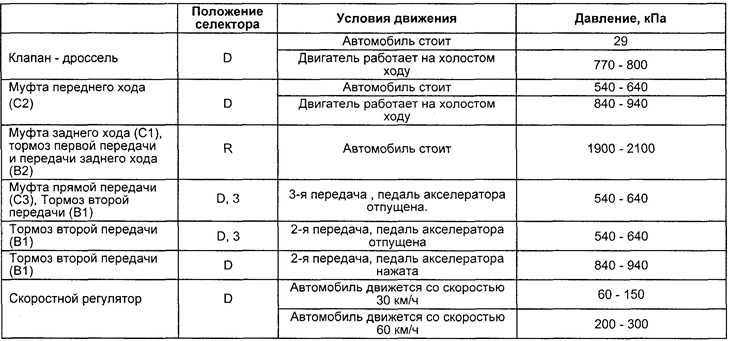


Table. Shift points. 2WD



2WD



4WD



[] - for "Sirion".


Checking the "Manual Gear Shift" mode

While driving the vehicle at 60 km/h, check the gear shifts and the corresponding indicator readings.
This article is available at: russian, bulgarian, belarusian, ukrainian, serbian, croatian, romanian, polish, slovak, hungarian
The article material has been checked: Kolokoltsev Grigory
Share information:
◀ Previous
Duet: Automatic gearbox
Next ▶

Hydraulic test
Checking the gear engagement time
Test on a fully braked car (stall test)
Selector and ignition key lock system
Checking the electrical components of the control system
Removal the gearbox
Gearbox — check
Gearbox installation
Replacing oil seals
Replacing the gearbox input shaft seals
Similar articles on other Toyota models

➥ Diagnosing faults using a road test Toyota Camry Vista V40 (1994-1998)
➥ Diagnosing faults using a road test Toyota Corona T190 (1992-1997)
➥ Road test Toyota Carina T190 (1992-1996)
➥ Testing the lamp test relay (modifications) Toyota Cruiser 70 (1985-1996, diesel)
➥ Vacuum test Toyota RAV 4 XA20 (2000-2005)
Link in different formats to this article
Comments and feedback from visitors
No comments yet


Add two numbers 31 + 17


Duet (1998-2004) 
  • General information
  • User manual
  • Maintenance
  • Power unit
  • Petrol engines 1.0 l
  • Petrol engines 1.3 l
  • Engine overhaul
  • Cooling system
  • Lubrication system
  • Fuel injection system
  • Starting and charging system
  • Transmission
  • Clutch
  • Mechanical gearbox
  • Automatic gearbox
  • Drive shafts and cardan
  • Chassis, running gear
  • Car suspension
  • Steering
  • Brake system
  • Body and interior
  • Body elements
  • Heating and air conditioning
  • SRS security system
  • Electrical equipment
  • Equipment and devices
  • Electrical circuits
Dyna Y50/Y60 (1984-1995) 
  • Petrol engines «Y»
  • Checks and adjustments
  • Overhaul engine
  • Cooling and lubrication system
  • Fuel system
  • Starting and charging system
  • Ignition system
  • Diesel engines «L»
  • Engine repair
  • Cooling and lubrication system
  • Fuel system
  • Starting and charging system
  • Transmission
  • Clutch
  • Manual gearbox
  • Cardan shaft
  • Chassis, running gear
  • Car suspension
  • Brake system
  • Steering
  • Electrical equipment and body
  • Body elements
  • Equipment and devices
  • Electrical diagrams
ToyotaMan.ru © 2018–2026 • Mobile version • Interesting about Toyota • Administration • Sitemap: EN BG BY UA RS HR RO PL SK HU • Search system • Bookmark
Camry Vista-V40 • Camry XV10 • Camry XV20 • Camry XV30 • Corolla Verso-AR10 • Corolla E80 • Corona T190 • Carina T170 • Carina T190 • Land Cruiser J70 (diesel) • Land Cruiser J60 (petrol) • Land Cruiser J100 • Highlander XU20 (petrol) • 4Runner N120 • RAV4 XA10 • RAV4 XA20 • Duet M100 • Dyna Y50 •
We require cookies to enable some interactive features. Is that ok with you?

