



When disassembling the hydraulic drive of one wheel, you can limit yourself to removing air only from the disassembled cylinder.
If the line from the master cylinder to the wheel cylinder was disassembled, then you can limit yourself to removing air only from this line.
1. With the engine stopped, press the brake pedal several times to restore atmospheric pressure in the brake booster.
2. Before bleeding, restore the fluid level in the tank and maintain the level during bleeding, not allowing the tank to empty. Fill only with fresh fluid.
3. Bleeding the brakes should be done by two people. Prepare the fluid, a container, a hose for bleeding and a key for unscrewing the nipple.
4. Start bleeding from the rear right wheel. Unscrew the bleed nipple and tighten it slightly so that it can be easily unscrewed again.
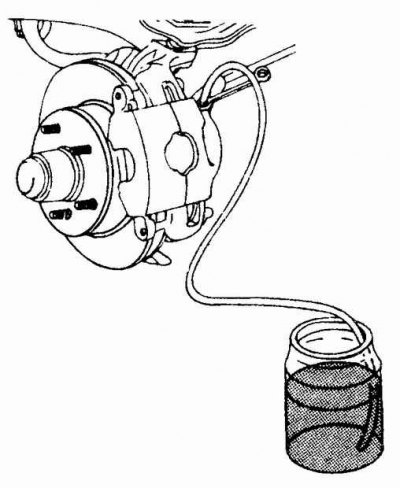
5. Attach a hose to the fitting and lower the other end of the hose into a container with brake fluid.
6. Have an assistant slowly press and hold the brake pedal.
7. Loosen the nipple and after 2 seconds, when the flow of liquid flowing out with bubbles weakens, tighten the nipple. Ask the assistant to release the pedal.
(The information was taken from a web portal: «www.toyotaman.ru»)
8. Repeat the procedure until there are no more air bubbles in the flowing fluid. Tighten the nipple. Perform these actions in the following sequence: left rear wheel, right front, left front. Monitor the fluid level in the reservoir.
9. After bleeding is complete, restore the fluid level in the tank.
10. After bleeding the brakes, the pedal should be "hard". Repeat the bleeding procedure if necessary.