



Mark the position of the wheel disk in relation to the hub with paint. Thanks to this, the balanced wheel can be put back in its original place.
Raise the front of the car.
Remove the wheel.
Lightly tighten the wheel nuts to secure the brake disc.
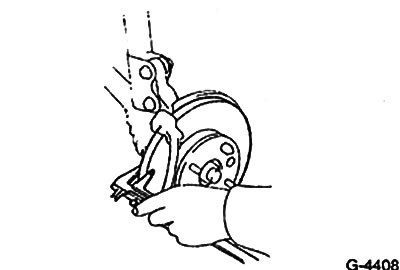
Measure the thickness of the brake disc. Specialized workshops use a special gauge or micrometer gauge for this, since an edge forms on the disc as it wears. The thickness of the disc can be measured with a regular caliper. In this case, a lining of a certain thickness must be placed on each side of the brake disc. The thickness of these linings is subtracted from the resulting size. Note: Measure at least 8 points on the brake disc.
If the wear limit is reached, the brake disc is replaced. Wear limit.
If there are scratches deeper than 0.5 mm, the brake disc is replaced.
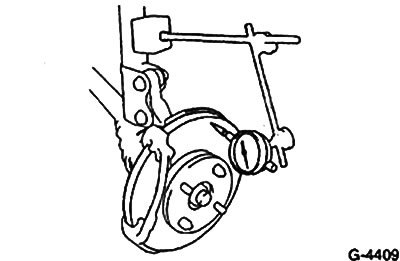
If there is an indicator, then the end runout of the disk in the working position should be measured. To do this, install the indicator at a distance of 10 mm from the outer edge of the disk. The end runout should not be more than 0.15 mm. Large end runout may be a consequence of wear of the wheel hub bearing. In this case, you should contact a specialized workshop.
Remove the wheel mounting nuts.
Install the wheel, observing the marking. Lower the car and tighten the wheel mounting nuts with a force of 105 Nm.