



Contents: Removal ↓ Installation ↓
Removal
Mark the position of the wheel disk relative to the hub. Thanks to this, the balanced wheel can be installed in its original position.
Loosen the wheel nuts on a vehicle parked on the ground.
Raise the front of the car.
Remove the wheel.
Attention: It is not allowed to change the brake pads from the outer side to the inner side and vice versa, or from the right wheel to the left. Such a change may lead to uneven brake action. Therefore, it is necessary to change both brake pads on both wheels at the same time. When removing the brake pads and then installing them, they must be marked.
Turn the caliper outward and thus press the brake cylinder piston.
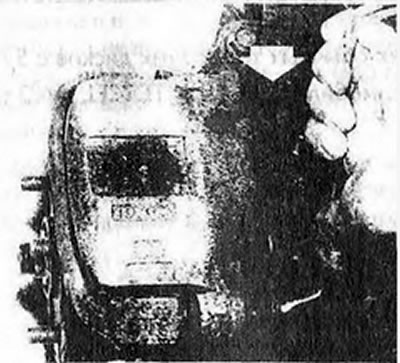
Remove the two guide bolts from the caliper housing.
(The original version is published on the website: TOYOTAMAN.ru)
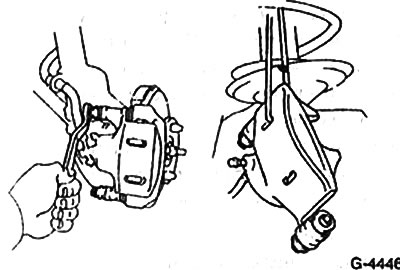
Remove the piston body upward and tie it to the body with wire without stretching the hose.
Caution: Do not disconnect the brake hose. Otherwise, the system will need to be bled during installation.
Tighten the wheel nuts to secure the brake disc.
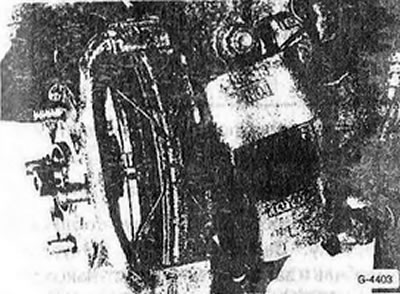
Open the springs that hold the washers in place to prevent brake squeal.
Remove the brake pads together with the springs, wear sensors and anti-squeal plates, see also Fig. G-4447.
Installation
Caution: Do not press the brake pedal when the brake pads are removed. Otherwise, the piston may be pushed out of the housing.
Clean the guide surface and the support surface of the pad in the caliper well with a soft metal brush and wipe with alcohol. Do not use solvents containing mineral oils or tools with sharp edges.
Before installing the brake shoe, check the quality of its surface, feel it with your fingers. Shoe with a ribbed surface is not allowed to be installed.
Measure the thickness of the brake disc.
Check the dust boots and protective cuffs in the brake caliper for cracks. Replace the dust boot that is damaged, as dirt getting through it will cause the caliper to lose its tightness. In this case, the caliper must be removed and disassembled (work of a specialized workshop).
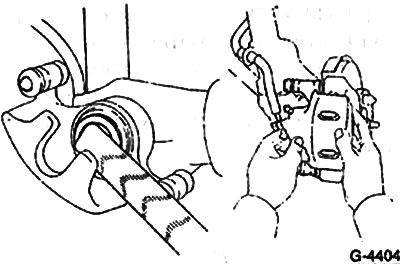
Press out the brake piston with a wooden block (with a hammer handle), taking care not to distort or damage the piston and dust boot surfaces.
Note: When pressing the piston, brake fluid is squeezed out of the brake cylinder into the reservoir. Monitor the flow of brake fluid into the reservoir. If necessary, suck out the fluid.
To suck out the fluid, use a special container or plastic bottle that is used only for brake fluids! Brake fluid is poisonous and should never be sucked out by mouth through a hose. Use a siphon for sucking out. After replacing the brake pads, the fluid level in the reservoir should not exceed the "Max" mark, because the fluid expands when heated. Leaking brake fluid causes damage to the protective varnish coating of the car and corrosion.
Caution: If the brake pads are heavily worn, check the ease of movement of the piston. To do this, insert a wooden block into the brake caliper and slowly press the brake pedal with outside help. The brake piston should easily move out and back in. To check, install another caliper. Make sure that the piston is not completely pressed out. If this accidentally happens, then after installing the piston in place from the brake system air must be removed.
The following procedure is recommended. To avoid squealing in disc brakes, the backs of the brake pads and anti-squeak plates can be coated with a thin layer of grease (for example, Plastilube, Tunap VC582/S, Chevron SRJ/2, Liqui Moly LM-36 or LM-508-ASC). Under no circumstances should grease be allowed to come into contact with the brake pads or brake discs. If grease does come into contact with these surfaces, they must be washed with alcohol.
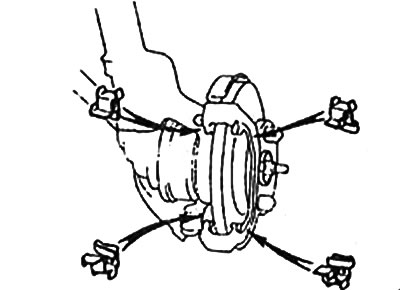
Insert new spacer springs into the brake caliper.
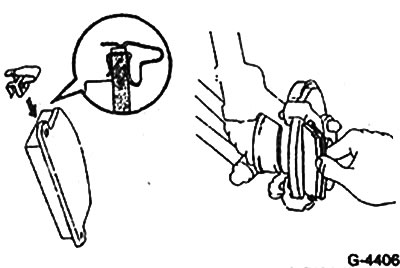
Insert a new wear sensor into the top of each brake pad.
Caution: Make sure that the arrow on the wear indicator points in the direction of disc rotation. The wear indicator signals that the brake pad wear limit has been reached with an audible signal in the form of a squealing brake sound (by touching the brake disc).
Install both brake pads with new anti-squeal plates.
Insert anti-squeal springs into the brake pads from above.
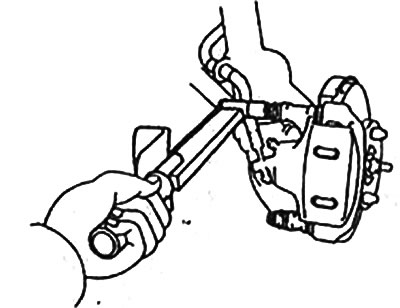
Install the piston housing and secure it with two bolts with a torque of 25 Nm.
Remove the wheel mounting nuts.
Install the wheel on the hub, observing the marking. Tighten the nuts. Lower the car and tighten the nuts crosswise with a force of 105 Nm.
Caution: Press the brake pedal vigorously several times until you feel strong resistance.
Check the brake fluid level in the reservoir. If necessary, top up the fluid to the "Max" mark.
Allow the new brake pads to break in. To do this, brake the car several times from 80 km/h to 40 km/h by briefly pressing the brake pedal. Allow the brake to cool in between.
Attention: Do not use sharp braking during the first 200 km of driving.