
Company Honda Company Ford Company Skoda Company Kia Company Mazda Company Mercedes Company Renault
English Русский
Български
Беларускі
Український
Српски
Hrvatski
Română
Polski
Slovenský
Magyar
Bookmark Articles Sitemap Contacts
ToyotaMan.ru


Camry Corolla Corona Carina Land Cruiser Highlander 4Runner RAV4 Others
Corolla E80 (1983-1990) Corolla Verso 3 (2004-2009)

Automatic anti-glare rearview mirror with electrochromic coating [Toyota Corolla Verso-AR10]

  • Main
  • Corolla
  • Verso-AR10 (2004-2009)
  • General information
  • User manual
  • Automatic anti-glare rearview mirror with electrochromic coating
0
Contents: Electrochromic mirror cell ↓ Reflectivity control ↓ Table 1.25. Purpose of the main…↓
When driving at night, if the intensity of light falling on the interior rearview mirror with electrochromic coating (for example, from the headlights of a car moving behind), significantly higher than the external illumination, the mirror reduces the reflection coefficient and reduces glare to the driver.

The system is included in the standard "SOL" gradation.

The system uses two sensors mounted on the interior rearview mirror. The sensors detect the difference between the intensity of light falling on the mirror from behind and the outside light in the car.
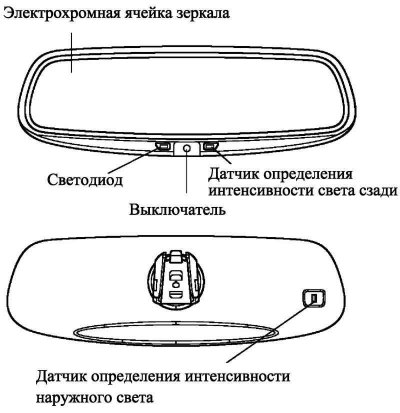


Fig. 1.57. Electrochromic mirror


When switching the power system from " Off " mode. ("OFF") in IG-ON mode, the system is always turned on automatically (Figure 1.57).
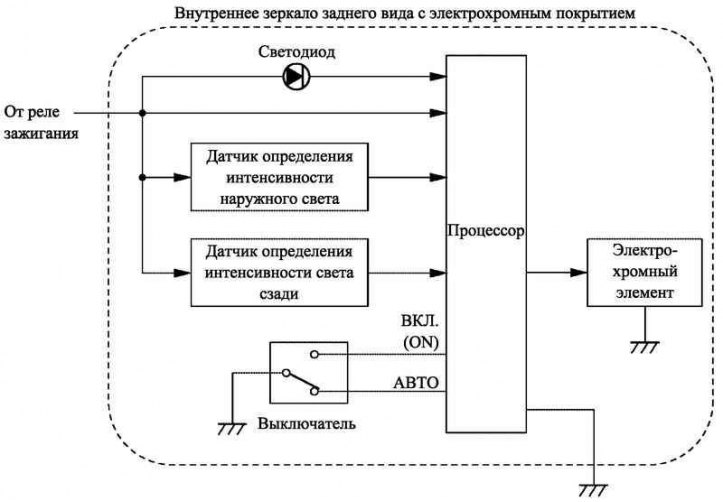


Fig. 1.58. Block diagram of the system


Electrochromic mirror cell
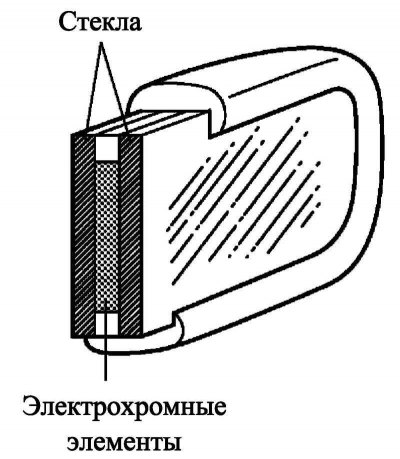


Fig. 1.59. Electrochromic mirror cell


The electrochromic cell consists of two layers of glass, between which electrochromic elements are located. Due to an electrochemical reaction, the electrochromic elements change their color characteristics. These characteristics provide electronic control of the mirror's reflectivity (Fig. 1.59).

Reflectivity control
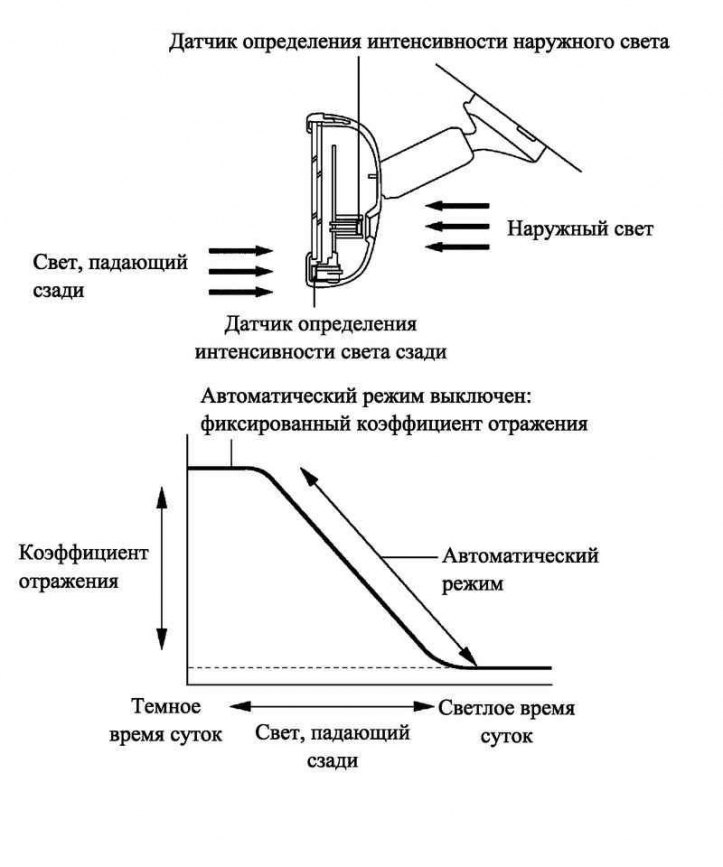


Fig. 1.60. Reflectivity control circuit


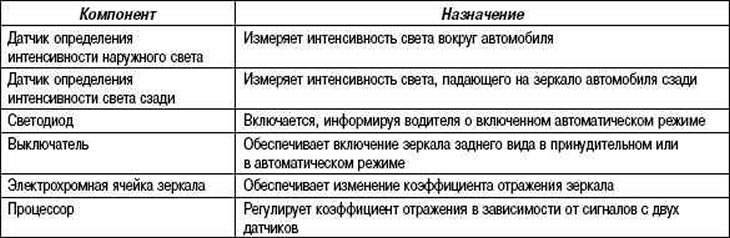
The processor determines the intensity of the outside light from the signal of the outside light sensor, and the intensity of the light falling on the rear mirror from the signal of the rear light sensor. Based on the intensity of the outside light, the processor determines the time of day (day or night). At the same time, the intensity of the glare is determined by the difference in intensity of the outside light and the light falling on the mirror from behind. Depending on the intensity of the light falling on the mirror from behind, the reflection coefficient of the mirror changes stepwise (Fig. 1.60).


Table 1.25. Purpose of the main components of the electrochromic mirror


This article is available at: russian, bulgarian, belarusian, ukrainian, serbian, croatian, romanian, polish, slovak, hungarian
The article material has been checked: Mitrofanova Elena
Share information:
◀ Previous
Corolla Verso 3: User manual
Next ▶

Electric window system
Windscreen wipers and washers
Sunroof on a car
Seats — description and adjustment
Gear shift lever
Engine start button
Design and operating principle of the ECU
Electronic immobilizer
Remote control door lock system
Replacing the battery of the remote control for door locks
Similar articles on other Toyota models

➥ Automatic non-glare electrochromic rearview mirror Toyota Camry XV30 (2001-2006)
➥ Scheme 31. Electric drives for side rearview mirrors and… Toyota RAV 4 XA20 (2000-2005)
➥ Removal and installation the interior rearview mirror Toyota Cruiser 100 (1998-2007)
➥ Adjusting the position of the rearview mirror Toyota 4Runner N120 (1989-1995)
➥ Driving a car with automatic transmission Toyota Corona T190 (1992-1997)
➥ Mirror cleaning system switch Toyota Carina T190 (1992-1996)
Link in different formats to this article
Comments and feedback from visitors
No comments yet


Add two numbers 48 + 20


Corolla E80 (1983-1990) 
  • General information
  • User manual
  • Start of movement
  • Faults en route
  • Maintenance
  • Power unit
  • Engine repair
  • Lubrication system
  • Cooling system
  • Ignition system
  • Supply system
  • Fuel supply (carburetor)
  • Fuel supply (injector)
  • Diesel engine
  • Exhaust system
  • Transmission
  • Clutch
  • Manual gearbox
  • Automatic gearbox
  • Chassis, running gear
  • Front suspension
  • Rear suspension
  • Steering
  • Brake system
  • Wheels and tires
  • Body and interior
  • Exterior (external elements)
  • Interior (internal elements)
  • Interior heating
  • Electrical equipment
  • Equipment and devices
  • Power devices
  • Lighting system
  • Glass cleaners and washers
Corolla Verso 3 (2004-2009) 
  • General information
  • User manual
  • Power unit
  • Petrol engines 1ZZ, 3ZZ
  • Diesel engines 1СD-FTV
  • Cooling system
  • Lubrication system
  • Fuel system
  • Control system
  • Exhaust system
  • Transmission
  • Clutch and drive shafts
  • Mechanical gearbox
  • Chassis, running gear
  • Car suspension
  • Steering
  • Brake system
  • Body and interior
  • Exterior (external elements)
  • Electrical equipment
  • Power devices
  • Electrical circuits
ToyotaMan.ru © 2018–2026 • Mobile version • Interesting about Toyota • Administration • Sitemap: EN BG BY UA RS HR RO PL SK HU • Search system • Bookmark
Camry Vista-V40 • Camry XV10 • Camry XV20 • Camry XV30 • Corolla Verso-AR10 • Corolla E80 • Corona T190 • Carina T170 • Carina T190 • Land Cruiser J70 (diesel) • Land Cruiser J60 (petrol) • Land Cruiser J100 • Highlander XU20 (petrol) • 4Runner N120 • RAV4 XA10 • RAV4 XA20 • Duet M100 • Dyna Y50 •
We require cookies to enable some interactive features. Is that ok with you?