



Second modification (without additional damper) has an automatic pneumatic drive of the secondary chamber throttle valve, and the air tract of each chamber is designed according to a three-diffuser scheme.
The carburetor is a two-chamber one with sequential mechanical opening of the throttle valve of the secondary chamber (see Fig. "Carburetor diagram").
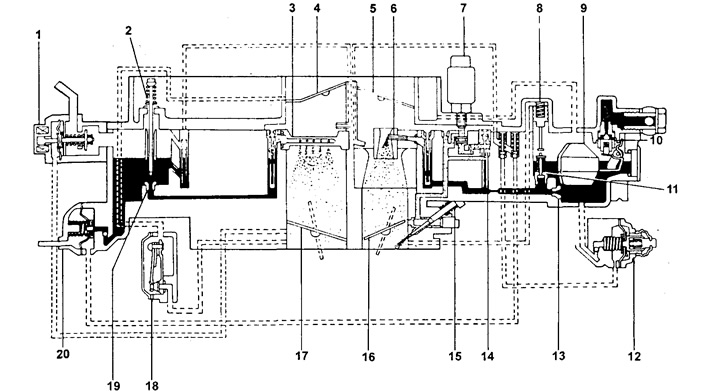
Carburetor diagram for Y series engines (with an additional damper in the secondary chamber):
1 - float chamber unbalance valve (OVCV),
2 - dosing needle,
3 - main sprayer of the secondary chamber,
4 - additional secondary chamber flap,
5 - primary chamber air damper,
6 - main sprayer of the primary chamber,
7 - primary chamber fuel cut-off electromagnetic valve,
8 - economizer drive piston,
9 - float,
10 - needle valve,
11 - economizer valve,
12 - accelerator pump,
13 - main fuel jet of the primary chamber,
14 - idle fuel jet,
15 - adjusting screw for the mixture composition for normal idle mode,
16 - primary chamber throttle valve,
17 - secondary chamber throttle valve,
18 - idle mixture composition corrector during engine warm-up,
19 - main fuel jet of the secondary chamber,
20 - additional accelerator pump (AAP).
The float chamber is located in the carburetor body and has a float 9 and a needle valve 10, which has a spring and a support ball inside to dampen the float's oscillations. An imbalance valve 1 is installed in the float chamber (carburetor ventilation valve).
The air tract of the primary chamber includes: air damper 5, large diffuser, small diffuser with sprayer 6, primary throttle valve 16.
The main dosing system of the primary chamber includes: the main fuel jet 13, the main air jet and the atomizer 6. Fuel enters the same fuel path through the valve 11 of the economizer 8 with a pneumatic drive.
The idle system of the primary chamber of the carburetor, included in the main metering system after the main fuel jet, has: idle fuel jet 14, idle air jet, electromagnetic valve 7 for shutting off the fuel supply, idle mixture adjustment screw 15 and two outlet openings through which the fuel enters the carburetor mixing chamber. Electromagnetic valve 7 shuts off the fuel supply in forced idle modes, and also closes the fuel path after the engine has stopped.
The 12-diaphragm-type accelerator pump, when the throttle valve is quickly opened, supplies fuel to the primary chamber of the carburetor in the annular gap between the large and small diffusers.
The carburetor has an auxiliary accelerator pump 20 with a pneumatic drive. It functions only when the engine is not warmed up and delivers fuel to the same place as the main accelerator pump 12.
In the air tract of the secondary chamber, there is actually no diffuser. Its role is performed by an additional flap 4 ("air valve"), eccentrically mounted on the axis at the entrance to the secondary air tract. This flap is subject to a torque created by the pressure difference on both sides of it and the air velocity pressure. At low engine speeds, this flap remains closed regardless of the position of the secondary throttle valve 17, which has a direct kinematic connection with the primary throttle valve 16. The presence of the additional flap 4 prevents a sharp depletion of the mixture during rapid and full opening of the throttle valves 16 and 17.
The main metering system of the secondary chamber includes: the main fuel jet 19, the metering needle 2, kinematically connected with the additional flap 4, the air jet and the sprayer 3. Opening of the additional flap 4 is accompanied by an increase in the flow cross-section of the main fuel jet 19, which ensures the required mixture composition.
The secondary chamber also has an economizer, which at high speeds supplies fuel to the air tract above the atomizer 3.
The secondary chamber also includes a corrector for the idle mixture composition of a warmed-up engine 18. When the engine warms up, the corrector supplies air from the inlet pipe of the secondary chamber directly to the throttle space, which leads to the necessary leaning of the mixture.
Structurally, the carburetor consists of three main assembly units (see Fig. "Carburetor Parts"): the carburetor cover unit 6, the carburetor body 11 assembled, and the mixing chamber body 21 assembled. An insulator 13 is installed between the last two units.
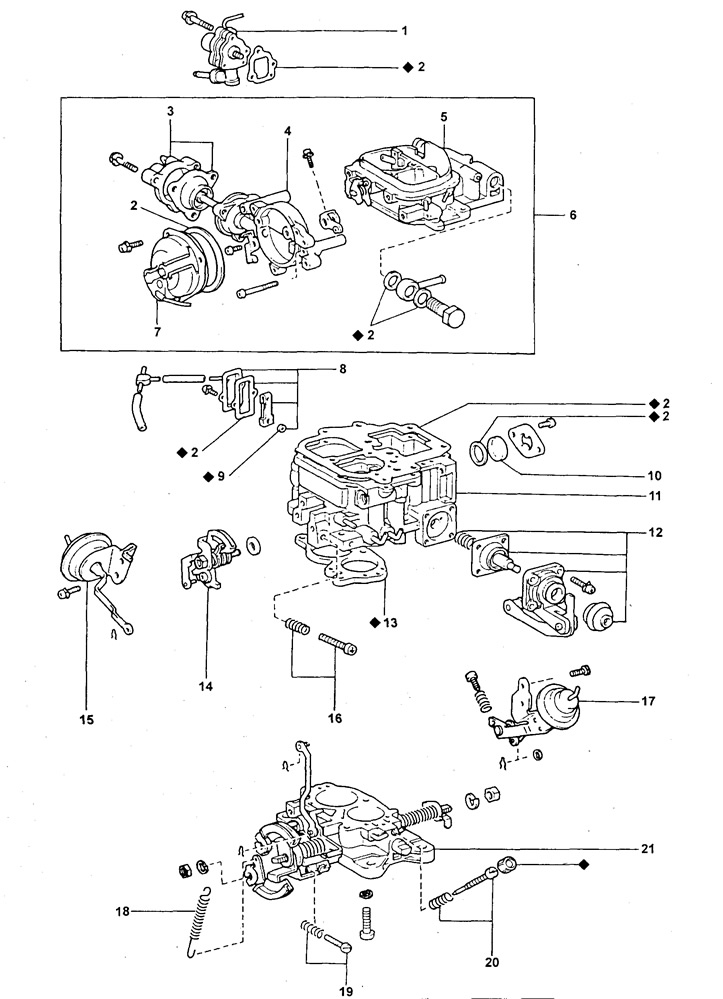
Carburetor parts (with an additional damper in the secondary chamber):
1 - carburetor ventilation valve (float chamber "imbalance" valve (OVCV)),
2 - gasket,
3 - position regulator ("switch") of the air damper (AD),
4 - thermostat housing,
5 - carburetor cover (float chamber cover),
6 - carburetor cover (float chamber cover) in assembly,
7 - spring housing (air damper actuator coil heater),
8 - idle mixture composition corrector during engine warm-up,
9 - valve seat,
10 - viewing glass,
11 - carburetor body,
12 - accelerator pump,
13 - insulating gasket,
14 - cam of the idle speed increase system,
15 - idle speed increase system cam switch,
16 - idle speed adjusting screw,
17 - opening mechanism or manipulator (positioner) throttle valve,
18 - accelerator return spring,
19 - adjusting screw for increased idle speed when warming up the engine,
20 - adjusting screw of the mixture composition for normal idle mode,
21 - carburetor mixing chamber housing ("carburetor flange"),
♦ - a part that cannot be reused.
In the carburetor cover are installed (see "Carburetor details"): an air flap with an automatic b control system ("switch" of the air flap position (CB) 3, an air flap spiral heater 7, a thermostat 4), a float chamber ventilation valve 1 (OVCV), a needle valve, a float and a fuel supply fitting.
The carburetor body assembly contains (see Fig. "Carburetor Parts"): diffusers, fuel and air jets, sight glass 10 of the float chamber, corrector 8 of the idle mixture composition of a warm engine, cam 14 for setting the increased idle speed and "switch" 15 of the position of this cam, position regulator (manipulator) throttle valve 17, air-operated economizer, accelerator pump 12, auxiliary accelerator pump (see pos. 9 in fig.), fuel shut-off solenoid valve (see 8 in fig.).
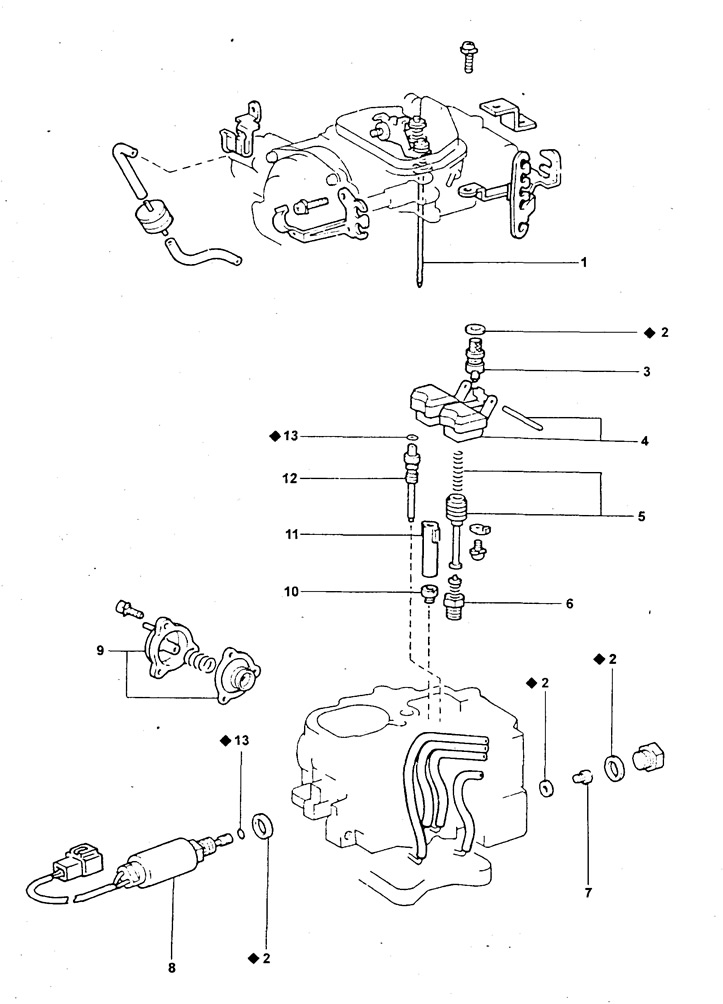
Carburetor parts (with an additional damper in the secondary chamber):
1 - dosing needle,
2 - gasket,
3 - needle valve,
4 - float,
5 - economizer drive piston,
6 - economizer valve,
7 - main fuel jet of the primary chamber,
8 - primary chamber fuel cut-off electromagnetic valve,
9 - additional (auxiliary) accelerator pump (AAP),
10 - main fuel jet of the secondary chamber,
11 - dosing needle guide,
12 - idle jet,
13 - O-ring sealing gasket,
♦ - a part that cannot be reused.
The mixing chamber assembly includes (see Fig. "Carburetor parts"): primary and secondary chamber throttle valves, their drive, normal idle mixture adjustment screw 20, idle mixture adjustment screw at high speed 19.
[This material is taken from a resource ToyotaMan.ru]