



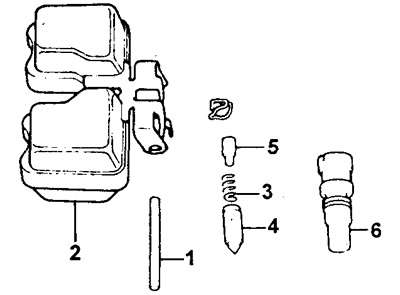
a) assess the wear of the float axis (1);
b) assess the wear of the float elements (2);
c) evaluate the condition of the spring (3);
d) assess wear and damage to the needle valve elements (4, 5);
d) check the condition of the filter (6).
2. Check the operation of the economizer drive piston, making sure that it moves freely.
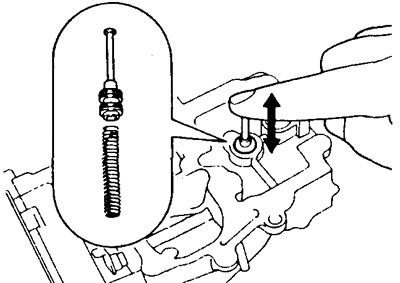
3. Check the operation of the economizer valve ("opening - closing").
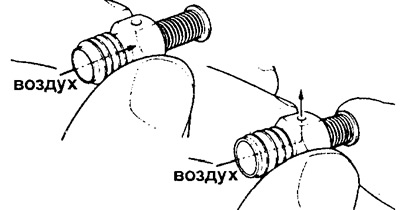
4. Check the primary chamber fuel shut-off solenoid valve
(Type A (with automatic air damper))
a) Connect the valve leads to the battery terminals.
b) When connecting and disconnecting the valves to the power source, a "click" should be heard.
If this does not happen, replace the valve.
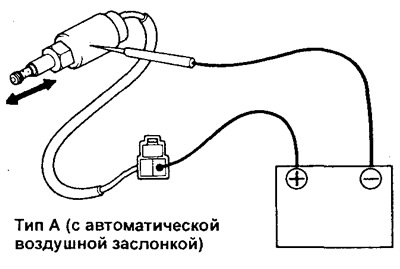
Similarly, check the operation of other types of fuel shut-off solenoid valves, paying attention to the terminals of the connectors to which the battery wires should be connected.
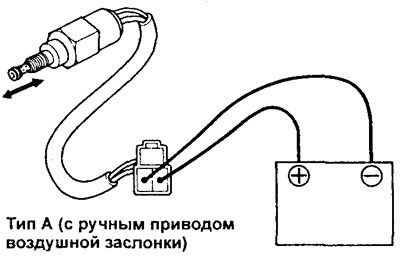 | 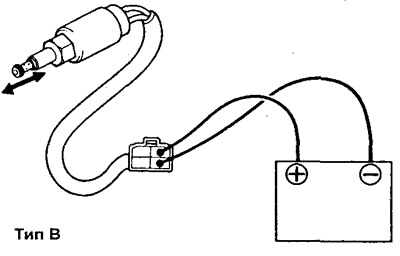 |
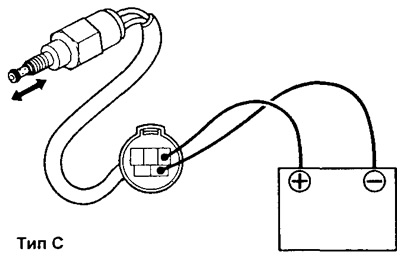
5. (Engines (2Y-C(U) and 3Y-C(U)) Check the operation of the secondary chamber fuel shut-off solenoid valve.
a) Connect the valve terminals to the battery terminals.
b) A "click" should be heard when connecting and disconnecting the valve from the power source.
If not, replace the valve.
6. (Carburetor with automatic choke)
Check the air damper heater (spring housing).
Using an ohmmeter, measure the resistance at the case terminals.
Resistance value at 20°C (cold engine) is for engines:
- 2Y-C(U) and 3Y-C(U) - 23-25 Ohm
- for the rest - 17-19 Ohm
If the resistance is outside the specified limits, replace the entire assembly.
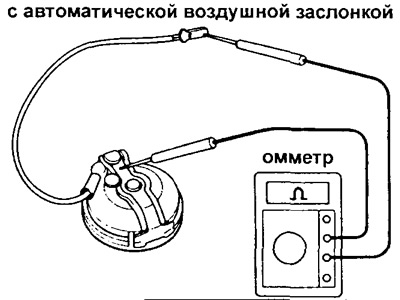
7. (Carburetor with overhead control valve (OVCV))
a) Check the OVCV valve by checking the condition of the valve and its seat, and the smoothness and freedom of movement of the valve guide stem.
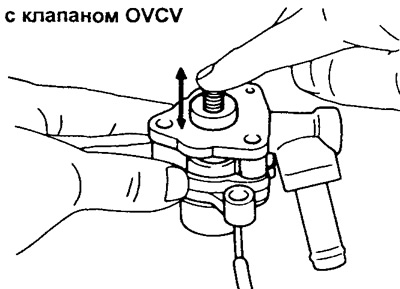
b) Using an ohmmeter, measure the resistance between the valve terminal and its body.
- Resistance value (cold engine) — 63-73 Ohm
If the resistance is outside the specified limits, replace the OVCV valve.
c) Connect the valve terminal and its body to the battery terminals and, by moving the valve guide rod, make sure that it does not return to its original position.
If not, replace the OVCV valve.