



a) Use a scraper to remove carbon deposits and other carbon deposits from the piston crown.
b) Clean the piston grooves from deposits with a piece of a broken ring.
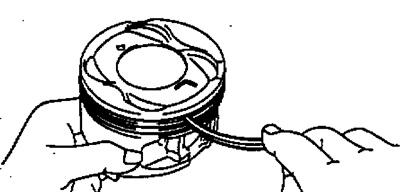
c) Using solvent and a soft bristle brush, thoroughly clean the piston.
Note: Do not use a wire brush.
2. Check the piston and piston rings.
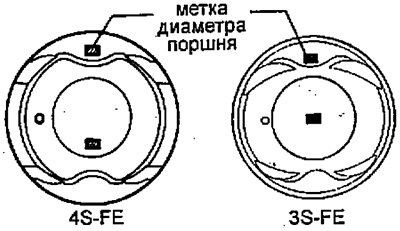
A. Check the clearance between the piston and the cylinder.
Note: There are three size groups of the nominal piston diameter, designated by the marks (numbers) "1", "2" and "3" respectively. The mark is applied to the piston bottom at the edge in the direction perpendicular to the axis of the piston pin or to the piston bottom in the center. Pay attention to the mark (notch) "front", along which the piston should be installed in the cylinder.
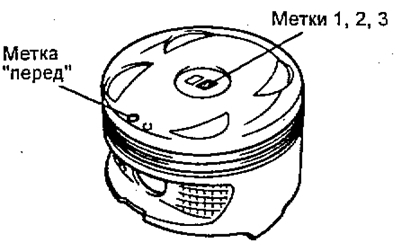
3S - FE, 4S - FE
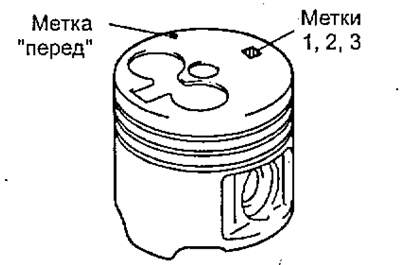
4A - FE, 5A - FE, 7A - FE
2C
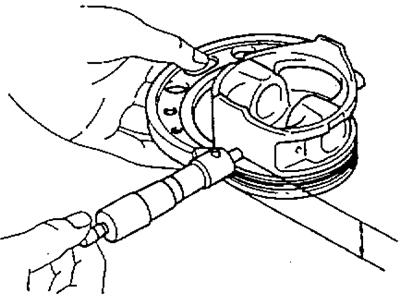
a) Using a micrometer, measure the piston skirt diameter at a distance of 25.4 mm (3S - FE), 26.0 mm (4S - FE); 24.5 mm (4A - FE, 5A - FE, 7A - FE); 64.5 mm (2C); from the piston bottom surface (below the piston ring groove level) and in the direction perpendicular to the axis of the piston pin, as shown in the figure.
Nominal piston diameter:
Engine 2C:
- mark "1" - 85.945 - 85.955 mm
- mark "2" - 85.955 - 85.965 mm
- mark "3" - 85.965 - 85.975 mm
- rem. (0.50) — 86.445 - 86.475 mm
Engine 3S - FE:
- mark "1" - 85.870 - 85.880 mm
- mark "2" - 85.880 - 85.890 mm
- mark "3" - 85.890 - 85.890 mm
- rem. (0.50) — 86.425 - 86.455 mm
4S - FE Engine:
- mark "1" - 82.437 - 82.447 mm
- mark "2" - 82.447 - 82.457 mm
- mark "3" - 82.457 - 82.467 mm
- rem. (0.50) — 82.937 - 82.967 mm
- rem. (0.75) — 83.187 - 83.217 mm
Engines 4A - FE, 7A - FE:
- mark "1" - 80.905 - 80.915mm
- mark "2" - 80.915 - 80.925 mm
- mark "3" - 80.925 - 80.935 mm
- rem. (0.50) — 81.430 - 81.460 mm
Engine 5A - FE:
- mark "1" - 78.605 - 78.615 mm
- mark "2" - 78.615 - 78.625 mm
- mark "3" - 78.625 - 78.630 mm
- rem. (0.50) — 79.130 - 79.160 mm
b) Measure the cylinder diameters in the direction of the engine axis.
c) Find the difference between the results of measurements of the piston diameter and the cylinder diameter.
Clearance between cylinder and piston:
2C:
- nominal - 0.045 - 0.065 mm
- maximum - 0.15 mm
3S - FE:
- nominal - 0.120 - 0.140 mm
- maximum - 0.190 mm
4S - FE:
- nominal - 0.053 - 0.073 mm
- maximum - 0.120 mm
4A - FE, 5A - FE, 7A - FE:
- nominal - 0.085 - 0.105 mm
- maximum - 0.130 mm
If the clearance is greater than the maximum, replace all four pistons and bore all four cylinders. Replace the cylinder block if necessary.
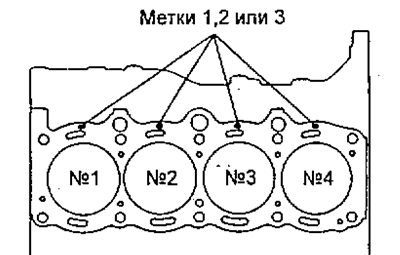
Note: When using a new cylinder block, use a piston with the same mark (number) as the cylinder diameter. The cylinder diameter marking is located on the cylinder block in the locations shown in the figure.
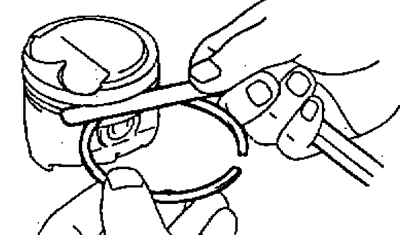
B. Check the end clearance "compression ring - piston groove" by measuring it with a flat feeler gauge as shown in the figure.
Nominal clearance:
Compression ring #1:
- 3S - FE - 0.040 - 0.080 mm
- 4S - FE - 0.030 - 0.070 mm
4A - FE, 5A - FE, 7A - FE:
- T — 0.050 - 0.085 mm
- 2R — 0.045 - 0.080 mm
- 2C — 0.100 - 0.140 mm
Compression ring #2:
- 3S - FE, 4S - FE, 4A - FE, 5A - FE, 7A - FE - 0.030 - 0.070 mm
- 2C — 0.050 - 0.090 mm
Oil scraper ring:
2C — 0.030 - 0.070 mm
4A - FE, 5A - FE, 7A - FE:
- T — 0.02 - 0.16 mm
- 2R — 0.03 - 0.11 mm
If the clearance is greater than the permissible limit, replace the piston.
B. Check the piston ring gap.
a) Insert the piston ring into the cylinder.
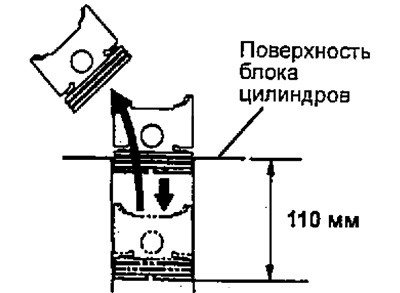
b) Use the piston to push the ring a distance of 110 mm (3S - FE, 5A - FE); 107 mm (7A - FE); 100 mm (4A - FE, 5A - FE); 120 mm (2C) from the cylinder block surface as shown in the figure.
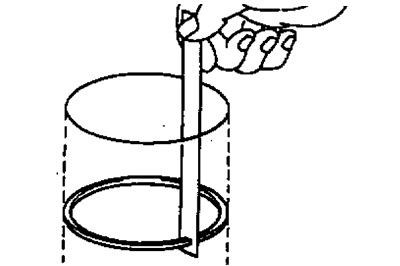
c) Use a flat feeler gauge to measure the gap in the lock.
Engine 2C:
Nominal clearance:
- compression ring No.1 - 0.27 - 0.037 mm
- compression ring #2 - 0.34 - 0.47 mm
- oil scraper ring (by scrapers) — 0.20 - 0.40 mm
Maximum clearance:
- compression ring No.1 - 0.98 mm
- compression ring #2 - 0.92 mm
- oil scraper ring (by scrapers) — 1.00 mm
Engine 3S - FE:
Nominal clearance:
- compression ring No.1 - 0.27 - 0.40 mm
- compression ring No.2 - 0.27 - 0.41 mm
- oil scraper ring (by scrapers) — 0.20 - 0.70 mm
Maximum clearance:
- compression ring No.1 - 1.00 mm
- compression ring #2 - 1.01 mm
- oil scraper ring (by scrapers) — 1.30 mm
4S - FE Engine:
Nominal clearance:
- compression ring No.1 - 0.25 - 0.38 mm
- compression ring No.2 - 0.20 - 0.32 mm
- oil scraper ring (by scrapers) — 0.15 - 0.40 mm
Maximum clearance:
- compression ring N°1 - 0.98 mm
- compression ring #2 - 0.92mm
- oil scraper ring (by scrapers) — 1.00 mm
Engine 5A - FE:
Nominal clearance: compression ring No.1
- T — 0.25 - 0.37 mm
- 2R — 0.25 - 0.35 mm
compression ring no.2
- T — 0.37 - 0.52 mm
- 2R — 0.35 - 0.50 mm
oil scraper ring (by scrapers)
- T — 0.15 - 0.40 mm
- 2R — 0.10 - 0.35 mm
Maximum clearance:
- compression ring #1 - 0.97 mm
- compression ring #2 - 0.95 mm
- oil scraper ring (by scrapers) — 0.70 mm
Engine 4A - FE, 7A - FE:
Nominal clearance:
- compression ring No.1 - 0.25 - 0.35 mm
- compression ring No.2 - 0.35 - 0.50 mm
oil scraper ring (by scrapers)
- T — 0.15 - 0.40 mm
- 2R — 0.10 - 0.35 mm
Maximum clearance:
- compression ring No.1 - 1.07 mm
- compression ring #2 - 1.02 mm
- oil scraper ring (by scrapers) — 1.62 mm
If the gap in the lock is greater than the maximum, replace the piston ring. If the gap in the lock is greater than the maximum even with a new piston ring, bore all cylinders or replace the cylinder block.
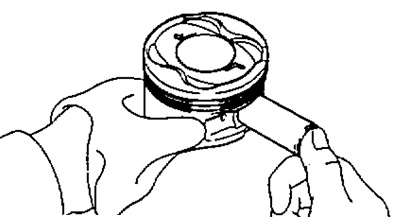
G. Check the piston pin.
When the piston is heated to 60°C, the piston pin should move in the piston without significant effort. After checking, remove the piston pin.
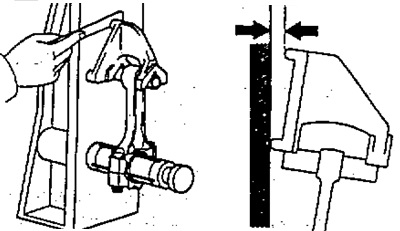
3. Check the alignment of the connecting rod.
A. Using the special tool and a flat feeler gauge, check the bend of the connecting rod as shown in the figure. The maximum allowable bend per 100 mm of length is:
- 5A - FE - 0.03 mm
- the rest - 0.05 mm
If the twisting is greater than the permissible limit, replace the connecting rod together with the connecting rod cap.
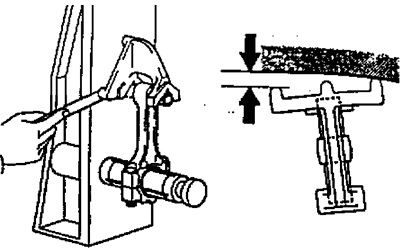
In a similar manner, check the twist of the connecting rod, as shown in the figure.
Maximum twist per 100 mm length:
- e series motors - 0.05 mm
- c, S series engines - 0.15 mm
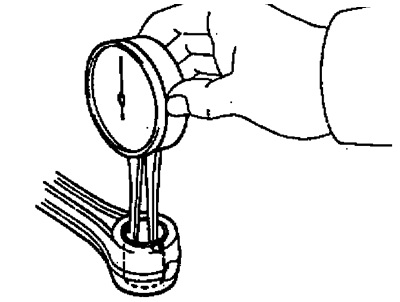
B. (2C, 3S - FE) Check the piston pin oil clearance.
a) Using a bore gauge, measure the inner diameter of the connecting rod upper head bushing.
Inner diameter of the bushing:
2C
- mark A - 27.011 - 27.015 mm
- mark B - 20.015 - 20.019 mm
- mark c — 20.016 - 20.021 mm
3S - FE - 22.005 - 22.017 mm
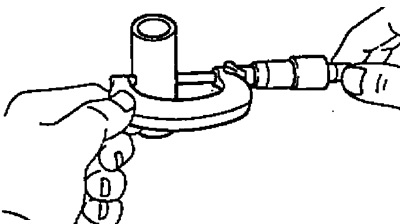
b) Using a micrometer, measure the piston pin diameter.
Piston pin diameter:
- 2C - 27,000 - 27,012 mm
- 3S - FE - 21.997 - 22.009 mm
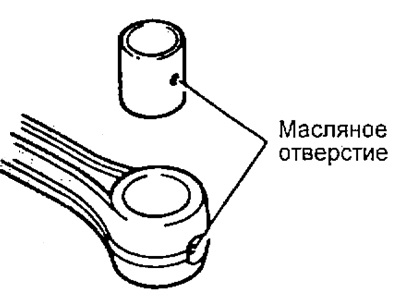
c) Subtract the measured value of the piston pin diameter from the measured value of the inner diameter of the bushing.
Nominal oil clearance:
- 2C — 0.007 - 0.015 mm
- 3S - FE - 0.005 - 0.011 mm
Maximum oil clearance - 0.05 mm
If the oil clearance is greater than the maximum, replace the bushing. If necessary, replace the piston and piston pin assembly.
IN. (2C, 3S - FE) If necessary, replace the connecting rod upper head bushing.
a) Using a mandrel and press, press the bushing out of the upper connecting rod head.
b) (3S - FE) Align the oil holes of the new bushing and connecting rod and press the bushing in place.
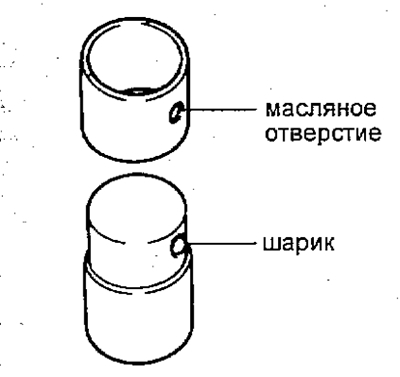
(2C) Install the bushing on the special device, securing it with a ball in the oil (lubrication) hole of the bushing.
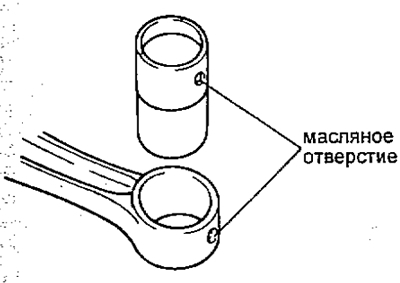
Align the oil holes of the bushing and connecting rod.
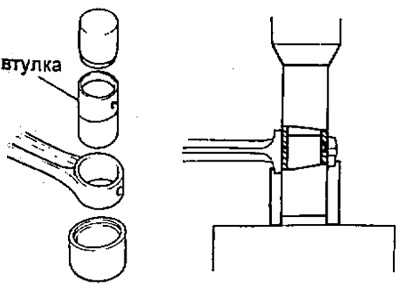
Using a special tool and a press, press in the bushing.
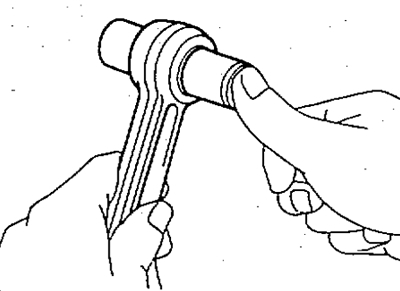
c) Measure the piston pin oil clearance and, if necessary, grind or regrind the new bushing until the nominal clearance is obtained.
d) Check the operation of the piston pin at normal room temperature. Apply engine oil to the piston pin and press it as shown in the figure.
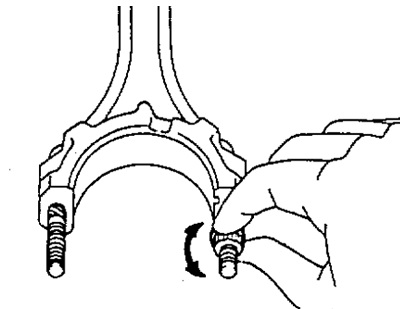
G. (3S - FE) Check the connecting rod bolts.
a) Thread a nut onto each bolt and make sure the nut can be easily threaded by hand, covering the entire length of the bolt thread.
b) If the nut does not screw on by hand, measure the outer diameter of the bolt thread with a caliper in the area of greatest thread wear.
Standard diameter:
- 3S - FE - 7.86 - 8.00 mm
Minimum diameter:
- 3S - FE - 7.60 mm
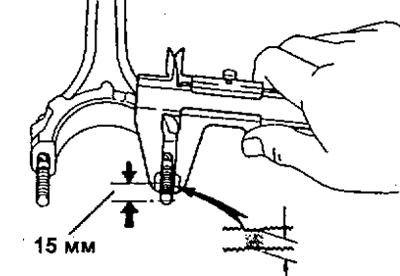
Note: If such an area is difficult to detect visually, measure at a distance of 15 mm from the end of the bolt, as shown in the figure.
If the outside thread diameter is less than the minimum allowable, replace the connecting rod bolt and nut as a single assembly.