



Contents: Removal ↓ Examination ↓
Removal
1. On four-cylinder engines, remove the engine balancer.
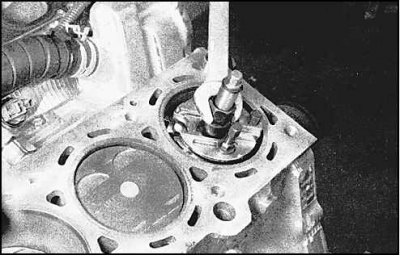
2. Using a special tool, remove the ledge at the top of the cylinder caused by wear and combustion deposits. Do not attempt to remove the piston without removing the ledge, or you will damage the piston.
3. Turn the engine over, crankshaft up.
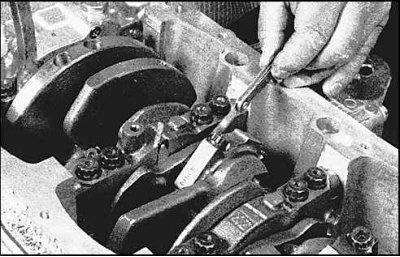
4. Using feeler gauges, measure the side clearance of the connecting rods. If the clearance exceeds the permissible limits, the connecting rod must be replaced. If you have any doubts, contact specialists.
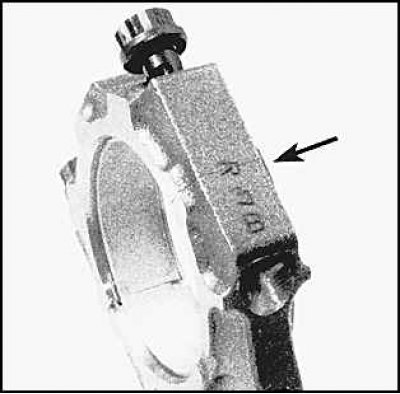
5. If the connecting rods and connecting rod caps are not numbered, number them.
6. Loosen the nuts of each connecting rod cap in several half-turn increments. Unscrew the nuts and remove the first connecting rod cap and bearing shell.
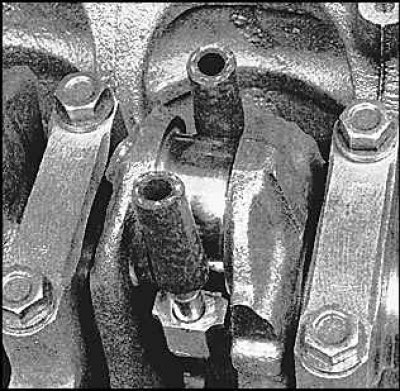
7. Remove the bearing shell and take out the connecting rod together with the piston. To avoid damaging the connecting rod bearing journals, put sections of hose on the connecting rod bolts.
8. Remove the remaining connecting rods and pistons in the same manner.
9. Place the pieces of each piston separately to avoid mixing them up.
Examination
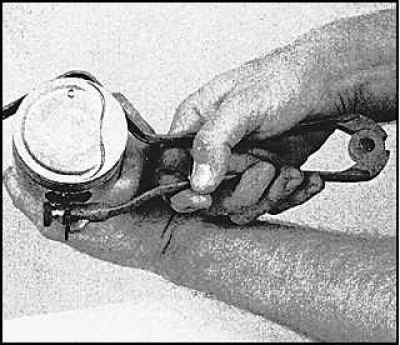
1. Remove the piston rings using a piston ring installer, being careful not to scratch the piston.
2. Use a wire brush or fine sandpaper to clean any deposits from the piston crown.
 |  |
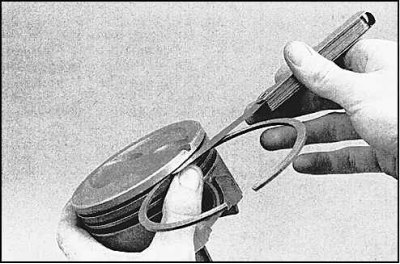
3. Using a special tool or a piece of a broken piston ring, clean the piston ring grooves.
4. After removing all deposits, clean the pistons and connecting rods with solvent and dry them.
5. If the pistons and cylinder walls are not very worn and the cylinders have not been bored, new pistons do not need to be installed.
6. Carefully inspect all pistons for cracks in the piston skirt and on the surface around the connecting rod pin.
(This material is taken from a resource ToyotaMAN)
7. Inspect the pistons for scratches, scoring, burnt areas or corrosion.
8. If the piston skirt is heavily scratched, the cause is overheating or abnormal combustion of the fuel mixture. In this case, it is necessary to carefully check the engine lubrication and cooling systems.
9. The presence of a hole in the piston head indicates abnormal combustion of the fuel mixture (its premature ignition occurs). Causes may include a leak in the intake manifold, poor fuel mixture, incorrect ignition timing, or problems with the exhaust system. Corrosion spots on the piston indicate that coolant is leaking into the combustion chamber.
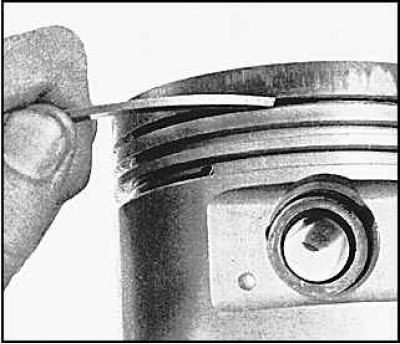
10. Measure the side clearances of the piston rings. If the clearance exceeds the permissible limits, the piston must be replaced.
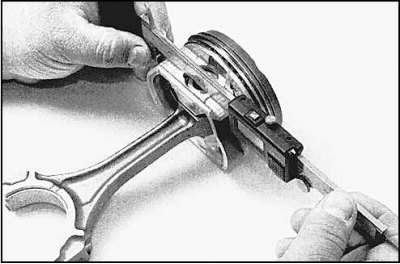
11. Measure the clearance between the piston and the cylinder by measuring the piston diameter perpendicular to the piston pin and measuring the cylinder diameter. Subtract the piston diameter from the cylinder diameter. If the clearance exceeds the permissible limits, the cylinder must be bored and a new piston and new piston rings installed.
12. Check the clearance between the piston and the connecting rod.
13. Inspect the connecting rods for cracks and other damage. For a more detailed inspection of the pistons and connecting rods, contact specialists.