



Contents: Checking functionality ↓ Resistance check ↓
The injection valve injects fuel in portions, i.e. for each revolution of the crankshaft, half of the fuel required to perform the working stroke is injected. The shape of the injected fuel has a cone and after each injection the valve closes tightly. Leakage of the injection valve causes difficulties when starting a hot engine. Damage to the inlet injection valve causes a diesel effect (detonation) and leads to interruptions in engine operation.
Checking functionality
Start the engine at idle speed.
Check each valve individually with a stethoscope while the engine is running to see if it makes a clicking sound. The clicking sound accompanies each opening and closing of the valve nozzle.
If you don't have a stethoscope, you can check the valve with a screwdriver or your finger.
If abnormal noise or no noise is detected, it is necessary to check the plug connection, the control unit signal or the resistance of the injection valve.
Resistance check
Turn off the ignition.
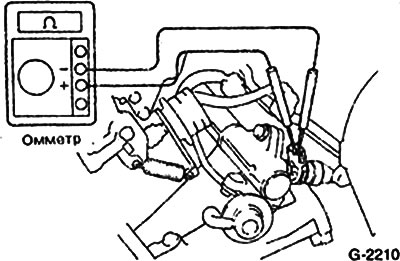
Check the resistance of all injection valves with an ohmmeter (fig. G-2210). Its value for all types of motors should be 13.8 Ohms.
If the measured resistance value does not correspond to the specified value, the injection valve must be replaced.
To check the injection jet and the tightness of the valve, special tools are required, which are only available in specialized TOYOTA workshops.