



Test conditions: The battery must be fully charged (12 V). The fuel filter must be clean.
Check the EFI 15A and IGN 7.5A fuses. Replace any defective fuses.
Turn off the ignition.
Disconnect the plug connection of the cold start valve.
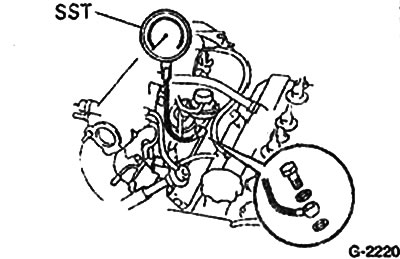
Disconnect the fuel supply hose to the cold start valve.
[The publication is taken from the website toyotaman]
Caution: This may cause fuel to leak.
Connect the pressure gauge with the hose to the fuel line. Specialized workshops of the TOYOTA company use a special tool SST 09268-45012 for this purpose. Use new gaskets.
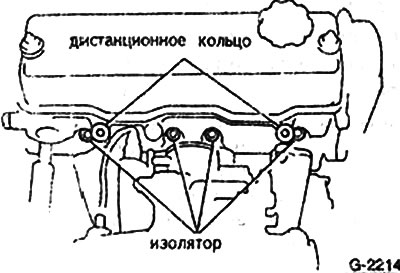
Connect terminals FP and +B with an electrical wire.
Turn on the ignition. Do not start the engine.
Measure the fuel pressure.
It should be 2.7-3.1 bar.
If the fuel pressure exceeds the set value, the fuel pressure regulator must be replaced.
Remove the wire from the diagnostic plug.
Start the engine at idle speed.
Disconnect the vacuum hose from the pressure regulator and plug it with a clean screw.
Measure the fuel pressure. It should be 2.7-3.1 bar.
Attach the vacuum hose to the pressure regulator.
Measure the fuel pressure.
It should be 2.1-2.6 bar. If the measured pressure is not equal to the specified one, it is necessary to check the vacuum hose and the fuel pressure regulator.
If the fuel pressure in all three dimensions is not equal to the specified one, it is necessary to check the fuel hoses and connections for damage, plugs and tightness. If all this is in order, it is necessary to replace the fuel pump.
Stop the engine.
Measure the fuel pressure after 5 minutes. It should be at least 1.5 bar.
If the fuel pressure drops too quickly, check the fuel pump and fuel pressure regulator.
Remove the fuel pressure gauge. Fit the fuel supply hose to the cold start valve with new gaskets and install the hollow mounting screws. Tightening torque: 1.3L and 1.6L engines (4A-EF) 10 Nm; 1.6L engine (4A-GE, 4A-GEL) - 15 Nm.
Connect the plug connection of the cold start valve of the engine.
Start the engine and check the fuel system for leaks.