



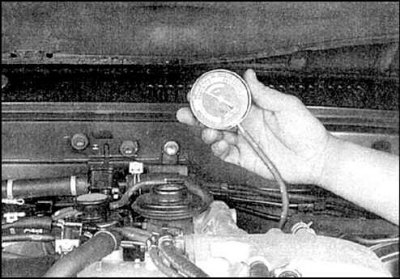
2. The vacuum gauge is connected to the throttle body to measure the pressure directly on the intake manifold. Do not connect the vacuum gauge to the auxiliary unit hoses.
3. It is advisable to combine vacuum diagnostics with other diagnostic methods.
4. The initial factors by which the vacuum gauge readings are analyzed and the most accurate conclusions about the engine condition are made are the absolute reading of the device and the nature of the movement of the instrument pointer (dynamics of readings).
5. Before starting the tests, warm up the engine completely and block the wheels.
6. Check the vacuum gauge reading. On a serviceable engine running at idle, the vacuum gauge should show a vacuum of 430–560 mm Hg, and the instrument needle should be practically motionless.
7. If the vacuum gauge readings are 75–200 mmHg below normal and are unstable (the arrow twitches), then this indicates a leak in the gasket at the inlet of the intake manifold, or a violation of the seal of the injector.
8. If the pointer regularly deviates by 50-100 mm Hg, then the cause is leaky valves. Check the compression in the engine cylinders.
9. If the needle irregularly deviates towards low readings, or trembles and shows low vacuum, the cause is increased resistance to valve movement, or misfires. Check the compression in the cylinders and inspect the spark plugs.
10. If the needle fluctuates rapidly within 100 mm Hg at idle speed, and the engine operation is accompanied by smoke from the muffler, then the valve guides are worn out. If the needle fluctuates rapidly with a simultaneous increase in engine speed, then it is necessary to check the tightness of the intake manifold gasket, the elasticity of the valve springs. Such readings can also be caused by burnt valves and ignition failures.
11. Weak fluctuations of the needle within 20–30 mm Hg indicate unstable ignition operation.
12. If the arrow fluctuates greatly, check the compression in the cylinders.
13. A slow change in vacuum over a wide range indicates a clogged boat ventilation system, an abnormal mixture composition, or a leak in the manifold gasket.
14. Increase the engine speed to 2500 rpm and release the pedal. The vacuum gauge readings should drop to almost zero, then increase and exceed the control readings corresponding to steady-state idle speed by approximately 125 mm Hg, after which the vacuum should be restored to the previous level. Different vacuum behavior indicates wear of the piston rings. If these readings change too slowly, then check the cleanliness of the exhaust system channels (especially the neutralizer).