



Contents: Transmission operating modes ↓ Freewheel clutches ↓ Switching technique ↓ Rear differential lock system ↓
Transmission operating modes
1. Rear wheel drive mode (control lever in position "H2", button "H4" protrudes and freewheel clutches are unlocked).
This mode is designed for normal driving on dry roads with hard surfaces. This mode is very economical, it provides the least noise and wear of the transmission, and the best controllability of the car.
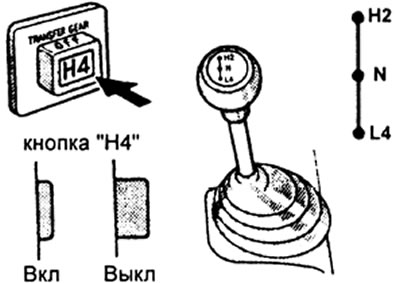
2. The overdrive gear is engaged in all-wheel drive mode (the control lever is in the "H2" position, the "H4" button is pressed and the freewheel clutches are locked).
This mode is intended for normal driving on wet, icy or snow-covered roads.
3. Neutral position of the transfer case (control lever in position "N").
No torque is transmitted to the wheels. This mode is intended only for use with a winch or other auxiliary equipment.
4. The low gear is engaged in all-wheel drive mode (the control lever is in the "L4" position, the "H4" button is pressed and the freewheel clutches are locked).
Use this mode for maximum torque and traction. Use low range ("L4") for severe driving conditions. For example, when climbing and descending steep hills, off-road driving, in sand, mud or deep snow.
Attention:
- The speed of movement in low gear is no more than 40 km/h.
- Be careful when downshifting on slippery roads. Sudden gear changes may cause the vehicle to skid or spin.
Freewheel clutches
To reduce noise, wear, vibration and fuel consumption in single-axle driving mode, freewheel clutches with manual or automatic front axle engagement are installed. Setting the clutches to the "unlocked" position disconnects the wheels from the axle shaft.
Note: To ensure reliable lubrication of the front axle components, it is necessary to drive the vehicle at least 15 km every month with the freewheel clutches locked.
1. Models with manual locking of freewheel clutches.
a) To engage the clutch lock, set the lock to the "LOCK" position (blocked).
Note: Make sure the triangle on the lock is aligned with the corresponding triangle on the clutch body.
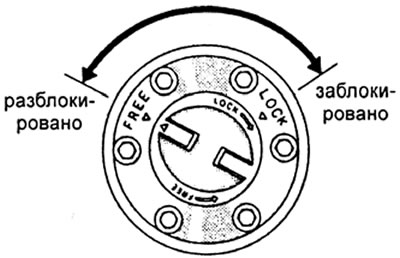
b) To disable the clutch lock, set the lock to the "FREE" position (unlocked).
2. Models with automatic locking of freewheel clutches.
a) Set the "Hub Lock" switch to the "ON" position (button pressed), then roll the car a few meters to engage the clutch locking mechanism. Make sure that the locking indicator on the instrument cluster lights up.
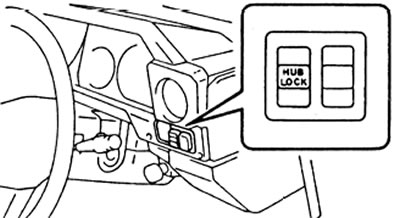
b) Set the "Hub Lock" switch to the "OFF" position (the button is pressed), then roll the car a few meters to engage the clutch locking mechanism. Make sure that the locking indicator light goes out.
Switching technique
1. Switching from (2WD-"H2") mode to (4WD-"H4") mode.
Make sure the freewheels are locked. At any speed, press the "H4" button on the instrument panel and briefly release the accelerator pedal. Pressing the clutch pedal is not necessary.
Attention:
- Do not engage the (4WD-"H4") mode if the wheels are slipping. Stop the slip or wheel spin before shifting.
- Driving is prohibited if only one freewheel clutch is locked.
2. Switching from (4WD-"H4") mode to (2WD-"H2") mode.
At any speed, press the "H4" button on the instrument panel. No need to press the clutch pedal.
Note: It is recommended to disengage the freewheel clutch lock when driving in the (2WD-"H2") mode for a long period of time.
3. Switching from (2WD-"H2") mode or (4WD-"H4") mode to low gear mode (4WD-"L4").
Stop the vehicle and make sure that the freewheel clutches are locked and the "H4" button is pressed. Press the clutch pedal and move the transfer case control lever to the "L4" position. If shifting is not possible, roll the vehicle forward or backward and repeat the shifting.
4. Switching from low gear mode "L4" to mode (2WD-"H2") or to mode (4WD-"H4").
Stop the car. Press the clutch pedal and move the transfer case control lever to the "H2" position. If the "H4" button is pressed, the mode will be switched to (4WD-"H4"), if the "H4" button is released, the mode will be switched to (2WD-"H2"). If switching is impossible, then roll the car forward or backward and repeat the switching.
Note: It is recommended to disengage the freewheel clutch lock when driving in the (2WD-"H2") mode for a long period of time.
Limited slip rear differential (self-locking) Some versions are equipped with a limited-slip differential. If one rear wheel starts to slip on a slippery surface, the limited-slip differential, designed to increase traction, automatically transfers torque to the other rear wheel.
If your vehicle is equipped with a limited-slip differential, there should be a plate on the differential housing with the mark "LSD". If the plate is missing or the markings are illegible, contact your Toyota dealer or check the plate in the engine compartment. If the last digit of the "AXLE" code is "3" or "5", your vehicle is equipped with a limited-slip differential.
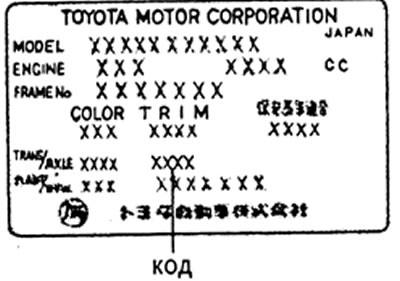
Caution: Use spare tires of the same size, design, and load capacity as the original vehicle tires, as using a different type of tire may cause damage to the limited slip differential.
Rear differential lock system
1. The rear axle differential lock is intended for use only in the event of wheel slippage when driving off-road or on slippery roads.
Note: Do not use the rear axle differential lock in other conditions. This may require more effort to steer the vehicle, especially when turning.
2. Differential lock.
Caution: The vehicle must be stopped before engaging the differential lock.
a) To lock the rear axle differential, press the switch and turn it clockwise until it clicks.
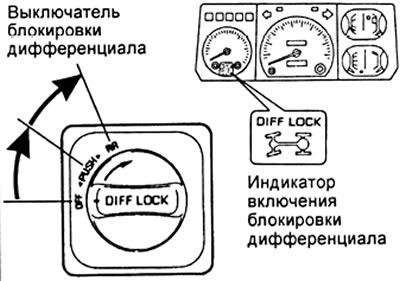
b) On vehicles with manual transmission: To facilitate locking, press the clutch pedal, turn the lock switch and slowly release the clutch pedal.
c) On vehicles with automatic transmission: To facilitate locking, turn the lock switch and gently press the accelerator pedal.
d) When the switch is moved to the differential lock state, the indicator will flash for a few seconds while the system locks. Once the differential lock is complete, the indicator will stop flashing and remain on continuously.
Note:
- Do not engage the differential lock when the wheels are slipping, as the vehicle may move in an unexpected direction when the lock is engaged, resulting in an accident or damage to the locking system.
- Do not accelerate the vehicle to speeds exceeding 8 km/h with the differential lock engaged.
3. Unlocking the differential.
Caution: Unlock the differential after the vehicle starts moving.
a) To unlock the differential, turn the switch fully counterclockwise (position "OFF").
b) To facilitate unlocking, turn the steering wheel slightly in any direction while the vehicle is moving.
c) When the rear differential is unlocked, the corresponding indicator will go out.
Note: Remember to turn off the lock when you no longer need it.