



Caution: To avoid damage to transmission components, partial loading of 4WD models is prohibited (by raising only one of the vehicle's axles).
4WD vehicles have permanent all-wheel drive, the so-called "Full time 4WD" (interaxle differential system). This allows for optimal distribution of torque between the wheels, but when slipping, a situation may arise where the torque is transmitted only to one wheel, which has the least grip on the road. To prevent this situation, the interaxle differential lock is designed.
Depending on the configuration, blocking can be done in two ways:
1) With mechanical locking system of the center differential (C. DIF. AUTO). When you press a button on the instrument panel, the hydraulic drive located on the transfer case locks the interaxle differential on command from the electronic control unit. This results in the necessary distribution of torque to the front and rear axles, which significantly improves cross-country ability.
2) With automatic center differential locking system (viscous coupling). This system does not require driver intervention, but cars equipped with this system have worse cross-country ability compared to cars with the "C. DIF. AUTO" system. This is due to the fact that the viscous clutch does not provide 100% locking and the clutch is activated with a slight time delay.
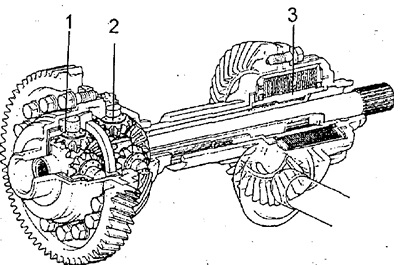
All-wheel drive diagram:
1 - interwheel differential,
2 - center differential,
3 - viscous coupling.