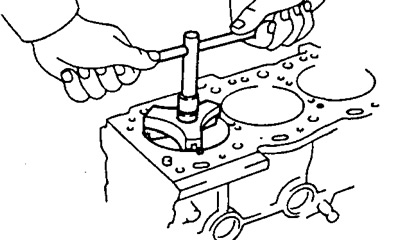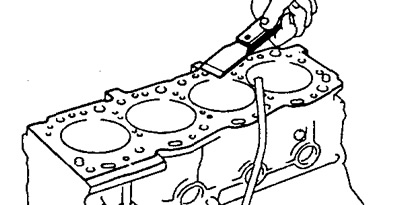
2. Clean the cylinder block using a soft brush and solvent.
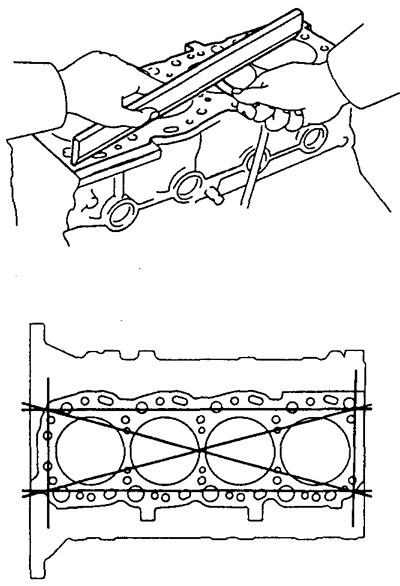
3. Check the warping of the plane of the cylinder block joint with the cylinder head.
- Maximum warpage - 0.20 mm
If the warpage exceeds the maximum permissible value, replace the cylinder block.
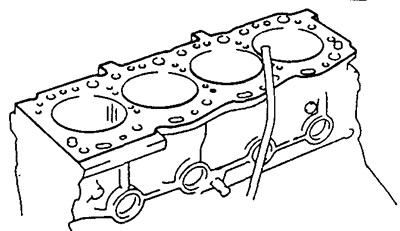
4. Check the cylinder mirror for vertical marks.
If there are deep scratches, bore all four cylinders. If necessary, replace the cylinder block.
5. Control of cylinder diameter.
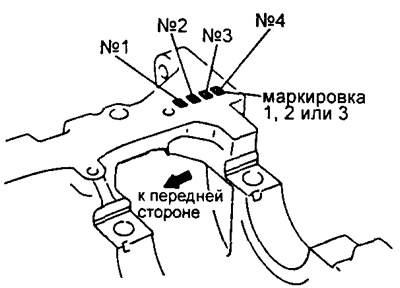
Note: There are three standard cylinder diameter sizes, labeled "1", "2" and "3" respectively. The markings are stamped on the lower left side of the rear side of the cylinder block.
Using a bore gauge, determine the cylinder diameter at positions A, B and C in the axial and transverse directions.
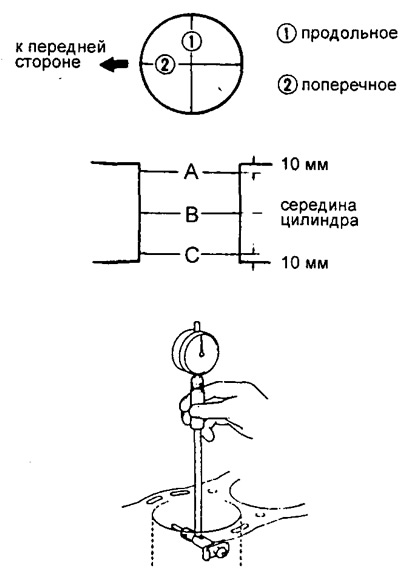
Nominal diameter:
2L Engines
- marking "1" - 92.00 -92.01 mm
- marking "2" - 92.01 - 92.02 mm
- marking "3" - 92.02 - 92.03 mm
3L Engine
- marking "1" - 96.00 -96.01 mm
- marking "2" - 96.01 - 96.02 mm
- marking "3" - 96.02 - 96.03 mm
Maximum allowable diameter:
- 2L Engines - 92.23mm
- 3L Engine - 96.23mm
Repair, increased by 0.50 mm:
- 2L Engines - 92.73mm
- Engine 3L - 96.73 mm
If the diameter exceeds the maximum permissible value, then bore all four cylinders. If necessary, replace the cylinder block.
6. Removing the wear groove.
If the wear is less than 0.2mm, use a reamer to remove the groove at the top of the cylinder.