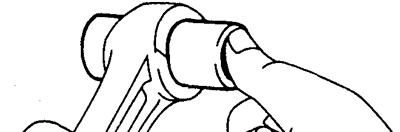
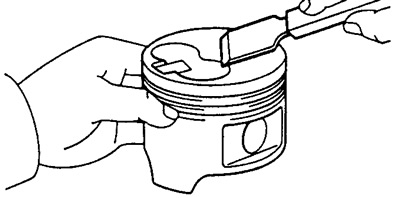
a) Using a scraper, remove carbon deposits from the piston bottom.
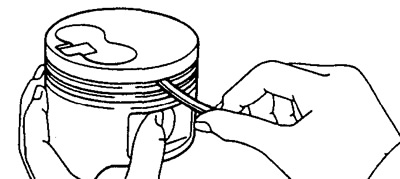
b) Using the broken ring, clean the piston ring grooves.
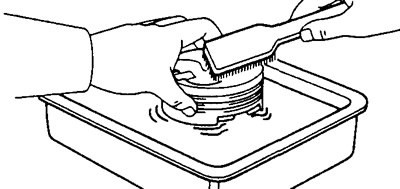
c) Using solvent and a soft brush, thoroughly clean the piston.
Warning: Do not use wire (metal) brush.
2. Check the piston diameter and the clearance between the piston and the cylinder.
Note: There are three nominal piston sizes by diameter, marked "1", "2" and "3" respectively. The marking is applied by stamping on the piston bottom.
a) Using a micrometer, measure the piston diameter at right angles to the pin axis at a distance of 58 mm for 2L engines and 56 mm for 3L engines from the piston bottom.
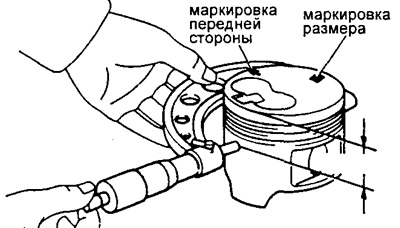
The original can be viewed on the website: toyotaman.ru
Nominal piston diameter:
2L Engines
- marking "1" - 91.94 - 91.95 mm
- marking "2" - 91.95 - 91.96 mm
- marking "3" - 91.96 - 91.97 mm
3L Engine
- marking "1" - 95.94 - 95.95 mm
- marking "2" - 95.95 - 95.96 mm
- marking "3" - 95.96 - 95.97 mm
Repair, increased by 0.50 mm:
- 2L Engines - 92.44 - 91.47 mm
- Engine 3L - 96.44 - 96.47 mm
b) Measure the diameter of the cylinder in the transverse direction (see above)
c) Subtract the piston diameter measurement from the cylinder diameter measurement.
- Nominal clearance - 0.05-0.07 mm
- Maximum gap - 0.14 mm
If the clearance value exceeds the maximum permissible value, replace four pistons and bore all four cylinders. If necessary, replace the cylinder block.
Note: When installing a nominal piston, this piston must have the same marking number as the marking number of the nominal diameter on the cylinder block.
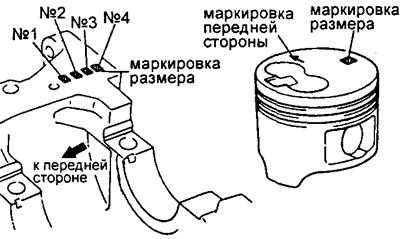
3. Check the gap between the ring and the piston groove using a feeler gauge.
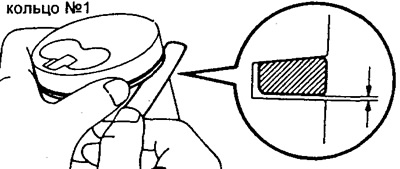 | 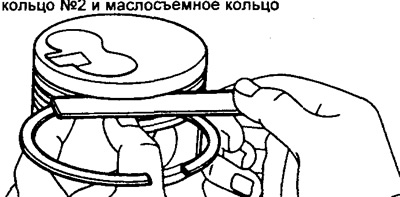 |
Gaps:
- Ring No.1 - 0.028 - 0.077 mm
- Ring No.2 - 0.060 -0.105 mm
- Ring No.2 - 0.070 - 0.115 mm
- Oil scraper - 0.030 - 0.070 mm
- Maximum gap - 0.20 mm
If the clearance is greater than the permissible limit, replace the piston.
4. Check the piston ring gap.
a) Install the ring into the cylinder.
b) Using a piston, push the piston ring to a depth of 140 mm from the parting plane of the cylinder block.
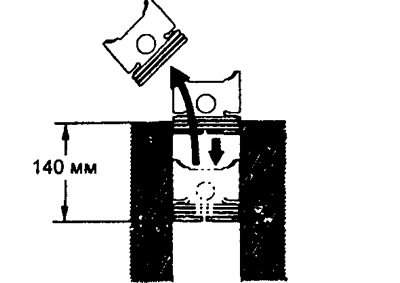
c) Using a feeler gauge, measure the gap in the ring lock.
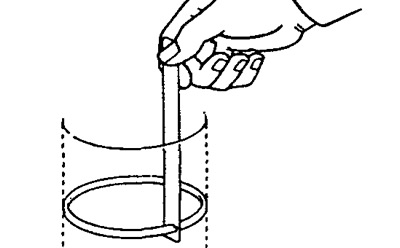
Nominal clearance in the lock:
- rings No.1 - 0.35-0.65 mm
- rings No.2 - 0.30 - 0.60 mm
- oil scraper - 0.20-0.50 mm
Maximum clearance:
- rings No.1 - 1.50 mm
- rings No.2 - 1.40 mm
- oil scraper - 1.40
If the gap in the ring lock exceeds the maximum permissible value, replace the piston ring.
If this gap exceeds the maximum permissible value even after installing a new ring, then bore all four cylinders or replace the cylinder block.
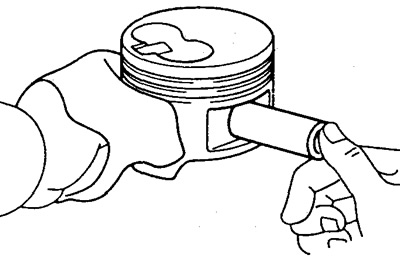
5. Check the fit of the piston pin: at a piston temperature of 60°C, the pin should enter the piston by hand.
6. Check the condition of the connecting rod.
A. Using a connecting rod tester, check the connecting rods for bending and twisting.
Maximum bending 0.05 mm per 100 mm of length.
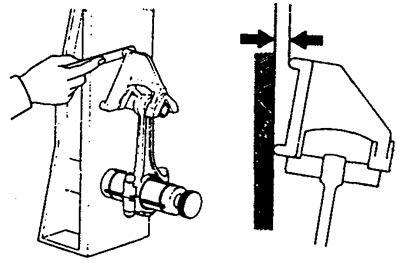
Maximum twist 0.15 mm per 100 mm length.
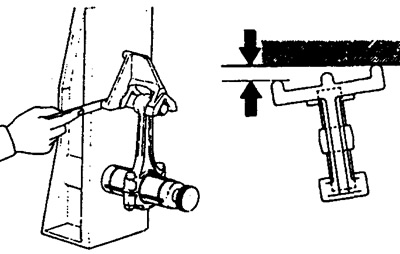
If the bend or twist exceeds the maximum allowable value, replace the connecting rod.
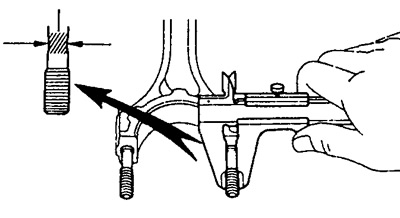
B. Using a caliper, measure the diameter of the bolt.
- Nominal diameter - 8.40 - 8.60 mm
- Minimum diameter - 8.20 mm
If the diameter is less than the minimum allowable value, replace the connecting rod bolt.
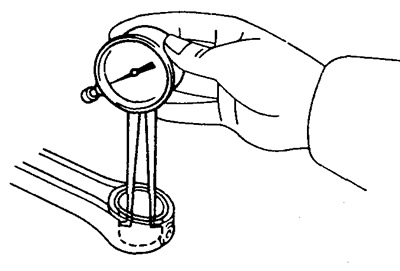
B. Check the clearance between the piston pin and the connecting rod upper head.
a) Using a dial indicator, measure the inner diameter of the connecting rod bushing.
Inner diameter of the bushing:
- Engine 2L - 27.008 - 27.020 mm
- Engine 3L - 29.008 - 29.020 mm
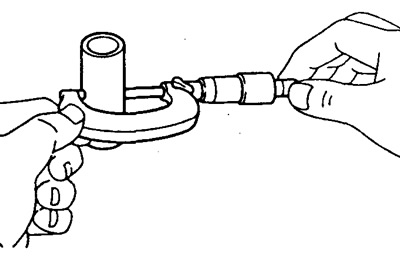
b) Using a micrometer, measure the piston pin diameter.
Piston pin diameter:
- Engine 2L - 27,000 - 27,012 mm
- Engine 3L - 29,000 -29,012 mm
c) Subtract the piston pin diameter measurement from the bushing inner diameter measurement.
- Nominal clearance - 0.004 -0.012 mm
- Maximum gap - 0.05 mm
7. If necessary, replace the connecting rod bushings.
A. Remove the connecting rod bushings. Using a jig and a press, press out the bushing.
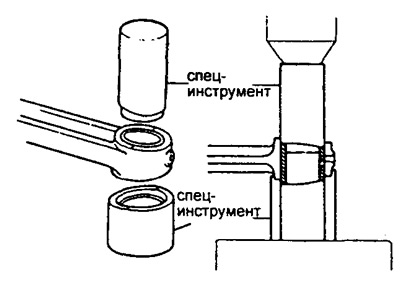
B. Install new connecting rod bushings.
a) Using a round file, lightly file away any rough spots on the upper connecting rod head.
b) Install the sleeve on the fixture so that the ball of the fixture enters the hole in the sleeve.
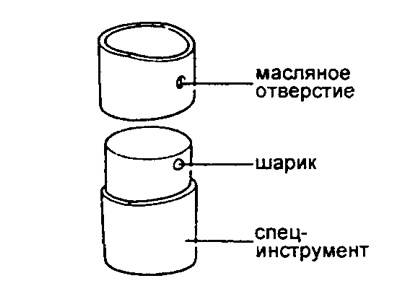
c) Align the lubrication holes of the bushing and connecting rod.
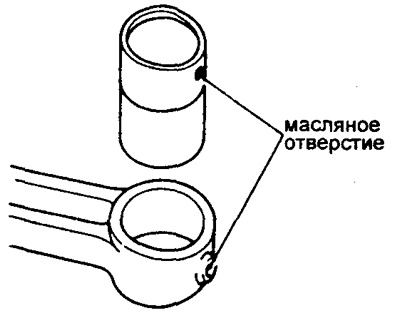
d) Using the fixture and press, press in the bushing.
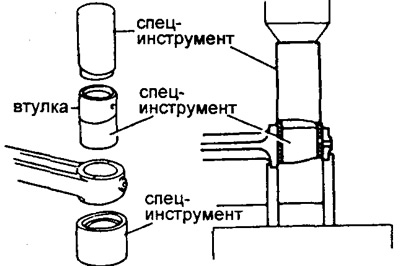
d) Using a piston pin hole grinder, hone the bushing until the nominal bushing-to-piston pin clearance is achieved (see above).
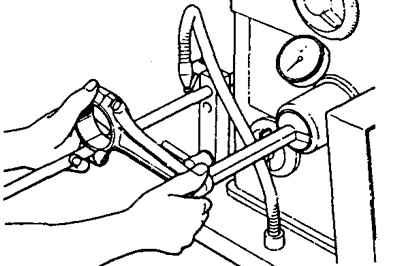
e) Check the piston pin fit at room temperature. Coat the piston pin with engine oil, then push it into the connecting rod upper end bushing with your thumb.