



Contents: Checking cylinder diameters ↓ Checking the piston assembly with…↓ Checking the piston oil clearance ↓ Checking the piston pin oil clearance ↓ Checking the gap between the end of…↓ The gap between the end of the…↓ Checking the gap in the piston ring…↓ Nominal clearance in the piston ring…↓ Maximum allowable clearance in the…↓ Checking the connecting rod assembly ↓ Checking the connecting rod bolts ↓ Checking the crankshaft ↓ Checking the crankshaft main bearing…↓ Checking the crankshaft oil clearance ↓ Pressing in guide pins ↓ Nominal projection ↓ Installing guide bushings ↓ Nominal projection ↓ Installing studs ↓ Installing the piston assembly with…↓ Installing a set of piston rings ↓ Installing crankshaft bearing shells ↓ Installing the upper thrust half…↓ Installing the crankshaft ↓ Installing connecting rod bearing…↓ Installing the connecting rods…↓ Installing the coolant drain tap…↓
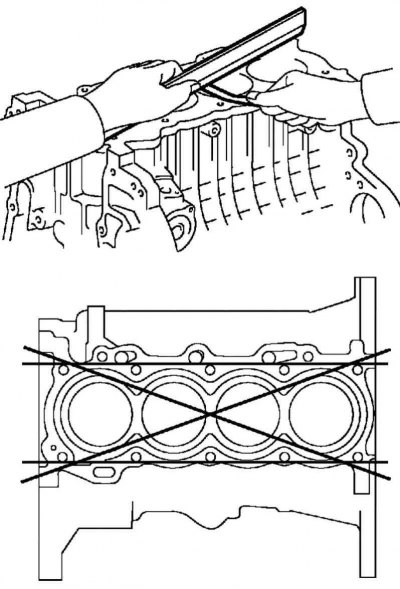
Fig. 2.282. Checking the cylinder block for warpage
Using a precision straight edge and feeler gauge, measure the warpage of the cylinder head gasket mating surfaces (fig. 2.282).
Maximum permissible warpage: 0.05 mm.
If the warpage exceeds the maximum permissible value, replace the cylinder block.
Checking cylinder diameters
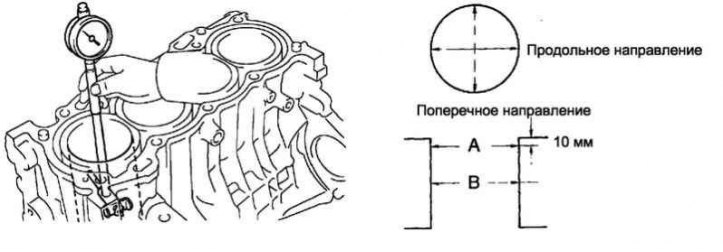
Fig. 2.283. Diagram of measuring the cylinder diameter
Using a bore gauge, measure the cylinder diameters in planes A and B in the longitudinal and transverse directions (fig. 2.283).
- Nominal diameter: 79.000–79.013 mm.
- Maximum allowable diameter: 79.133 mm.
If the average diameter of the four measurements exceeds the maximum allowable value, replace the cylinder block.
(The article is taken from a web resource toyotaman)
Checking the piston assembly with the piston pin
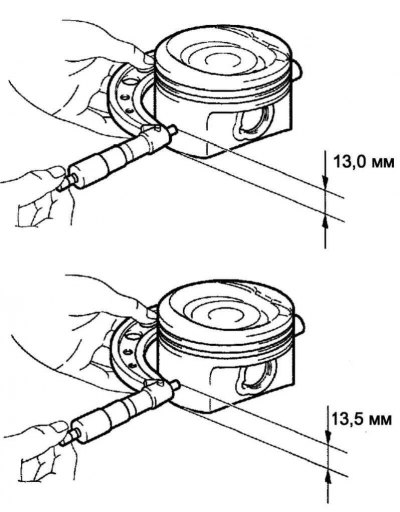
Fig. 2.284. Checking the piston assembly with the piston pin
For engine 1ZZ-FE:
Use a micrometer to measure the piston diameter.
Set the micrometer so that it is 13.0 mm from the edge of the piston skirt and at a right angle (90°) to the axis of the piston pin holes, as shown in Figure 2.284a.
Piston diameter: 78.955–78.965 mm.
If the diameter does not correspond to the nominal, replace the piston.
For 3ZZ-FE engine:
Use a micrometer to measure the piston diameter.
Set the micrometer so that it is 13.5 mm from the edge of the piston skirt and at a right angle (90°) to the axis of the piston pin holes, as shown in Figure 2.284b.
Piston diameter: 78.960–78.975 mm.
If the diameter does not correspond to the nominal, replace the piston.
Checking the piston oil clearance
Subtract the measured piston diameter from the cylinder diameter.
- Nominal oil clearance: 0.073–0.096 mm.
- Maximum permissible oil gap: 0.10 mm.
If the oil clearance exceeds the maximum allowable value, the piston assembly must be replaced.
Replace the cylinder block if necessary.
Checking the piston pin oil clearance
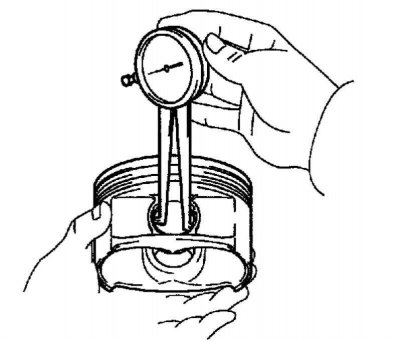
Fig. 2.285. Measuring the diameter of the hole for the piston pin
Using a dial indicator, measure the diameter of the piston pin bore (fig. 2.285).
Piston pin bore diameter: 20.006–20.015 mm.
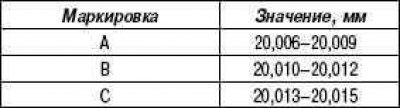
If the diameter is not within the nominal value, replace the piston assembly.
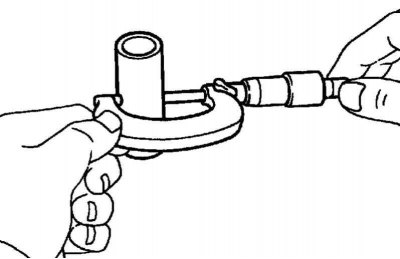
Fig. 2.286. Measuring the outside diameter of the piston pin
Use a micrometer to measure the outside diameter of the piston pin (fig. 2.286).
Piston pin outer diameter: 20.004–20.013 mm.
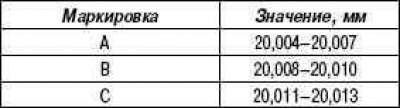
If the diameter is not within the nominal value, replace the piston assembly.
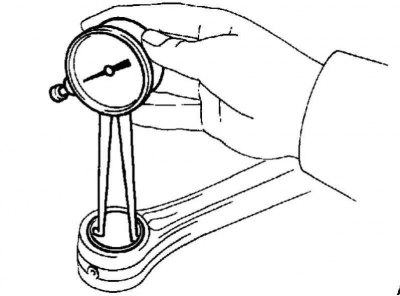
Fig. 2.287. Measuring the diameter of the small end hole of the connecting rod
Using a dial indicator, measure the diameter of the small end bore of the connecting rod (fig. 2.287).
Connecting rod small end bore diameter: 20.012–20.021 mm.
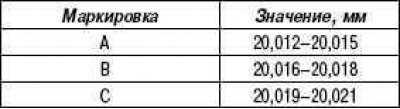
If the diameter does not correspond to the nominal, replace the connecting rod assembly.
Subtract the measured piston pin outside diameter from the piston pin bore diameter.
- Nominal oil clearance: from 0.001 to 0.017 mm.
- Maximum allowable oil clearance: 0.017 mm.
If the oil clearance exceeds the maximum allowable value, replace the connecting rod.
Replace the piston pin if necessary.
Subtract the measured piston pin outside diameter from the piston pin bore diameter.
- Nominal oil clearance: 0.005–0.011 mm.
- Maximum allowable oil clearance: 0.011 mm.
If the oil clearance exceeds the maximum allowable value, replace the connecting rod.
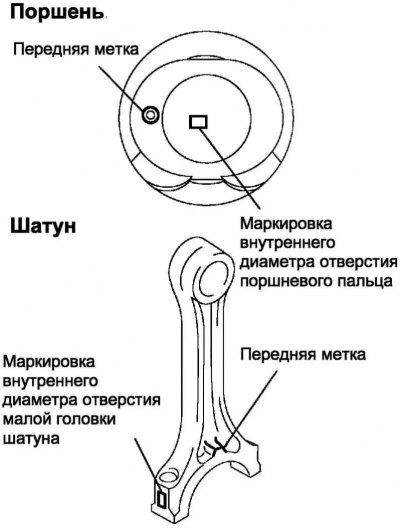
Fig. 2.288. Piston and connecting rod diameter markings
If necessary, replace the connecting rod and piston pin (fig. 2.288).
Checking the gap between the end of the piston ring and the piston groove
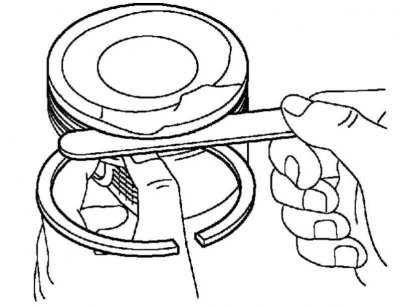
Fig. 2.289. Measuring the gap between the end face of a new piston ring and the wall of the piston groove
Use a feeler gauge to measure the gap between the end of the new piston ring and the wall of the piston groove (fig. 2.289).
The gap between the end of the piston ring and the piston groove
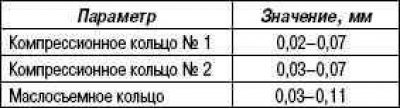
If the clearance is not within the specified value, replace the piston assembly.
Checking the gap in the piston ring lock
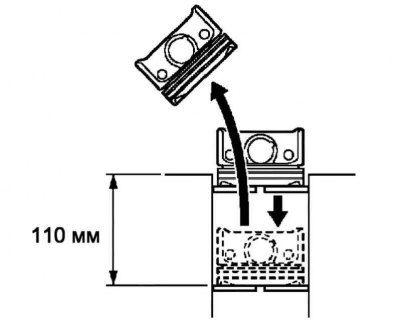
Fig. 2.290. Pushing the piston ring into the cylinder
Using a piston, push the piston ring into the cylinder, slightly before reaching the bottom of the ring stroke, at a distance of 110 mm from the upper plane of the cylinder block (fig. 2.290).
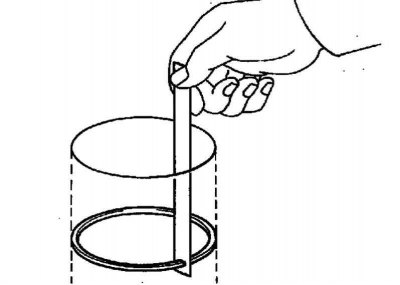
Fig. 2.291. Measuring the gap in the ring lock
Use a feeler gauge to measure the gap in the ring lock (fig. 2.291).
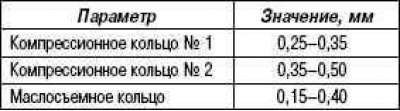
If the piston ring gap exceeds the maximum allowable value, replace the piston ring.
Nominal clearance in the piston ring lock
Maximum allowable clearance in the lock
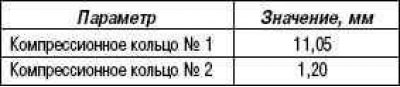
If the piston ring gap exceeds the maximum allowable value, even with a new piston ring, replace the cylinder block.
Checking the connecting rod assembly
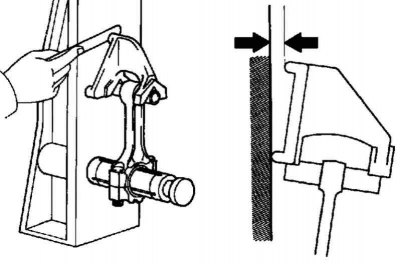
Fig. 2.292. Checking the curvature of the connecting rod
Using a connecting rod curvature tester and a set of feeler gauges, measure the curvature of the connecting rod (fig. 2.292).
- Maximum permissible curvature: 0.05 mm per 100 mm.
If the connecting rod curvature exceeds the maximum permissible value, the connecting rod should be replaced.
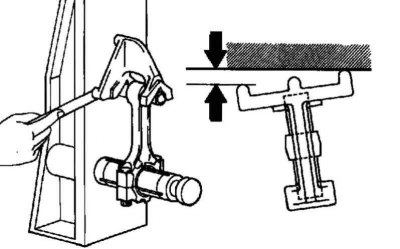
Fig. 2.293. Checking the connecting rod twist
Check the connecting rod twist (fig. 2.293).
- Maximum permissible twist: 0.05 mm per 100 mm.
If the connecting rod twist exceeds the maximum allowable value, the connecting rod should be replaced.
Checking the connecting rod bolts
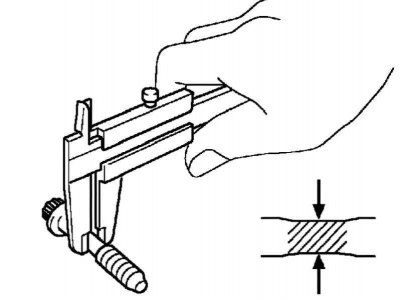
Fig. 2.294. Measuring the connecting rod bolt
Use a caliper to measure the diameter of the extended part of the bolts (fig. 2.294).
- Nominal diameter: 6.6–6.7 mm.
- Minimum allowable diameter: 6.4 mm.
If the diameter is less than the minimum allowable value, the bolt should be replaced.
Checking the crankshaft
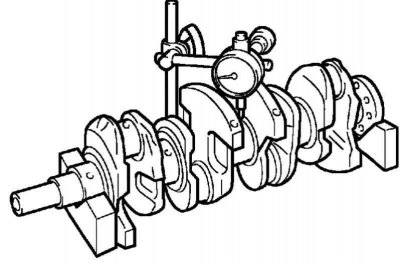
Fig. 2.295. Measuring the radial runout of the crankshaft
Mount the crankshaft on prisms and use a dial indicator to measure the radial runout as shown in Figure 2.295.
- Maximum permissible radial runout: 0.03 mm.
If the radial runout exceeds the maximum permissible value, the crankshaft should be replaced.
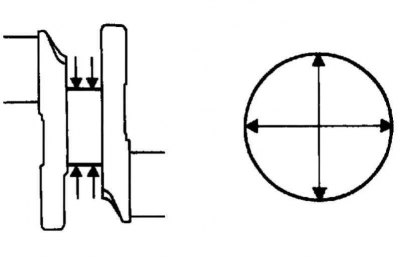
Fig. 2.296. Crankshaft main journal measurement diagram
Using a micrometer, measure the diameter of all main journals at the points indicated in Figure 2.296.
- Diameter: 47.988–48.000 mm.
If the journal diameter is not as specified, check the crankshaft oil clearance.
Check the taper and ovality of all main journals as shown in Figure 2.296.
- Maximum permissible taper and ovality: 0.02 mm.
If the taper and out-of-roundness exceed the maximum permissible value, the crankshaft should be replaced.
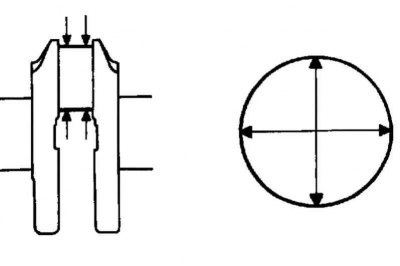
Fig. 2.297. Diagram of measuring the crankshaft connecting rod journals
Using a micrometer, measure the diameter of all connecting rod journals at the points indicated in Figure 2.297.
- Diameter: 43.992–44.000 mm.
If the journal diameter is not as specified, check the connecting rod oil clearance.
Check the taper and ovality of all connecting rod journals as shown in Figure 2.298.
Maximum permissible taper and ovality: 0.02 mm.
If the taper and out-of-roundness exceed the maximum permissible value, the crankshaft should be replaced.
Checking the crankshaft main bearing cap bolts
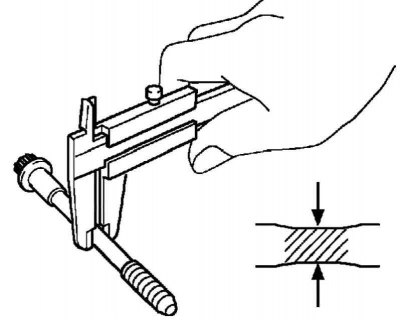
Fig. 2.298. Measuring the diameter of the bolt extension
Use a caliper to measure the diameter of the extended part of the bolts (fig. 2.298).
- Nominal diameter: 7.3–7.5 mm.
- Minimum allowable diameter: 7.3 mm.
If the diameter is less than the minimum allowable, the main bearing cap mounting bolt should be replaced.
Checking the crankshaft oil clearance
Clean all main bearing journals and shells.
Note: Do not turn the crankshaft.
Install the crankshaft into the cylinder block.
Place a compressible plastic gauge along each main journal.
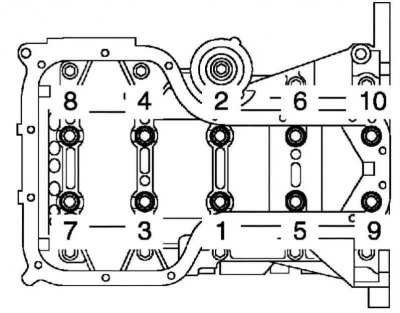
Fig. 2.299. Sequence of tightening the main bearing block mounting bolts
Using SST, tighten the bolts in several stages to the specified torque, following the sequence shown in Figure 2.299.
- Tightening torque: 44 Nm.
Mark the front side of each main bearing cap bolt with paint.
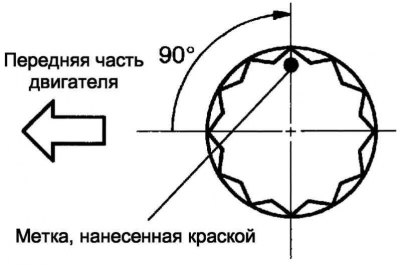
Fig. 2.300. Angle of rotation of main bearing mounting bolts
Tighten the cover mounting bolts by 90° as shown in Figure 2.300.
Make sure the marks are rotated 90° from their original position.
Tighten the remaining 10 main bearing cap block bolts.
Tightening torque: 19 Nm.
Remove 10 bolts.
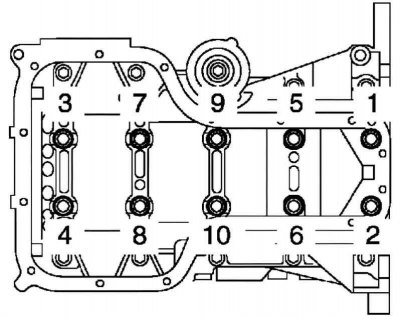
Fig. 2.301. Sequence of unscrewing the main bearing block mounting bolts
In several steps, evenly loosen and unscrew the 10 bearing cap block mounting bolts in the sequence shown in Figure 2.301.
Measure the crushable plastic gauges at their widest point.
- Nominal oil clearance: 0.015–0.032 mm.
- Maximum allowable oil clearance: 0.05 mm.
Note: Remove all remaining plastic crumple gauges.
If the oil clearance exceeds the maximum allowable value, replace the main bearing shells.
Replace the crankshaft if necessary.
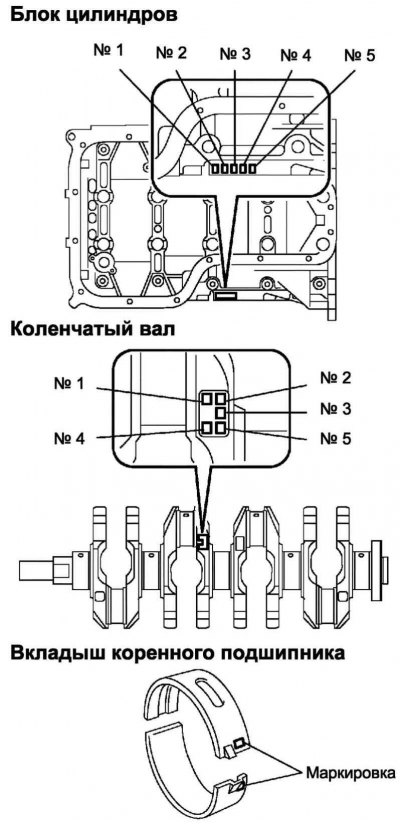
Fig. 2.302. Scheme for selecting liners
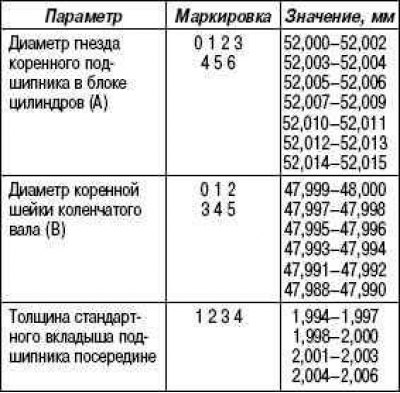
Note. The new bearing shell must be of the same size group as the old shell. The size group number is indicated on the shell. If the number on the shell cannot be determined, the size group of the shell is selected according to the table below after adding the numbers stamped on the cylinder block and on the crankshaft. Bearing shells are supplied in 4 standard size classes, marked with numbers accordingly "1", "2", "3" and "4" (fig. 2.302).
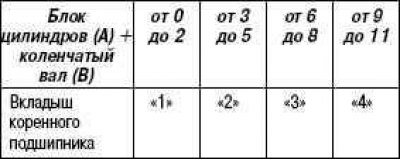
Example: cylinder block "3" (A) + crankshaft "4" (B) = sum 7 (use bearing insert "3").
Pressing in guide pins
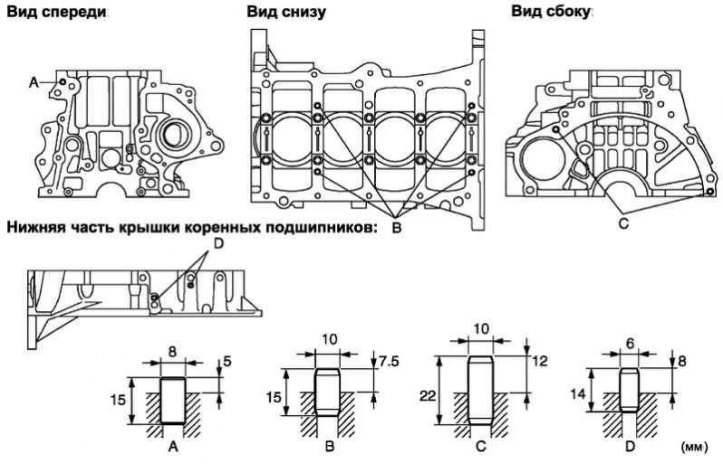
Fig. 2.303. Diagram of pressing in guide pins
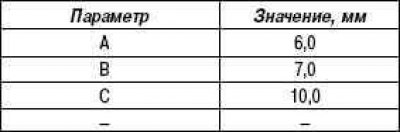
Using a plastic hammer, press 9 guide pins into the cylinder block (fig. 2.303).
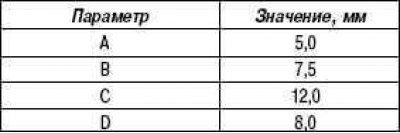
Nominal projection
Installing guide bushings
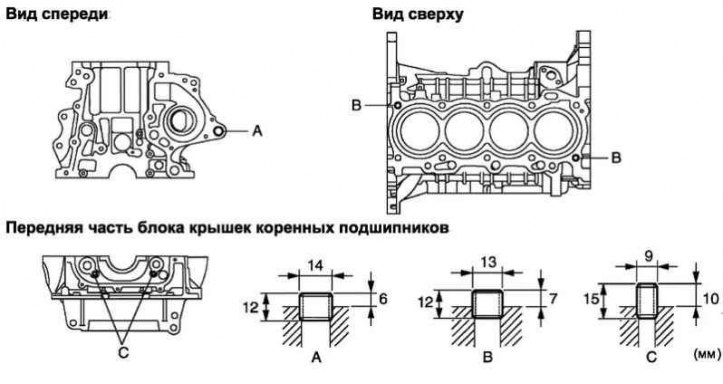
Fig. 2.304. Diagram of pressing in guide bushings
Using a plastic hammer, press 5 new guide bushings into the cylinder block (fig. 2.304).
Nominal projection
Installing studs
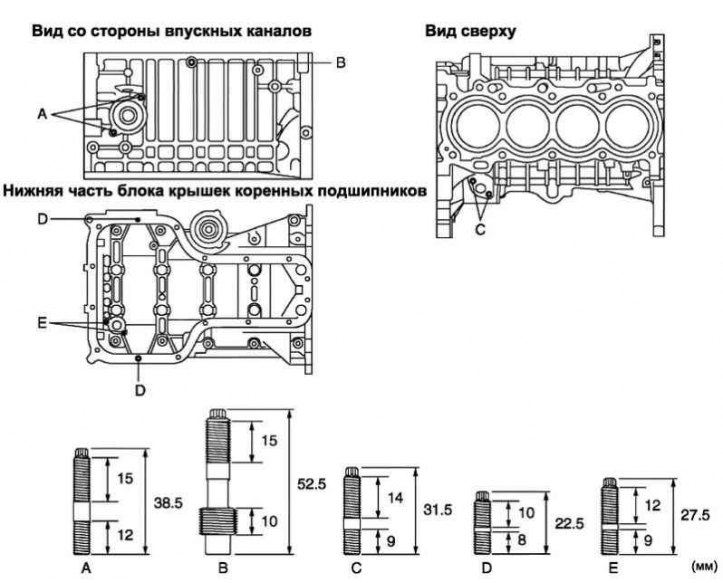
Fig. 2.305. Stud installation diagram
Using TORX socket wrenches E5 and E7, tighten 9 studs into the cylinder block (fig. 2.305).
Tightening torque:
- 5.0 Nm for A;
- 11 Nm for B;
- 5.0 Nm for C;
- 5.0 Nm for D;
- 5.0 Nm for E.
Installing the piston assembly with the piston pin
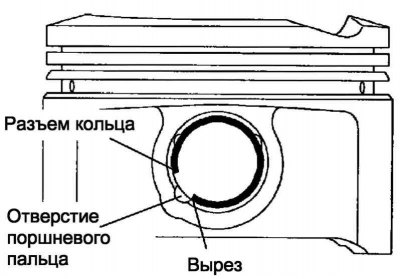
Fig. 2.306. Diagram of installation of a new retaining ring
Using a small screwdriver, install a new snap ring into one of the piston holes toward the piston pin (fig. 2.306).
Note: Make sure the ring slot aligns with the cutout in the piston.
Gradually heat the piston to a temperature of 80–90°C.
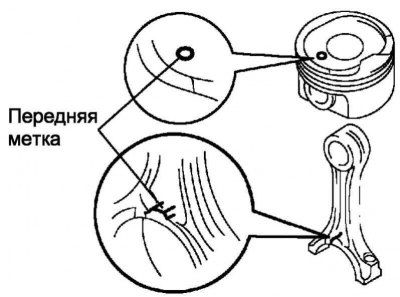
Fig. 2.307. Piston and connecting rod alignment marks
Align the front marks of the piston and connecting rod and insert the piston pin by hand into the holes in the piston and in the upper head of the connecting rod (fig. 2.307).
Using a small screwdriver, install a new snap ring into one of the piston holes toward the piston pin (fig. 2.306).
Installing a set of piston rings
Use your hands to install the expander and 2 sides of the composite oil scraper ring.
Note: When reusing piston rings, they should be installed on the same pistons from which they were removed and in the same position.
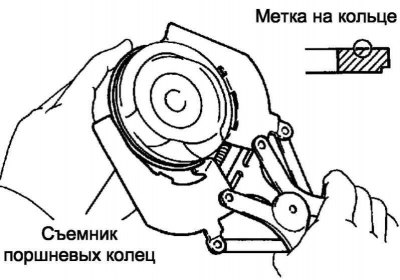
Fig. 2.308. Installation of compression rings
Using a piston ring puller, install 2 compression rings with the marking facing the piston bottom (fig. 2.308).
Marking (only for compression ring No.2): 2R.
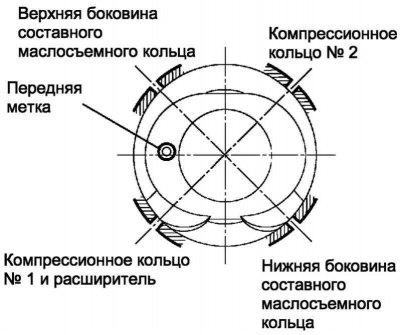
Fig. 2.309. Piston ring lock arrangement diagram
Rotate the piston rings so that their locks are located in accordance with Figure 2.309.
Installing crankshaft bearing shells
Install the upper bearing shell with the oil groove into the cylinder block.
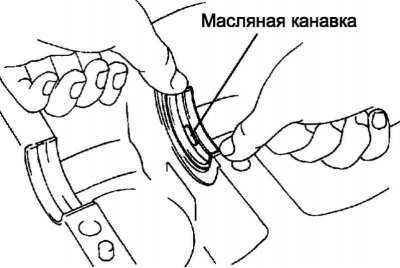
Fig. 2.310. Installing crankshaft bearing shells
Install the lower bearing shells into the main bearing cap block (fig. 2.310).
Note: Do not lubricate bearing shells or the contact surface with engine oil.
Installing the upper thrust half rings of the crankshaft
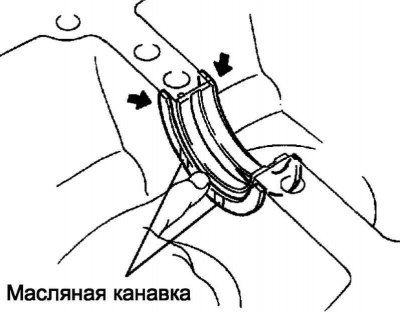
Fig. 2.311. Installing the upper thrust half rings
Install 2 upper thrust half rings on the main journal seat No.3 in the cylinder block with the oil grooves facing outward (fig. 2.311).
Installing the crankshaft
Lubricate the upper bearing shells with engine oil and install the crankshaft into the cylinder block.
Apply a thin coat of engine oil to the bolt threads, bolt seats and main bearing cap shells.
Install the crankshaft into the cylinder block.
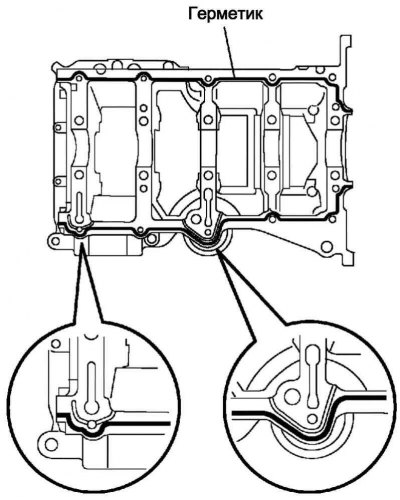
Fig. 2.312. Sealant installation diagram
Apply the sealant in a continuous bead (diameter 2.5–3.5 mm), as shown in Figure 2.312.
Note: Clean the mating surface from oil.
Note: Install the main bearing cap assembly within 3 minutes after applying the sealant.
Note: Do not add oil to the engine earlier than 2 hours after installing the block of covers.
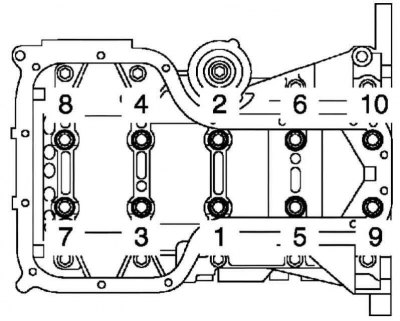
Fig. 2.313. Sequence of tightening the bolts for fastening the main bearing cap block
Tighten the bolts in several stages to the specified torque, acting in the sequence shown in Figure 2.313.
- Tightening torque: 44 Nm.
Mark the front side of each main bearing cap bolt with paint.
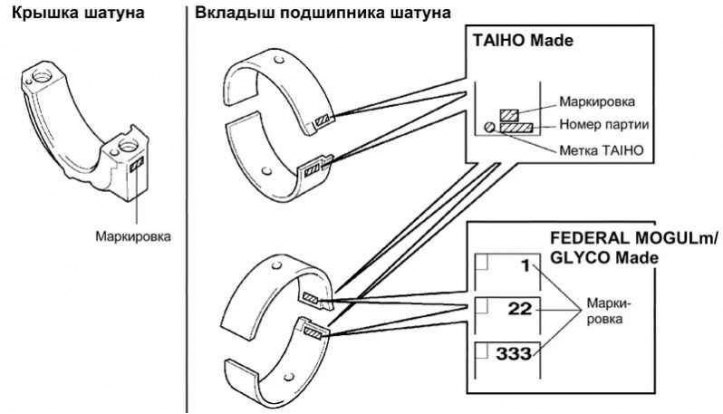
Fig. 2.263. Markings and marks on connecting rod caps and on connecting rod bearing shells
Tighten the cover mounting bolts by 90° as shown in Figure 2.263.
Make sure the marks are rotated 90° from their original position.
Tighten the remaining 10 main bearing cap block bolts.
- Tightening torque: 19 Nm.
Installing connecting rod bearing shells
Align the protrusion on the bearing shell with the groove on the connecting rod cap.
Install the connecting rod bearing shell into the connecting rod cap.
Note: Do not lubricate bearing shells or the contact surface with engine oil.
Align the protrusion on the bearing shell with the groove on the connecting rod.
Install the bearing shell into the connecting rod.
Installing the connecting rods assembly
Rotate the piston rings so that their locks are located in accordance with Figure 2.309.
Lubricate the cylinder walls, pistons and surfaces of the connecting rod bearing shells with engine oil.
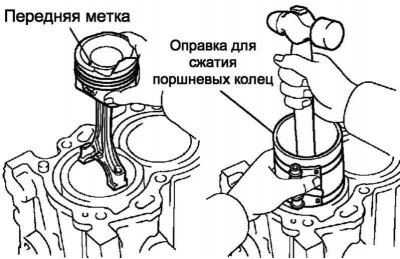
Fig. 2.314. Installing the piston with connecting rod assembly
Using a piston ring driver, insert the pistons with connecting rods into the cylinders so that the mark on the piston is facing the front of the engine (fig. 2.314).
Align the dowel pins on the connecting rod cap with the holes in the connecting rod and install the cap.
Note: Install connecting rod caps on the corresponding connecting rods.
Make sure the tab on the connecting rod bearing cap is oriented in the correct direction.
Apply a thin coat of motor oil to the threads and under the heads of the connecting rod cap bolts.
Using SST 09205-16010, tighten the bolts to the specified torque in several steps.
- Tightening torque: 20 Nm.
Mark the front side of each connecting rod cap bolt with paint.
Tighten the cover mounting bolts to an angle of 90°.
Make sure the crankshaft rotates smoothly.
Installing the coolant drain tap assembly
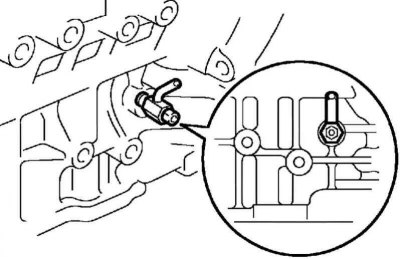
Fig. 2.315. Installation diagram of the coolant drain tap assembly
Apply thread lock to 2 or 3 threads of the coolant drain cock, then screw the cock in within 3 minutes as shown in the figure (fig. 2.315).
- Tightening torque: 25 Nm.
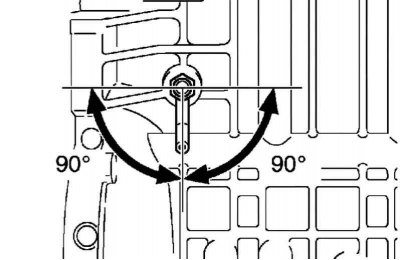
Fig. 2.316. Position of the drain nipple
Tighten to the specified torque by turning the tap clockwise so that the drain nipple points downwards (fig. 2.316).
Note: Do not add coolant earlier than one hour after installing the tap.
Note: When turning the tap, it is prohibited to rotate it more than 360°, and it is also prohibited to loosen it after it is installed correctly.