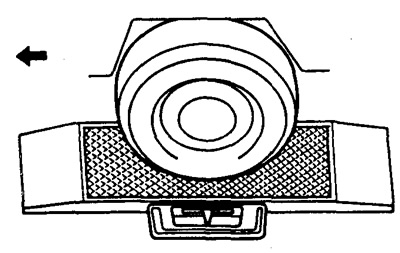
a) Check tire wear and tire pressure.
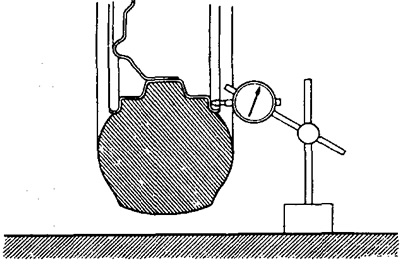
b) Check the wheel runout.
- Wheel runout is 1.2 mm or less.
c) Check the front wheel bearings for looseness.
d) Check the reliability of the front suspension fastening.
d) Check the reliability of the steering drive fastening.
e) Check that there is no excessive play in the ball joint.
g) Check the correct operation of the shock absorbers by performing a rebound test using the standard method.
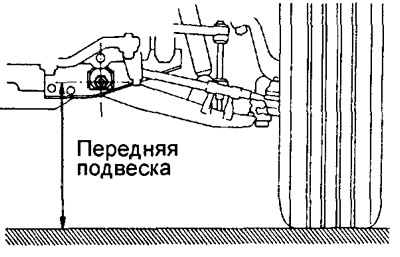
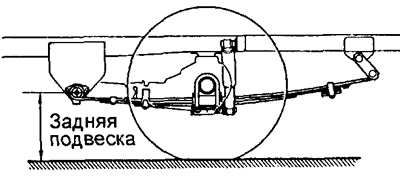
2. Measure the vehicle's ride height.
If the height of the car's clearances does not correspond to the established standards, then you should try to adjust this height by pressing the body down or lifting the body up. If the height of the clearances after this still remains incorrect, then you should conduct a control check to identify defective springs or other suspension parts.
 |  |
3. Install the equipment for adjusting the front wheel alignment angles according to the manufacturer's instructions.
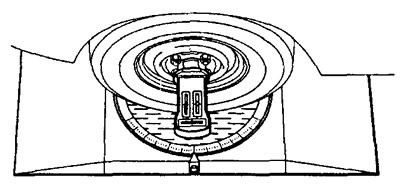
4. Adjust the front wheel alignment angles.
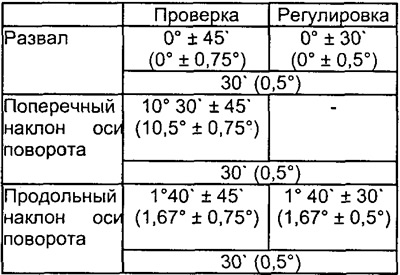
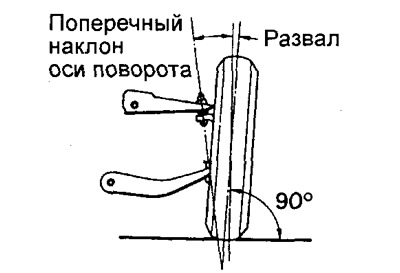
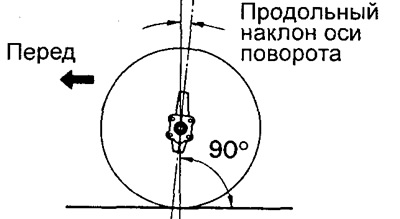
If the camber or caster angle of the front wheel axle does not meet the specifications, then adjustment should be made by rotating the adjusting cam or by rotating the strut nut.
(The information was taken from a web portal: TOYOTAMAN)
 |  |
Warning: The adjustment cam should not be turned more than 4.5 notches from its neutral position.
Warning: Do not turn the nut on the strut more than three thread turns from its original position.
Note: The front camber angle changes approximately 13' for every one notch the cam is turned.
Note: The caster angle of the pivot axis changes approximately 29'33" per one turn of the nut.
Tightening torque:
- Adjusting cam - 216 Nm
- Strut nut - 121 Nm
If the lateral tilt angle of the steering axis does not correspond to the technical data after adjusting the camber and longitudinal tilt of the steering axis, then check the front wheel steering knuckle again for deformation or loosening.
5. Check the front wheel alignment using a special device for measuring the front wheel alignment in the following sequence:
a) Make sure that the position of the front wheels of the vehicle corresponds to the straight-ahead direction of travel, on a level surface.
b) Mark the center of the tread of each tire at the rear and measure the distance between the marks on the right and left tires.
c) Move the vehicle so that the marks on the rear side of the tires move to a height corresponding to the height of the front wheel alignment gauge installed on the front side of the tires.
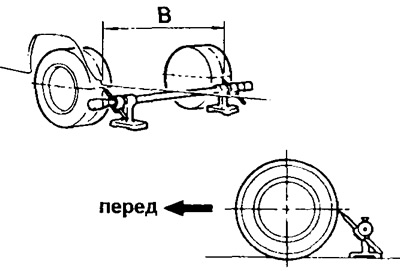
d) Measure the toe-in of the front wheels, at the same points on the right and left tires.
- Nominal toe-in during testing: 0 ±2 mm
- Nominal toe-in during adjustment: 0±1 mm
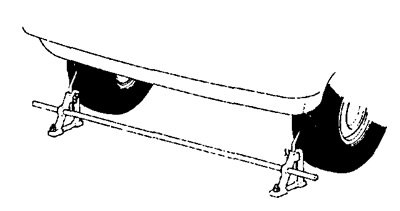
d) Loosen the steering rod clamp.
e) By turning the ends of the left and right steering rods by the same number of turns, adjust the toe-in of the front wheels.
Note: After taking the appropriate measurements, make sure that the lengths of the left and right steering rod ends are equal.
- The difference in length between the ends of the left and right rods is no more than 3 mm
d) Tighten the clamp.
- Tightening torque - 25 Nm
6. Check the steering angle of the front wheels.
Remove the caps from the steering knuckle limit bolts and check the wheel turning angles.
Wheel turning angle (tolerance +0°, -3°):
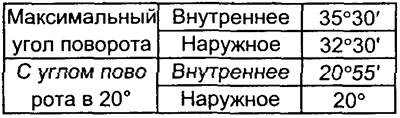 | 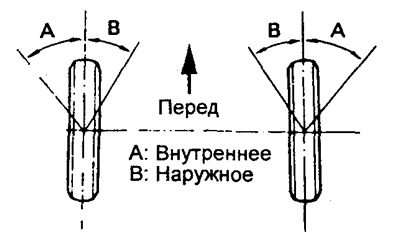 |
Note: When turning the wheels fully, make sure that the wheels do not touch the body or flexible brake hoses.
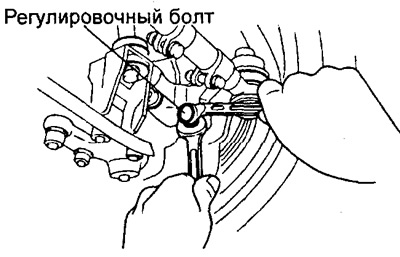
7. If the maximum value of the steering angle of the steered wheels differs from the norm specified here, then the steering angle of the wheels should be adjusted using the steering knuckle limiting bolts.
- Tightening torque - 44 Nm
8. If the wheel turning angle still cannot be adjusted within the established norm, then it is necessary to conduct a control inspection and replace damaged or worn steering components.
9. Check for lateral slip
- Lateral slip - 3.0 mm/m no more than
If the side slip exceeds the standard slip, check the toe or other adjustments of the front wheels.