



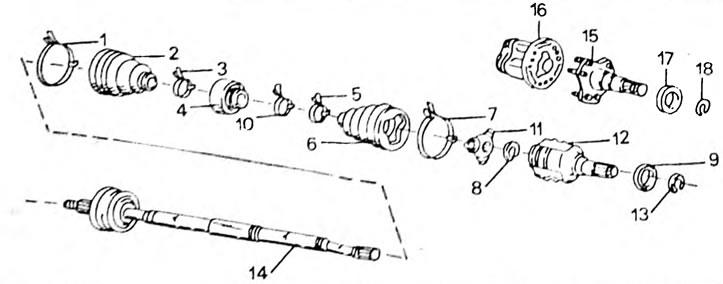
Fig. 179. Assembly drawing of the drive shaft. Parts 15 to 18 are installed only on a vehicle with flange mounting on the inside. 1. Fastening clamp, large; 2. Rubber cuff; 3. Fastening clamp, small; 4. Vibration damper; 5. Fastening clamp, small; 6. Rubber cuff; 7. Fastening clamp, large; 8 Retaining ring; 9. Anther ring; 10. Damper clamp; 11. Crosspiece; 12. Internal joint of torn angular velocities; 13. Retaining ring; 14. Drive shaft with external constant velocity joint; 15. Differential output shaft; 16. Inner constant velocity joint; 17. Anther ring; 18. Retaining ring
When repairing the drive shaft, use the installation drawing:
- Remove the tension bands from both cuffs. Move the cuff (6) to the center of the shaft.
- Clamp the shaft in a vice and mark with paint the relative positions of the shaft and the inner joint, as shown in Figure 180. The figure shows the shaft with a drive flange.
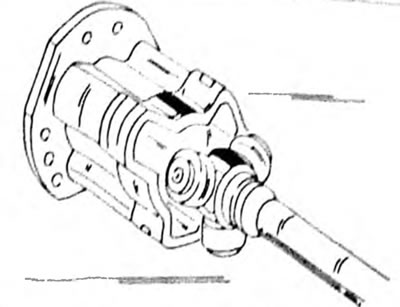
Fig. 180. Before removing the joint housing, mark the relative positions of the crosspiece and housing with paint.
- Remove the joint from the shaft.
- Remove the retaining ring (8) and, to mark the relative positions of the parts, strike the end of the shaft and the crosspiece with a punch. Knock the crosspiece outward, but do not strike the rollers (Fig. 181).
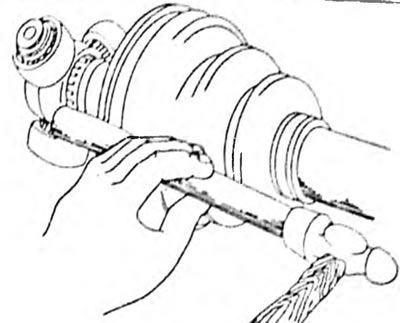
Fig. 181. Knock the crosspiece off the shaft using a soft metal drift. Place the drift against the hinge shoulders
- Remove the seals (2) and (6) from the shaft.
- Using a screwdriver, remove the vibration damper mounting clamp (if installed) and remove the damper from the shaft.
- Clean all parts thoroughly. If necessary, replace the broken joint as a set. Bent shafts should also be replaced, be sure to replace the cuffs that have tears and cracks, because! dirt can get into the joints. If the crosspiece is replaced, do not throw it away temporarily, as it will be needed during assembly.
- Place the large clamp (7), the collar (6), the small clamp (5), the other clamps (10), the collar (2), and the large clamp (1) on the shaft and clamp the shaft in a vice. Wrap the splined part of the shaft with adhesive tape so that it does not damage the collars. Be sure to install new clamps. The method of installing the clamps is important because the ends of the clamps must face the direction of rotation of the stool.
- Take the joint star in your hands and determine which side has the inner bevel. This side should face the outer joint. Check from the outside whether the fasteners match if the old parts are being installed. Install the new joint so that the joint roller is in the same position as the old joint.
- Place the joint on the shaft using a rod (evenly placing the rod in a circle).
- Insert a new snap ring into the groove in front of the hinge.
- On the "AT" series shaft (1.6L engine) place 120-130 g of grease, squeezed together with the repair kit, into the joint and lubricate the cuff.
- Lubricate the inner hinge and cuff. On the shaft of the "ST" series (2.0L engine) or "ST" (diesel engine) requires 212-220 g of grease, for the shaft of the "AT" series (1.6L engine) — 190 g.
- Align the hinge housing with the paint mark on the shaft as shown in Figure 180 and assemble the parts.
- Place rubber cuffs on the hinges. The cuff protrusion should fit into the shaft groove.
- Apply the clamps and tighten the ends. Then bend the ends and lock them. Secure the small clamps with the same harness. After putting on the cuffs, they should be loose and not unravel too much.
(The original article is on the portal: www.toyotaman.ru)