



Contents: Checking for "spark" ↓ Checking high voltage wires ↓ Checking spark plugs (with…↓ Checking spark plugs (with platinum…↓ Checking the ignition coil (contact…↓ Checking the ignition coil…↓ Checking the switch (electronic…↓ Checking the distributor (contact…↓ Checking the distributor…↓
Checking for "spark"
Check for spark (Contact ignition system):
a) Disconnect the high voltage wire from the distributor.
b) Holding the wire at a distance of approximately 12.5 mm from the car body ("ground"), turn on the starter.
c) When turning the engine, a spark should jump.
If no spark appears, perform the test as described below. (Contactless ignition system)
a) Disconnect the high-voltage wires from the spark plugs.
b) Remove the spark plugs.
c) Connect the high-voltage wires to the spark plugs.
d) Ground the spark plugs.
d) Check for the presence of a new formation when turning the engine with the starter.
If there is no spark, perform the test as described in Table 1.
Checking high voltage wires
1. Carefully remove the spark plug wires from the spark plugs by holding the rubber end of the wire.
Caution: When disconnecting a wire, pull on the tip and not on the wire itself.
Measure the resistance of each wire.
- Maximum resistance - 25 kOhm
Caution: Pulling or bending the wires may damage the conductor inside.
2. Without removing the high-voltage wire from the distributor, measure its resistance using an ohmmeter.
- Maximum resistance: 25 kOhm.
If the resistance is higher than the specified value, check the terminals. Replace the wire or distributor cap if necessary.
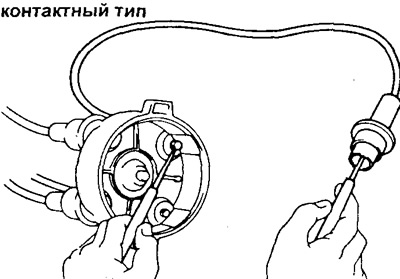 | 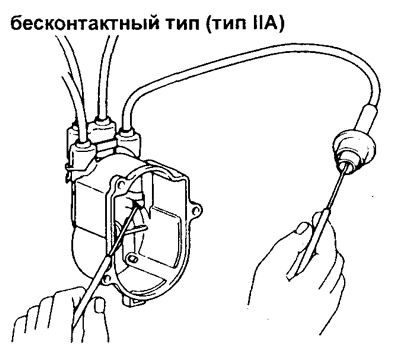 |
Checking spark plugs (with conventional electrodes)
Spark gap size:
- standard candle - 0.8 mm
platinum candle:
- nominal - 1.1 mm
- maximum permissible - 1.3 mm
1. Remove the spark plugs.
2. Clean the spark plugs with a cleaner or a metal brush.
3. Visually inspect the spark plugs for electrical erosion of the electrodes, damage to the threads and insulator. If defects are found, replace the spark plugs.
4. Adjust the gaps between the spark plug electrodes. Gap: 0.8 mm.
5. Install the spark plugs.
- Tightening torque - 18 Nm
Checking spark plugs (with platinum electrodes)
Attention:
- Do not use a wire brush to clean spark plugs;
- Do not attempt to adjust the gap between the electrodes on the workbench (in operation) candles;
- Spark plugs should be replaced after 100,000 km.
1. Check the electrodes:
a) Using a megohmmeter (insulation resistance meter), check the insulation resistance, the value of which should be more than 10 MOhm. If the resistance is less, replace the spark plug.
b) If you don't have a megohmmeter, you need to quickly accelerate the engine to 4000 min'1 5 times. Then turn off the engine, remove the spark plugs and visually assess their condition:
- if the electrodes are dry, then everything is fine,
- if the electrodes are wet, clean the spark plug.
2. Remove the spark plugs.
3. Visually assess the condition of the spark plugs for damage to the insulator and threads. If defects are found, replace the spark plug.
- Spark plug brands: ND P16R
4. Check the gap between the electrodes.
- Maximum gap - 1.3 mm
If the gap is larger, replace the spark plug.
- The nominal gap on a new spark plug is 1.1 mm
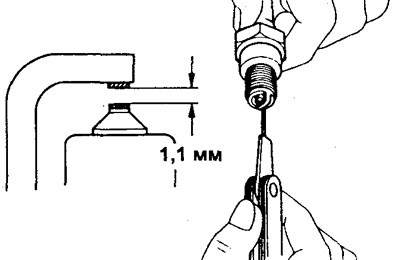
When adjusting the gap on a new spark plug, bend the side electrode by its base without touching the electrode.
5. Clean the spark plugs with gasoline and spark plug cleaner.
- Air pressure - up to 6 kg/cm² (588 kPa)
- Cleaning duration - up to 20 sec
6. Install the spark plugs.
- Tightening torque - 18 Nm
Checking the ignition coil (contact ignition system)
1. Disconnect the high-voltage wire.
2. Using an ohmmeter, check the resistance of the primary winding at the (+) and (-) terminals.
- The resistance of the primary winding (cold) should be within the range: 1.3-1.6 Ohm
Otherwise, replace the ignition coil.
3. Check the resistance of the secondary winding by connecting an ohmmeter to the (+) terminal and the high-voltage terminal. The resistance of the secondary winding (cold) should be within 10.7-14.5 kOhm. Otherwise, replace the ignition coil.
4. Check the resistance of the additional resistor (installed on the ignition coil). The resistance value should be within 1.3-1.5 Ohms. Otherwise, replace the resistor.
5. Check the insulation resistance between the positive terminal of the ignition coil and the ignition coil housing with an ohmmeter. The resistance should be equal to infinity.
6. Check the power line.
a) With the ignition on, use a voltmeter to check for voltage at the terminal of the additional resistor by connecting the positive (+) terminal of the voltmeter to the resistor terminal (black and red wire), and the negative (-) terminal of the voltmeter to ground (-). The voltage should be approximately 12 V.
b) After starting the engine, use a voltmeter to check for voltage between the (+) terminal of the ignition coil and the ground (-). The voltage should be approximately 12 V.
If there is a fault, check the ignition switch and wiring harness.
Table 1.
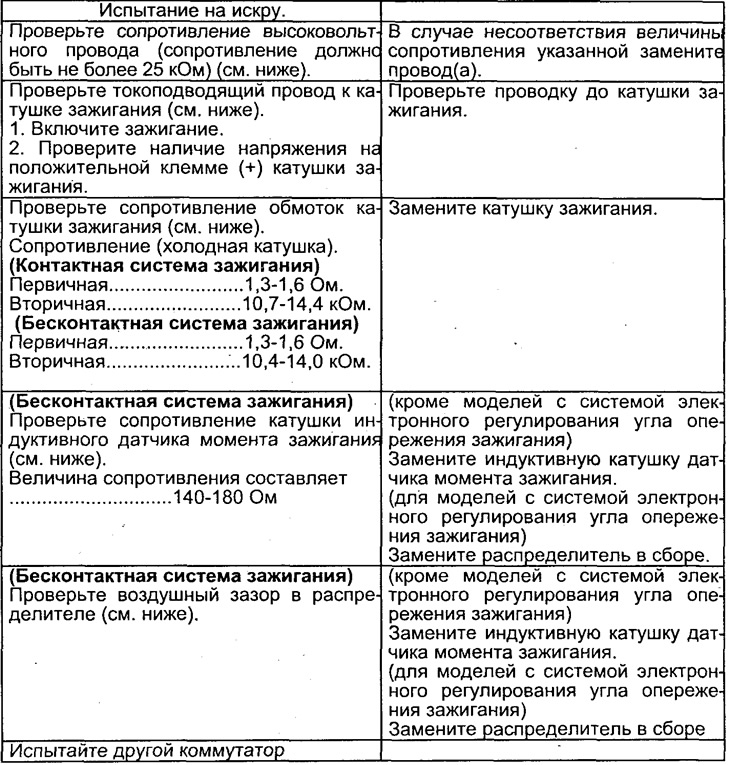
Table 2.

Checking the ignition coil (electronic ignition system)
1. Remove the distributor cap, distributor rotor and dust deflector.
2. Check the resistance of the primary winding of the ignition coil at terminals (+) and (-).
- Primary winding resistance value (cold): 1.3-1.6 Ohm
3. Check the resistance of the secondary winding between the (+) terminal and the high voltage terminal.
- Secondary winding resistance value (cold): 10.4-14.0 kOhm
If the resistance value of the primary or secondary windings of the ignition coil is outside the specified limits, replace the ignition coil.
Checking the switch (electronic ignition system)
(See spark plug testing procedure).
Checking the distributor (contact ignition system)
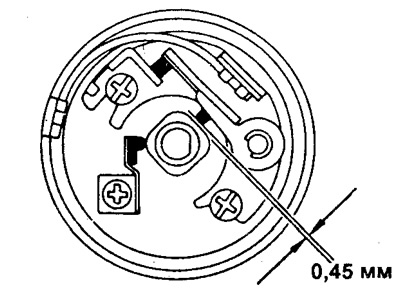
1. Check the contact group by measuring the gap between the cam and the plastic tappet with a feeler gauge. The gap should be about 0.45 mm. Adjust if necessary.
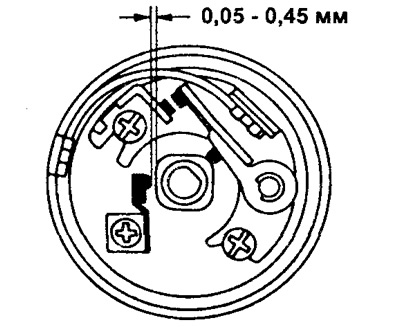
2. Check the damping spring by measuring the gap between the cam and the damping spring with a feeler gauge. The gap should be within 0.05-0.45 mm.
If the gap is outside this range, adjust it.
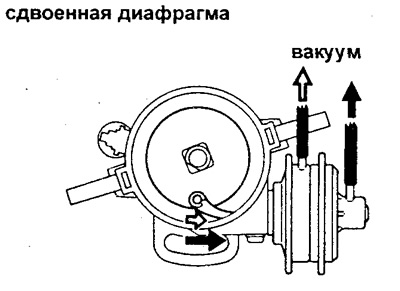
3. Check the vacuum regulator of the ignition timing angle.
[The article is taken from a web resource ToyotaMan]
a) Disconnect the distributor vacuum tube and connect it to the vacuum pump.
b) Apply vacuum and check the vacuum regulator for mobility. If the vacuum regulator does not work, repair or replace it.
4. Check the centrifugal ignition timing regulator.
a) Turn the rotor clockwise and make sure that the rotor quickly returns to its original counterclockwise position.
b) The rotor must have a tight (without play) fit on the drive shaft.
Checking the distributor (contactless ignition system)
1. Use a feeler gauge to check the air gap between the ignition timing sensor rotor and the inductive coil of this sensor. The gap should be within 0.2-0.4 mm. If the gap is outside the specified limits, replace the torque sensor assembly.
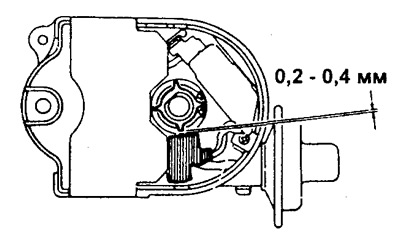
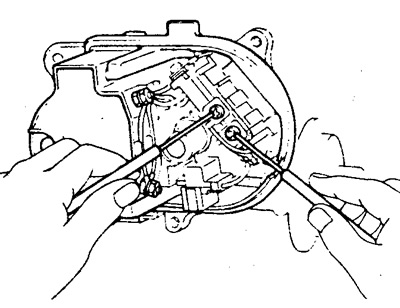
2. Check the ignition timing sensor coil with an ohmmeter as shown in the figure. Coil resistance: 140-180 ohms. Otherwise, replace the ignition timing sensor coil.
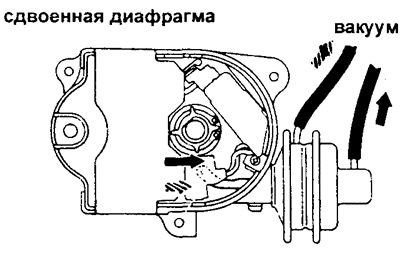
3. Check the vacuum regulator of the ignition timing angle.
a) Disconnect the distributor vacuum hose and connect it to the vacuum pump.
b) Create a vacuum and check the mobility of the vacuum regulator.
If the vacuum regulator does not work, replace the regulator.
4. Check the centrifugal ignition timing regulator.
a) Turn the rotor clockwise, release it and check that the rotor quickly returns to its original counterclockwise position.
b) The rotor must have a tight (without play) fit on the drive shaft.