



Disassembly
1. Remove the carburetor.
2. Remove the intake and exhaust manifolds.
3. If necessary, separate the intake and exhaust manifolds by loosening and removing the connecting bolts.
4. Remove the valves: Using a puller, compress the valve spring and remove the two crackers; then remove the valve plate (or valve rotator), spring, spring seat, valve and oil deflector cap. Arrange the removed parts so that they are not mixed up during installation.
5. If necessary, remove the following parts:
a) Coolant drain pipe.
b) Heater outlet pipe.
c) Rear flange of the cylinder head.
Checking and cleaning parts and elements of the cylinder head
1. Clean the piston bottoms and the block joint plane.
a) Turn the crankshaft and bring each piston to TDC. Use a scraper to clean the piston bottoms.
b) Remove any remaining gasket from the block connector.
c) Blow out the oil passages and bolt holes with compressed air.
Warning: When using compressed air, wear eye protection.
2. Use a scraper to remove any remaining gaskets from the cylinder head and manifold surfaces.
Caution: Do not damage the surfaces being cleaned.
3. Use a wire brush to remove any remaining deposits from the combustion chamber surfaces, being careful not to damage the cylinder head joint surface.
4. Clean the valve guide holes.
5. Using a soft brush and solvent, thoroughly clean the cylinder head.
Caution: Do not wash the head in hot solvents as this may damage the part.
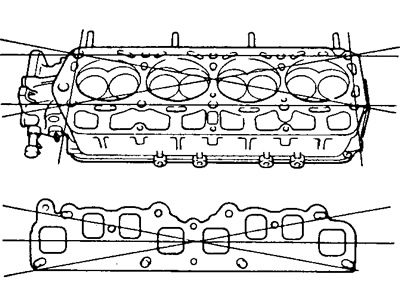
6. Using a precision ruler and feeler gauges, check the flatness of the cylinder head joints along the lines indicated in the figure. Maximum out-of-flatness:
- By gas joint connector - 0.15 mm
- By the connector of the intake and exhaust manifolds - 0.10 mm
If the measured value is greater than the specified maximum, replace the head or regrind its surface (but not more than 0.30 mm).
7. Using penetrating dye, check the combustion chambers, intake and exhaust ports, and the parting surfaces for cracks. If cracks are present, replace the head.
8. Use a scraper and wire brush to remove carbon deposits from the valve head.
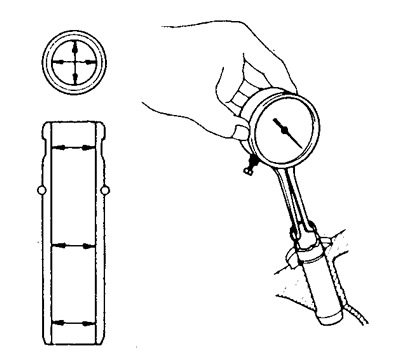
9. Using a bore gauge, measure the diameters of the valve guide holes.
- Inner diameter of valve guide bushings - 8.010 - 8.030 mm
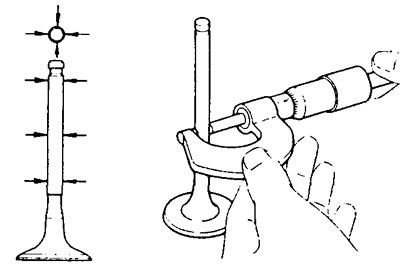
Using a micrometer, measure the valve stem diameters at three different levels.
Valve stem diameters:
- Intake - 7.970 - 7.985 mm
- Graduation - 7.965 - 7.980 mm
By subtracting the obtained values of the valve stem diameters from the corresponding values of the diameters of the holes in the guide bushings, determine the amount of clearance in the bushings.
Nominal clearance value:
- inlet valve - 0.025 - 0.060 mm
- exhaust valve - 0.030 - 0.065 mm
Maximum allowable gap size:
- inlet valve - 0.10 mm
- exhaust valve - 0.12 mm
10. If necessary, replace the guide bushing.
a) Using a rod and hammer, loosen the guide bushing, first making sure that the bushing retaining ring has been removed.
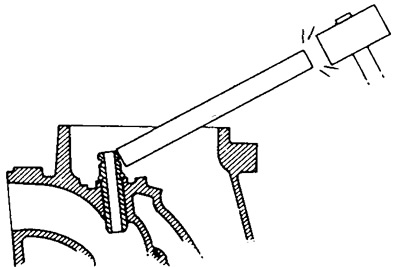
b) Slowly heat the cylinder head in a water bath to a temperature of 80-100°C.
c) Using a punch and a hammer, knock out the guide bushing.
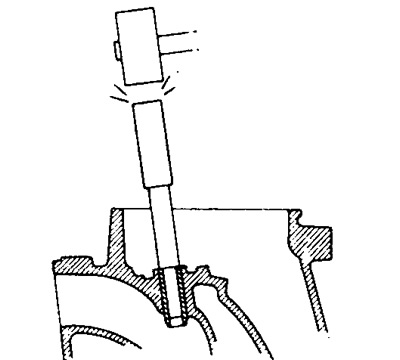
d) Using a bore gauge, measure the hole in the cylinder head for the guide bushing.
d) Select a new bushing of the nominal (STD) or oversize (O/S) size increased by 0.05 mm.
If the hole for the bushing in the cylinder head is larger than 13.027 mm, then drill the hole to the repair size (13,050-13,077 mm).
If the bore exceeds 13.077 mm, replace the cylinder head.
e) Slowly heat the cylinder head to 80-100°C.
g) Using a drift and hammer, press in the new valve sleeve until the snap ring seats.
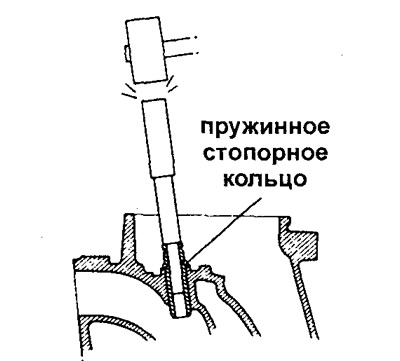
h) Using an 8mm reamer, ream the bushing hole until the recommended clearance "bushing hole - new valve diameter" is obtained.
(The original is published on the website: ToyotaMan)
11. Check and polish the valves.
a) Grind the valve chamfer until all traces of wear and carbon deposits are removed.
b) Check the angle of the valve working chamfer (44.5°).
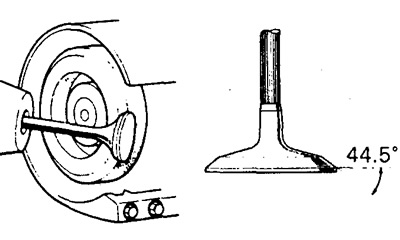
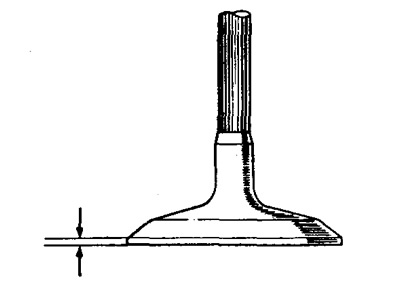
c) Check the thickness of the valve plate belt.
The nominal value of the valve plate belt thickness is:
- For the inlet valve - 1.0-1.4 mm
- For the exhaust valve - 1.3-1.7 mm
The minimum value of the valve plate belt thickness is:
- For the inlet valve - 0.5 mm
- For the exhaust valve - 0.8 mm
If the minimum belt thickness is less than the specified values, replace the valve.
d) Check the overall length of the valve. The nominal and minimum values of the valve length are:
- For intake - 108.2 mm and 107.7 mm
- For exhaust - 108.5 mm and 108.0 mm
If the valve length is less than the minimum, replace the valve.
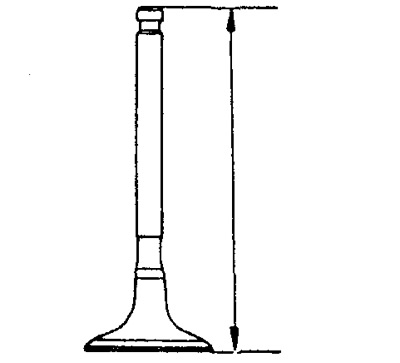
d) If the end of the valve stem is worn, grind the end until the wear marks are removed or replace the valve.
12. Check and clean the valve seats.
a) Using a 45° cutter, machine the valve seats.
b) Check the valve seat. Apply a thin coat of paint (white lead) on the valve chamfer, place the valve and press it lightly, but do not rotate it.
c) Check the valve and seat:
If the paint mark appears on all 360° of the valve seat, then the valve head and seat are concentric.
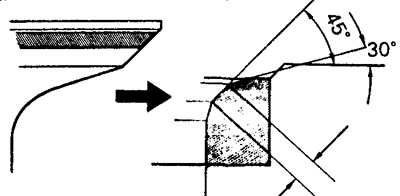
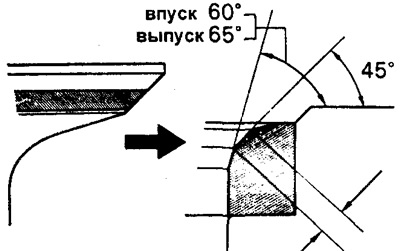
If not, regrind the seat. Check the contact mark in the middle of the valve chamfer:
Contact width 1.2-1.6 mm for intake and exhaust valves.
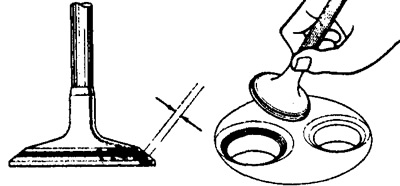
If necessary, make adjustments as follows:
(1) If the contact mark is too high on the valve chamfer, use 30° and 45° cutters to adjust the contact mark.
(2) If the contact mark is located too low on the valve chamfer, 60° and 45° cutters for the intake valve and 65° and 45° cutters for the exhaust valve must be used to correct the valve seat.
d) Grind the valve to the seat using abrasive paste.
d) After lapping, clean (wash) the valve and seat from abrasive.
13. Check the valve springs.
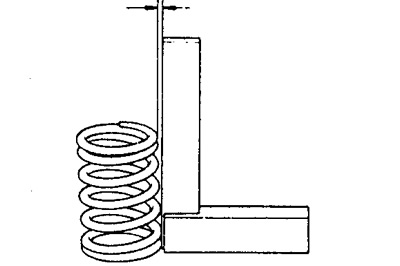
a) Using a square, check the valve springs for non-perpendicularity.
- Maximum non-perpendicularity - 2 mm
If the non-perpendicularity values are large, replace the valve spring.
b) Using a caliper, measure the length of the spring in its free state.
- Spring length - 47.0 mm
If the spring length differs from the specified value, replace the spring.
c) Using a spring tester, measure the force required to compress the spring to 40.6 mm:
- Force - 282-345 N
If the measured value is outside the permissible range, replace the spring.
14. Check the rocker arm and rocker shaft.
a) Check the condition of the rocker arm working surface in contact with the valve stem.
b) Check the clearance between the rocker arm and the rocker arm shaft by moving the rocker arm as shown in the figure.
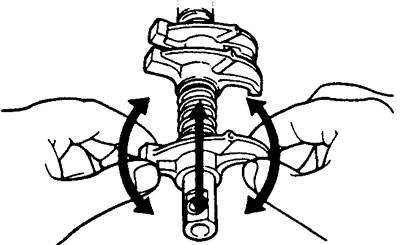
If movement is felt, disassemble the rocker arm assembly and inspect it.
c) Disassemble the rocker arm assembly with the axle, arranging the rocker arms in the appropriate order. If wear is visible on the contact surface of the rocker arm strikers, remove the wear marks with a grinder or replace the rocker arm.
d) Check the clearance between the rocker arm shaft and the rocker arm:
Using a bore gauge, measure the inside diameter of the rocker arm.
- Nominal - 18.500 - 18.515 mm
Using a micrometer, measure the rocker arm shaft diameter.
- Nominal - 18.474 - 18.487 mm
By subtracting the rocker arm shaft diameter from the rocker arm hole diameter, determine the clearance.
- standard - 0.013-0.041 mm
- maximum allowable - 0.08 mm
If the clearance exceeds the maximum value, replace the rocker arm and axle.
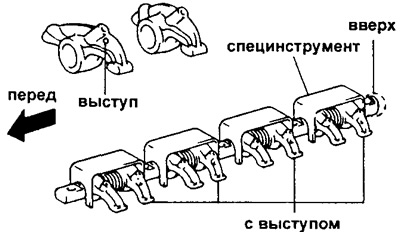
d) Assemble the "rocker arm - rocker arm axle" unit.
Make sure the rear end of the rocker arm shaft is positioned correctly, assemble the rocker arms and springs as shown and hold them together with the special tool.
15. Check the push rods.
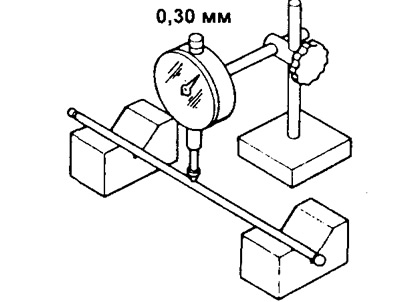
a) Place the bars on the prisms.
b) Using an indicator, check the straightness of the rods.
Maximum deviation from straightness 0.30 mm.
If the deviation is greater, replace the rod.
Check the oil hole of the rod. If the hole is clogged, blow it out with compressed air.
16. Check the intake and exhaust manifolds. Using a precision ruler and feeler gauge, check for warpage (non-flatness) contact surfaces of collectors.
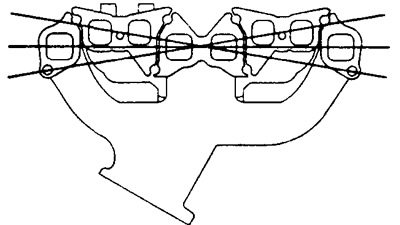
- The maximum permissible flatness is 0.40 mm
If the values of this indicator are high, replace the manifold.