



a) Turning the crankshaft, set the pistons in sequence to TDC. Use a scraper to clean the surfaces of the piston bottoms from carbon deposits.
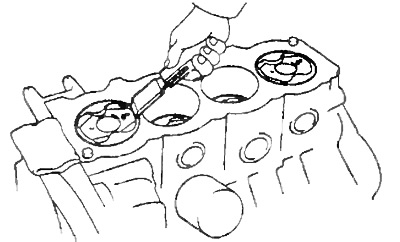
b) Use a scraper to remove the remaining cylinder head gasket from the cylinder block joint surface.
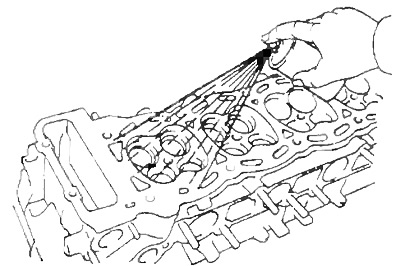
c) Use compressed air to remove carbon deposits and head gasket residue from surfaces and bolt holes.
Note: When using compressed air, be careful not to get dirt particles into your eyes.
2. Clean the cylinder head.
a) Clean the cylinder head surface from any remaining cylinder head gasket.
Note: Be careful not to damage the cylinder head gasket mating surfaces.
b) Clean the surfaces of the combustion chambers of the cylinder head with a wire brush, removing any remaining carbon deposits.
c) Clean the cylinder head guide bushing holes with a brush and solvent
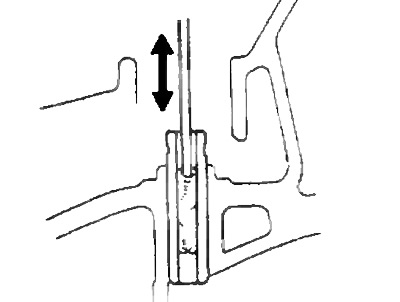
d) Clean the surface of the cylinder head (mating with the cylinder block surface), using a soft brush and solvent.
3. Check the cylinder head.
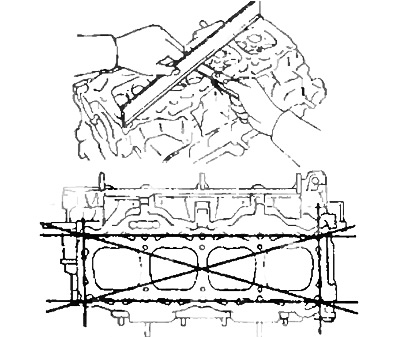
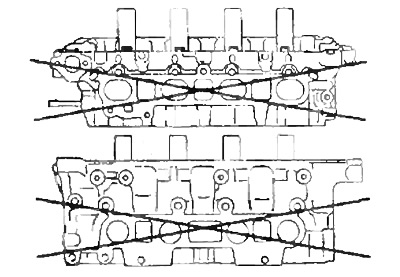
a) Using a precision ruler and a flat feeler gauge, as shown in the figure, check the non-flatness of the working surfaces of the cylinder head that are mated:
- with the surface of the cylinder block.
- with the surfaces of the inlet and outlet pipelines.
 |  |
d) Clean the surface of the cylinder head (mating with the cylinder block surface), using a soft brush and solvent.
3. Check the cylinder head.
a) Using a precision ruler and a flat feeler gauge, as shown in the figure, check the non-flatness of the working surfaces of the cylinder head that are mated:
- with the surface of the cylinder block.
- with the surfaces of the inlet and outlet pipelines.
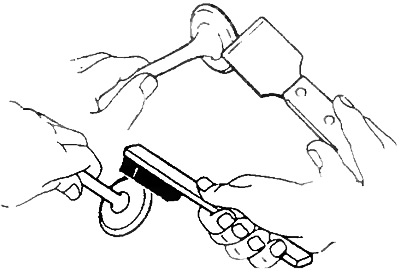
4. Clean the valves.
a) Use a scraper to remove carbon deposits from the valve plate.
b) Use a brush to finally clean the valve.
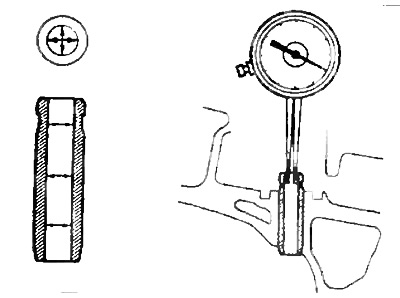
5. Check the valve stem diameters and the inside diameters of the valve guides*.
a) Using a bore gauge, measure the inner diameter of the valve guide bushings.
Inner diameter of the bushing:
- 3S-FE, 4S-FE - 6.010 - 6.030 mm
- ZS-T - 8.010 - 8.030 mm
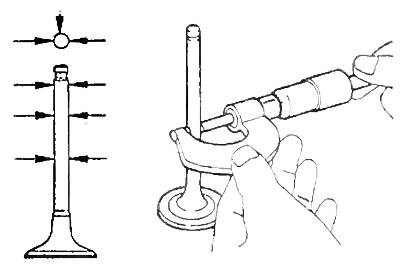
b) Use a micrometer to measure the diameter of the valve stem.
Valve stem diameter:
inlet valve:
- 3S-FE, 4S-FE - 5.970 - 5.985 mm
- ZS-T — 7.975 -7.990 mm
exhaust valve:
- 3S-FE, 4S-FE - 5.965 - 5.980 mm
- ZS-T - 7.960 - 7.975 mm
c) Using the difference in measurements of the valve stem diameter and the inner diameter of the guide bushing, find the gap between the valve stem and its guide.
Nominal clearance:
inlet valve:
- 3S-FE, 4S-FE - 0.025 - 0.060 mm
- ZS-T - 0.020 - 0.055 mm
exhaust valve:
- 3S-FE, 4S-FE - 0.030 - 0.065 mm
- ZS-T - 0.035 - 0.070 mm
Maximum clearance:
- inlet valve - 0.08 mm
- outlet - 0.10 mm
If the clearance is greater than the maximum allowable, replace the valve and guide bushing.
6. If necessary, replace the valve guides.
a) Gradually heat the cylinder head in a water bath to a temperature of 80 - 100°C.
b) Using a punch and hammer, press out the guide bushing.
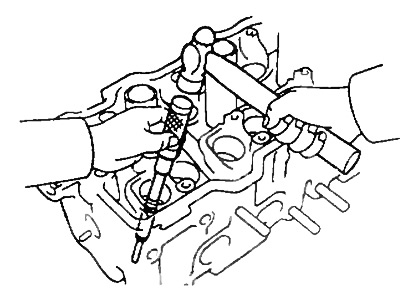
c) Use a bore gauge to measure the diameter of the bore for the guide in the cylinder head housing.
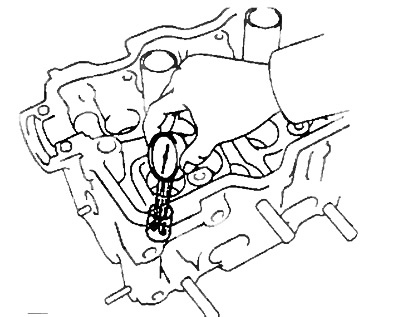
Nominal diameter (in a cold state):
- 3S-FE, 4S-FE - 10.985 - 11.012 mm
- ZS-T - 13,000-13,027 mm
If the diameter of the hole for the guide in the cylinder head housing does not exceed:
- 3S-FE, 4S-FE — 11.012 mm
- ZS-T - 13.027 mm
Use a guide with a standard outside diameter.
If the diameter of the guide hole in the cylinder head housing exceeds the specified size, bore the hole to the size:
- 3S-FE, 4S-FE - 11.035 - 11.062 mm
- ZS-T - 13.027 - 13.050 mm
and use a guide with an outside diameter increased by 0.05 mm.
If the diameter of the hole for the guide in the cylinder head housing exceeds:
- 3S-FE, 4S-FE — 11,062 mm
- ZS-T - 13.027 mm
Replace the cylinder head.
Select the size of the outer diameters of the inlet and outlet valve bushings depending on the diameters of the holes for the guides.
Guide bushing diameter:
Standard:
- 3S-FE, 4S-FE - 11.033 - 11.044 mm
- ZS-T - 13.040-13.051 mm
Repair:
- 3S-FE, 4S-FE - 11.083 - 77.094 mm
- ZS-T - 13.090-13.101 mm
Note: on the ZS-T engine, the guide bushings of the intake and exhaust valves have different lengths.
Guide bushings:
ZS-T
- intake valves - 46.0 mm
- exhaust valves - 50.0 mm
3S-FE - 41.96 mm
4S-FE — 45,40
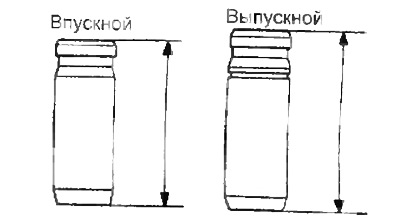
ZS-T
d) Heat the cylinder head in a water bath at a temperature of 80-100°C.
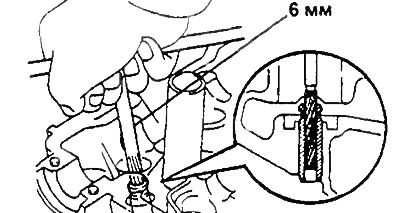
e) Install the valve guide. Using a drift and hammer, install the new valve guide so that it protrudes from the cylinder head by:
- 3S-FE, 4S-FE — 10.0 mm
- ZS-T — 17.3-18.1 mm
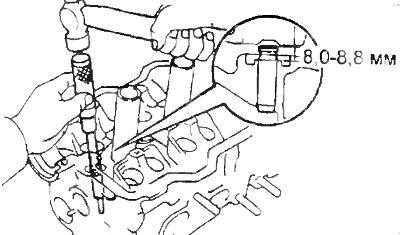
d) Heat the cylinder head in a water bath at a temperature of 80-100°C.
e) Install the valve guide. Using a drift and hammer, install the new valve guide so that it protrudes from the cylinder head by:
- 3S-FE, 4S-FE — 10.0 mm
- ZS-T — 17.3-18.1 mm
7. Check and grind the valves.
a) Grind the valves until all traces of carbon and scratches are removed.
b) Ensure that the lapped face of the valve forms an angle of 45° relative to the plane perpendicular to the axis of the stem.
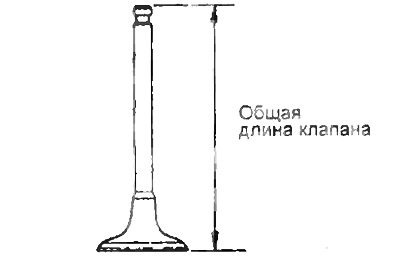
c) Check the overall length of the valve.
Nominal length:
Inlet valve:
- 3S-FE — 97.60 mm
- 4S-FE — 100.60 mm
- ZS-T - 105.70 mm
Exhaust valve:
- 3S-FE - 98.45 mm
- 4S-FE — 100.45 mm
- ZS-T - 105.35 mm
Minimum length:
Inlet valve:
- 3S-FE - 97.10 mm
- 4S-FE — 100.10 mm
Exhaust valve:
- 3S-FE - 98.00 mm
- 4S-FE - 99.95 mm
If the overall length is less than the minimum allowable length, replace the valve.
d) Check the condition of the end surface of the valves for wear.
If the valve end is worn, regrind the end or replace the valve.
Note: When regrinding, do not allow the overall length of the valve to be reduced beyond its minimum permissible value.
8. Check and clean the valve seats.
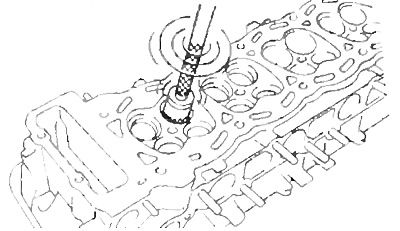
a) Using a carbide bur with a 45° cone angle, grind the valve seats, removing a minimum layer of metal only to clean the working chamfers of the seats.
b) Check that the valve is seated correctly in the seat.
Apply a thin layer of white paint to the valve face. Press the valve face against the seat, but do not rotate the valve. Then remove the valve and inspect the seat and valve face.
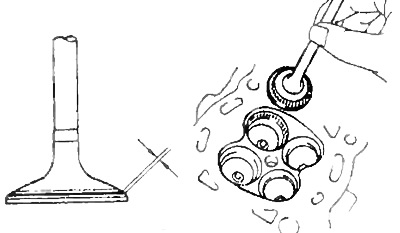
If paint remains around the entire circumference (360°) of the valve bevel, the valve is concentric. Otherwise, replace the valve.
If the paint shows up all the way around (360°) the valve seat, the valve guide (bushing) and valve seat are concentric. Otherwise, regrind the chamfer.
Make sure that the contact patch is in the middle of the valve working face and has a width of:
- 3S-FE, 4S-FE — 1.0-1.4 mm
- ZS-T - 1.2-1.6 mm
Otherwise, adjust the chamfer as follows:
If the contact patch is located too high on the valve chamfer, use 30° and 45° cone angle cutters to regrind the seat.
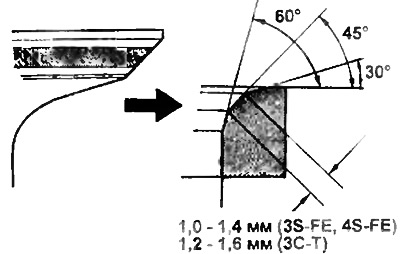
If the contact patch is located too low on the valve chamfer, use 60° and 45° cone angle cutters to regrind the seat.
d) Manually lap the valve and valve seat using abrasive paste.
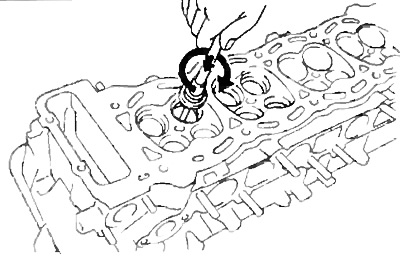
d) After lapping, clean the valve and valve seat.
9. Check the valve springs.
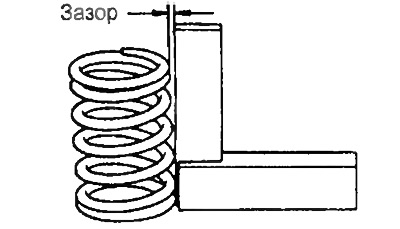
a) Using a metal square (90°), check the non-perpendicularity of the valve spring as shown in the figure.
The maximum permissible non-perpendicularity is 2.0 mm
b) Using a caliper, measure the free length of the spring in a free state:
Valve spring length:
- 3S-FE - 41.96 mm
- 4S-FE — 45.40 mm
- ZS-T - 47.50 mm
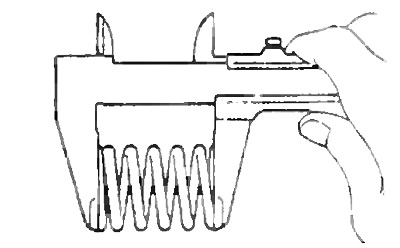
If the spring length differs from the nominal length, replace the valve spring.
10. Check the camshafts and bearings.
A. Check the camshaft for bending.
a) Place the camshaft on the prisms.
b) Using a dial indicator, check the runout of the camshaft relative to the center journal.
Nominal runout:
- 3S-FE, 4S-FE - 0.020-0.200 mm
Maximum runout:
- 3S-FE, 4S-FE — 0.03 mm
- ZS-T - 0.06 mm
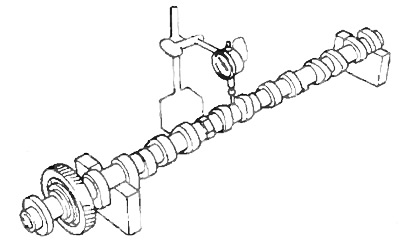
If the runout exceeds the permissible value, replace the camshaft.
B. Check the camshaft lobe height by measuring it with a micrometer.
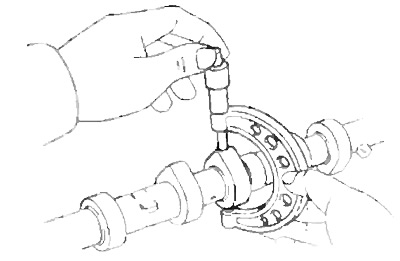
Nominal height of intake camshaft cams:
- 3S-FE — 42.01 -42.11 mm
- 4S-FE — 34.91-35.01 mm
- ZS-T - 47.40 mm
Nominal height of intake camshaft cams:
- 3S-FE — 42.01 -42.11 mm
- 4S-FE — 34.91-35.01 mm
- ZS-T - 47.40 mm
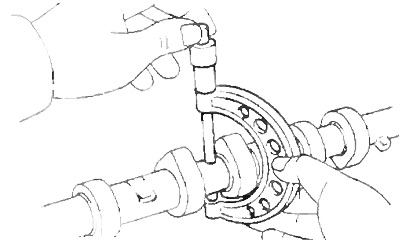
If the journal diameters are outside the limits specified in the specifications, check the oil clearance between the journal and the bearing
D. Check the condition of the camshaft bearings for chipping and scratches on their surfaces. If the above defects are present, replace the bearing caps or the cylinder head assembly.
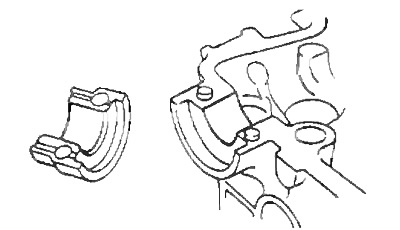
D (3S-FE, 4S-FE) Check the condition of the camshaft gear leaf spring by measuring the clearance of its lock in a free state.
Clearance in free position - 22.5 - 22.9 mm
If the clearance of the lock in the free state is outside the specified limits, replace the pinion leaf spring.
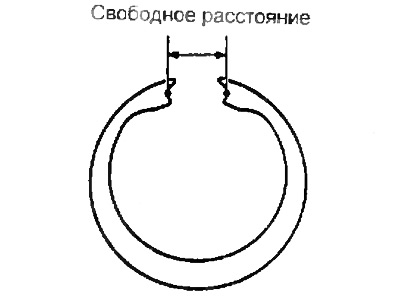
E. Check the radial clearance in the camshaft bearings.
a) Clean the working surfaces of the camshaft journals and bearing caps.
b) Place the camshafts in the cylinder head beds.
c) Place a piece of plastic gauge on each camshaft journal.
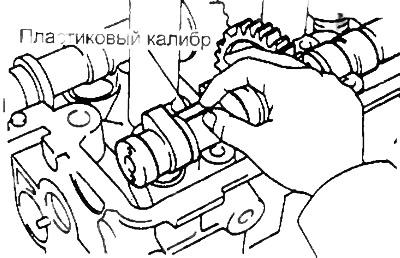
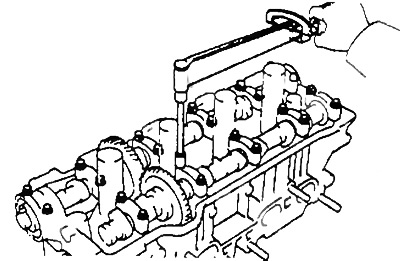
Note: (ZS-T) Tighten the bolts in three stages, starting from the inside.
d) Install the bearing caps. Tighten the cap bolts.
- Tightening torque - 18 Nm
Note: Do not turn the camshaft.
d) Remove the bearing caps.
e) Measure the width of the flattened plastic gauges at their widest part and calculate the gap.
Radial clearance in camshaft bearings:
Nominal:
- 3S-E, 4S-E - 0.025 - 0.062 mm
- ZS-T - 0.037 - 0.073 mm
Maximum allowed:
- 3S-E, 4S-E — 0.1 mm
If the clearance is greater than the maximum allowable, replace the camshaft. If necessary, replace the bearing caps and cylinder head.
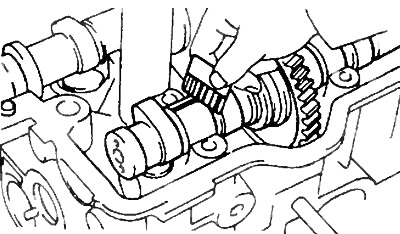
g) Remove any remaining plastic gauges.
G. Check the axial clearance of the camshaft.
a) Install the camshaft in the cylinder head bed.
b) Using a dial indicator, measure the axial clearance when moving the camshafts back and forth.
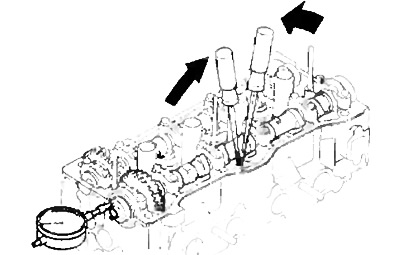
Axial clearance of camshafts:
3S-FE, 4S-FE:
Nominal:
- intake valves - 0.045 -0.100 mm
- exhaust valves - 0.030 - 0.085 mm
Maximum allowable.
- intake valves - 0.12 mm
- exhaust valves - 0.10 mm
ZS-T:
- nominal - 0.080 -0.18 mm
- maximum allowable - 0.25 mm
If the axial clearance is greater than the maximum allowable, replace the camshaft. If necessary, replace the bearing caps and cylinder head.
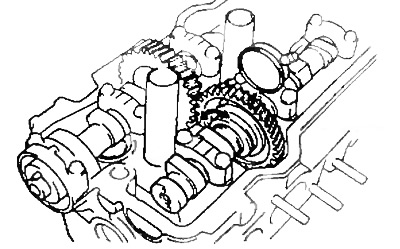
3. (3S-FE, 4S-FE) Measure the clearance in the camshaft gear engagement.
a) Install both camshafts into the cylinder head without installing the exhaust camshaft drive auxiliary gear.
b) Use a dial indicator to measure the clearance in the gear engagement.
- Nominal clearance - 0.020 - 0.200 mm
- Maximum clearance - 0.300 mm
If the clearance is greater than maximum, replace the camshafts.
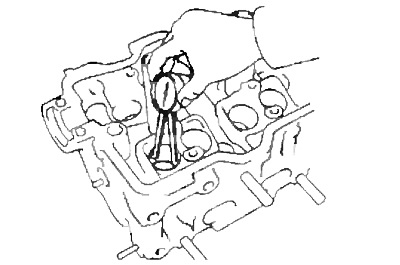
11. Check the tappets and tappet holes in the cylinder head housing.
a) Using a bore gauge, measure the diameters of the tappet holes in the cylinder head.
The diameter of the hole for the tappet in the cylinder head:
- 3S-FE - 28,000 - 28,021 mm
- 4S-FE - 28,000 - 28,021 mm
- ZS-T — 37,960 - 37,975
b) Use a micrometer to measure the diameter of the tappet.
Pusher diameter:
- 3S-FE - 27.975 - 27.965 mm
- 4S-FE - 27.975 - 27.985 mm
- ZS-T - 37,922 - 37.932 mm
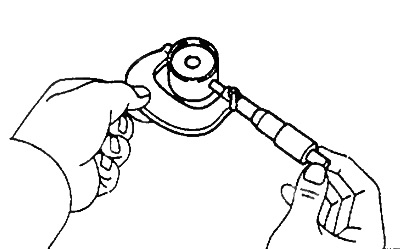
c) Check the oil clearance. Subtract the tappet diameter from the tappet hole diameter in the head housing to determine the clearance.
Clearance between the pusher and the wall of the pusher hole:
Nominal
- 3S-FE, 4SF-E - 0.02 - 0.05 mm
- ZS-T - 0.028 - 0.053 mm
Maximum
- 3S-FE, 4SF-E — 0.07 mm
- ZS-T - 0.10 mm
If the clearance exceeds the maximum allowable, replace the tappet. If necessary, replace the cylinder head.
12. Using a precision straightedge and a flat feeler gauge, check the contact surfaces of the manifolds for non-flatness of the mating surfaces.
Maximum non-flatness:
- 3S-FE, 4S-FE — 0.08 mm
- ZS-T - 0.20 mm