Company Honda Company Ford Company Skoda Company Kia Company Mazda Company Mercedes Company Renault
English Русский
Български
Беларускі
Український
Српски
Hrvatski
Română
Polski
Slovenský
Magyar
Bookmark Articles Sitemap Contacts
ToyotaMan.ru


Camry Corolla Corona Carina Land Cruiser Highlander 4Runner RAV4 Others
Cruiser 100 (1998-2007) Cruiser 60/80 (1980-1997, petrol) Cruiser 70 (1985-1996, diesel)

Checking the cylinder block [Toyota Land Cruiser J70]

  • Main
  • Land Cruiser
  • J70 (1985-1996)
  • Power unit
  • Engine repair
  • Checking the cylinder block
0
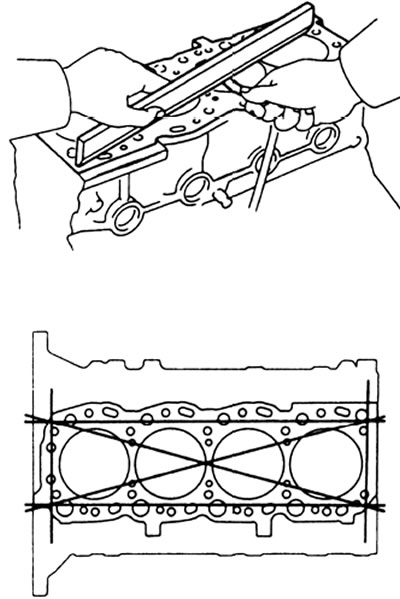
1. Using a scraper, remove all gasket material from the cylinder block surface.

2. Clean the cylinder block using a soft brush and solvent.

3. Check the warping of the plane of the cylinder block joint with the cylinder head.

Maximum warpage:
  • l series - 0.20 mm
  • kZ series - 0.10 mm

If the warpage exceeds the maximum permissible value, replace the cylinder block.


4. Check the cylinder mirror for vertical marks.

If there are deep scratches, bore all four cylinders. If necessary, replace the cylinder block.

5. Control of cylinder diameter.

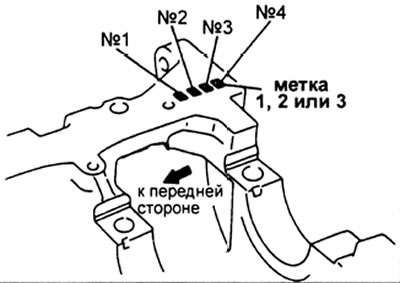
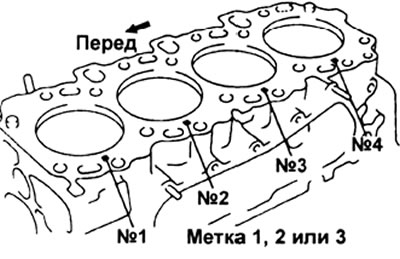
Note: There are three standard cylinder diameter sizes, labeled "1", "2" and "3" respectively. The markings are stamped on the lower left side of the rear side of the cylinder block (L series) or on the mating surface (KZ series).


L-series engines


KZ series engines


Using a bore gauge, determine the cylinder diameter at positions A, B and C in the axial and transverse directions.
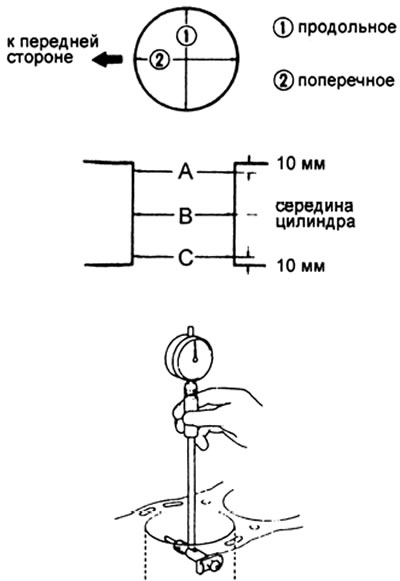


Nominal diameter:

Engines 2L, 2L-T:
  • Marking "1" - 92.00-92.01 mm
  • Marking "2" - 92.01 - 92.02 mm
  • Marking "3" - 92.02 - 92.03 mm

Engine 3L and 1KZ-T:
  • Marking "1" - 96.00-96.01 mm
  • Marking "2" - 96.01 - 96.02 mm
  • Marking "3" - 96.02 - 96.03 mm

Maximum allowable diameter:
  • Engines 2L, 2L-T - 92.23 mm
  • Engine 3L and 1KZ-T - 96.23 mm

Repair, increased by 0.50 mm:
  • Engines 2L, 2L-T - 92.73 mm
  • Engine 3L - 96.73 mm

If the diameter exceeds the maximum permissible value, then bore all four cylinders. If necessary, replace the cylinder block.

6. Removing the wear groove.

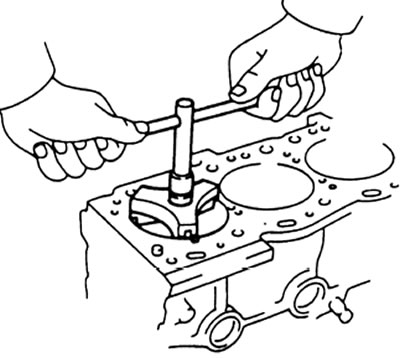
If the wear is less than 0.2mm, use a reamer to remove the groove at the top of the cylinder.


7. (Only 1 KZ-T) Checking the main bearing bolts.

Measure the thread diameter of the bolt at several points along its length.

Nominal diameter - 13.5-14.0 mm

Minimum diameter - 12.6 mm

If the thread diameter is less than the permissible value, replace the bolt.

8. Check for a flow section in the block jet, clean if necessary.

(The original can be viewed on the website: www.ToyotaMAN.ru)
This article is available at: russian, bulgarian, belarusian, ukrainian, serbian, croatian, romanian, polish, slovak, hungarian
The article material has been checked: Mitrofanova Elena
Share information:
◀ Previous
Cruiser 70: Engine repair
Next ▶

Disassembling the cylinder block
Preparing for disassembling the cylinder block
Engine reassembly
Installing the cylinder head
Cylinder head assembly
Disassembling the piston and connecting rod
Assessment of the technical condition of connecting rods, pistons and…
Checking balance shafts (KZ series only)
Cylinder boring
Crankshaft condition monitoring and repair
Similar articles on other Toyota models

➥ Cylinder Block — Cleaning and Checking Toyota Camry XV20 (1996-2001)
➥ Checking the cylinder block for deformation Toyota Corolla Verso 3 (2004-2009)
➥ Checking the cylinder block Toyota Corona T190 (1992-1997)
➥ Checking the cylinder block Toyota Carina T190 (1992-1996)
➥ Cylinder Block — Cleaning and Checking Toyota 4Runner N120 (1989-1995)
➥ Checking the cylinder block Toyota Duet (1998-2004)
Link in different formats to this article
Comments and feedback from visitors
No comments yet


Add two numbers 37 + 25


Cruiser 100 (1998-2007) 
  • General information
  • Introduction to the guide
  • Controls and instruments
  • Maintenance
  • Power unit
  • Petrol engines
  • Diesel engines
  • Cooling and heating
  • Power and exhaust systems
  • Engine electrical equipment
  • Engine management systems
  • Transmission
  • Automatic gearbox
  • Transmission line
  • Chassis, running gear
  • Brake system
  • Car suspension
  • Steering
  • Body and interior
  • Exterior (external elements)
  • Interior (internal elements)
  • Doors, locks and windows
  • Electrical equipment
  • Equipment and devices
  • Electrical circuits
Cruiser 60/80 (1980-1997, petrol) 
  • General information
  • User manual
  • Maintenance
  • Power unit
  • Petrol engines 2F and 3F-E
  • Petrol engines 1FZ-FE
  • Engine overhaul
  • Engine electrical equipment
  • Cooling and heating
  • Fuel system (carburetor)
  • Fuel system (injector)
  • Toxicity reduction system
  • Transmission
  • Car gearbox
  • Clutch
  • Transfer case
  • Drive shafts and axles
  • Chassis, running gear
  • Brake system
  • Car suspension
  • Steering
  • Body and interior
  • Exterior and interior
  • Doors, locks and windows
  • Electrical equipment
  • Equipment and devices
  • Electrical circuits
Cruiser 70 (1985-1996, diesel) 
  • General information
  • User manual
  • Maintenance
  • Power unit
  • Engine adjustment
  • Engine repair
  • Fuel system
  • Control system
  • Turbocharging system
  • Cooling and lubrication system
  • Charge and start system
  • Transmission
  • Clutch
  • Mechanical gearbox
  • Automatic gearbox
  • Transfer case
  • Chassis, running gear
  • Car suspension
  • Brake system
  • Steering
  • Body and interior
  • Body elements
  • Heating and air conditioning
  • Electrical equipment
  • Equipment and devices
  • Electrical circuits
ToyotaMan.ru © 2018–2026 • Mobile version • Interesting about Toyota • Administration • Sitemap: EN BG BY UA RS HR RO PL SK HU • Search system • Bookmark
Camry Vista-V40 • Camry XV10 • Camry XV20 • Camry XV30 • Corolla Verso-AR10 • Corolla E80 • Corona T190 • Carina T170 • Carina T190 • Land Cruiser J70 (diesel) • Land Cruiser J60 (petrol) • Land Cruiser J100 • Highlander XU20 (petrol) • 4Runner N120 • RAV4 XA10 • RAV4 XA20 • Duet M100 • Dyna Y50 •
We require cookies to enable some interactive features. Is that ok with you?