a) Press the brake pedal several times with the engine off and check that the pedal travel does not change.
b) Press the brake pedal and start the engine. If the brake pedal goes down smoothly, the vacuum booster is working.
2. Checking air tightness.
a) Start the engine and stop it after one or two minutes of operation. Slowly press the brake pedal several times. If the pedal drops lower on the first press than on the second and third press, the vacuum booster is sealed.
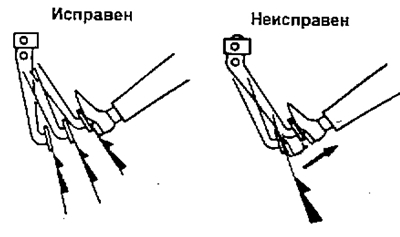
b) Press the brake pedal with the engine running and stop it with the pedal depressed. If the distance between the floor and the depressed pedal does not change within thirty seconds, the vacuum booster is sealed.
1. Checking with a tester.
a) Connect the pressure gauges and vacuum gauge as shown in the figure and remove air from the system.
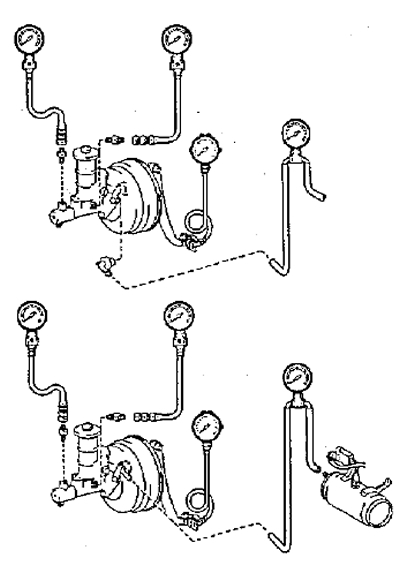
b) Check for leaks. Start the engine. Stop the engine when the vacuum is approximately 600 mm Hg.
After the engine stops, the vacuum does not drop for 15 seconds.
c) Check for leaks without load.
Start the engine and press the brake pedal with a force of 200 N. Stop the engine when the vacuum is approximately 500 mm Hg.
After stopping the engine, the vacuum drop will not exceed 25 mm Hg within 15 seconds.
d) Checking with the amplifier not working.
Stop the engine. Make sure the vacuum is 0 kPa. Check if the brake fluid pressure corresponds to the permissible values with a brake pedal force of 150 N and 300 N.
Permissible brake fluid pressure values:
with a pedal force of 150 N:
- 2WD models without ABS - 0.3-1.1 MPa
- other models - 0.1-0.9 MPa
with a pedal force of 300 N:
- 2WD models without ABS - 1.7-2.5 MPa
- 4WD models without ABS - 1.5-2.3 MPa
- models with ABS - 1.3-2.1 MPa
[The full article is posted on the website: toyotaman]
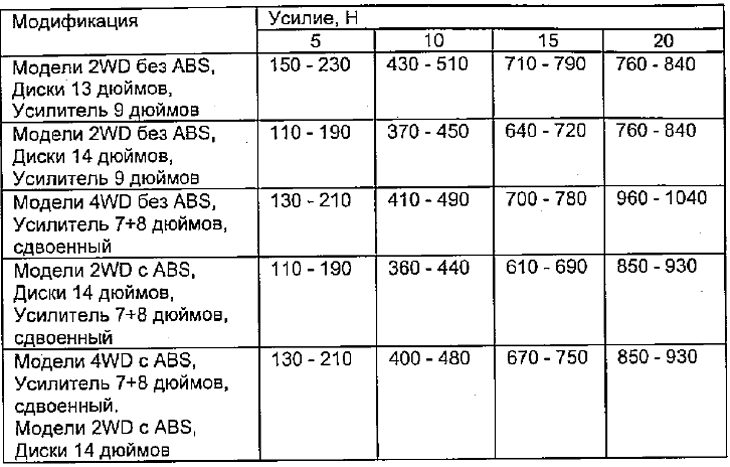
d) Checking the operation of the booster. Start the engine. Create a vacuum of 500 mm Hg. Check the pressure with different forces applied to the brake pedal (see the table "Permissible values of brake fluid pressure").