



Contents: Disc brake ↓ Drum brake ↓
Disc brake
Mark the position of the wheel disk relative to the hub so that when reassembling, the balanced wheel can be installed in its original place. Remove the wheel mounting nuts.
Place the car on a lift. Remove the wheels.
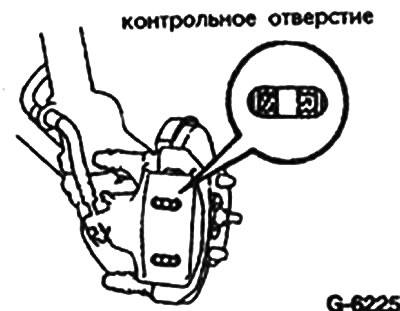
Visually check the thickness of the brake lining without removing it. In doubtful cases, remove the brake shoe and measure the thickness of the friction lining with a caliper.
The friction lining is considered worn out if its thickness has reached 1 mm (without regard to the basis).
If the lining is worn out, it must be replaced. In this case, all linings of one axle must be replaced.
Note: According to existing experience, 1 mm of worn lining thickness corresponds to a vehicle traveled 1000 km. However, this applies to severe operating conditions. Under normal conditions, linings last longer. With a lining thickness of 5.0 mm (with base) the brake pad remains functional for another 4000 km.
Install the wheels according to the markings. Remove the car from the lift and tighten the wheel with nuts crosswise with a force of 105 Nm.
Drum brake
Raise the rear.
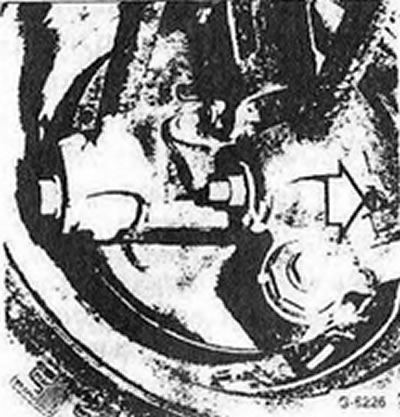
Remove the rubber covers from the inspection holes on the rear brake shields and illuminate them with a lamp. The lining is considered worn if its thickness is 1 mm (without reason). In doubtful cases, remove the brake drums and measure the thickness of the linings.
If the lining is worn, it must be replaced. All 4 linings on both wheels must be replaced.
Install the rear wheels, taking into account the markings. Remove the car from the lift and tighten the wheel nuts crosswise with a force of 105 Nm.