



Contents: General information ↓ Purpose of the main components ↓ Table 1.13. Purpose of the main…↓ Design and operating principle of…↓ Conditions for disabling the system ↓ Ultrasonic sensor buzzer ↓ Table 1.14. Operation of the sound…↓ Dependence of the buzzer signal…↓ Table 1.15. Buzzer sounding frequency ↓ Control lamp and switch for…↓ ECU of ultrasonic sensors ↓ Turning on the system ↓ Table 1.16. Sensor activation…↓ Initial check ("Self-diagnosis") ↓ Precautions when working with the…↓
General information
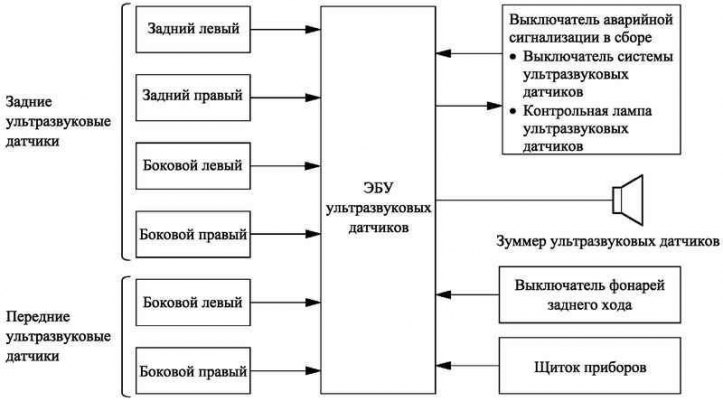
Fig. 1.30. Block diagram of the echo sounder system
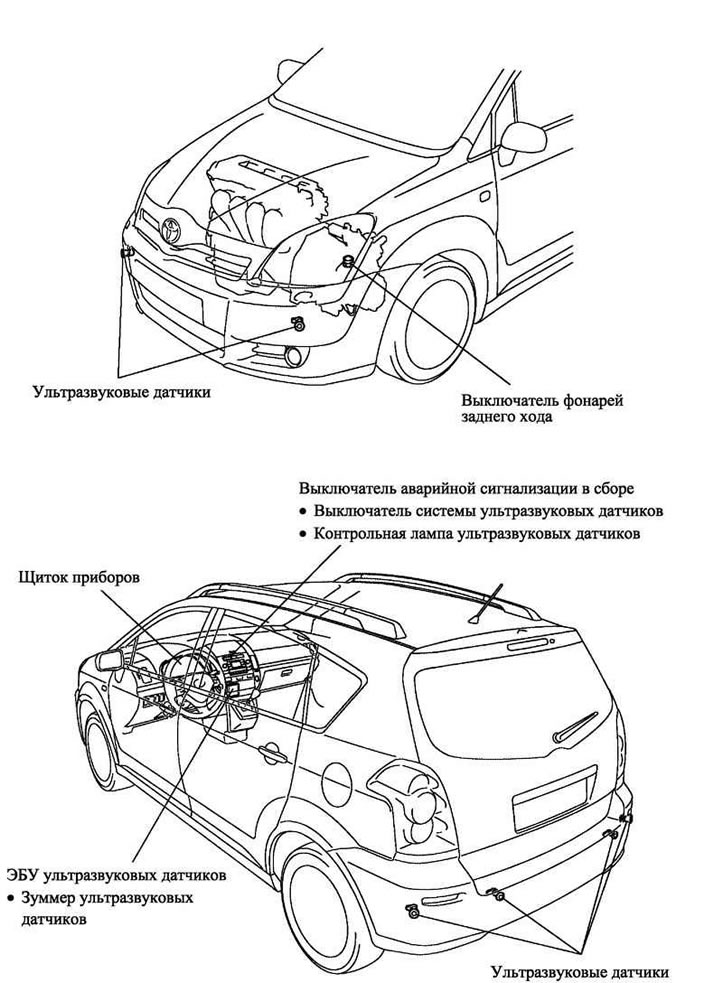
Fig. 1.31. Location of main components
Front and rear sonar sensors are available as an option on the new Corolla Verso.
The system includes ultrasonic sensors, warning lights and an audible signal. The system detects obstacles at the corners in front and behind the vehicle and provides the driver with information about the distance to the obstacle and the position of the obstacle.
If the system detects a nearby obstacle, the indicator lamp in the hazard warning switch starts to flash and an audible signal sounds to warn the driver.
Purpose of the main components
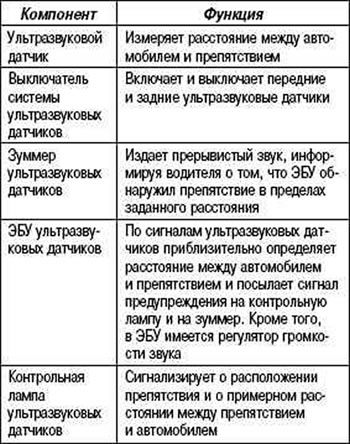
The purpose of the main components is shown in Table 1.13.
Table 1.13. Purpose of the main components
Design and operating principle of the ultrasonic sensor
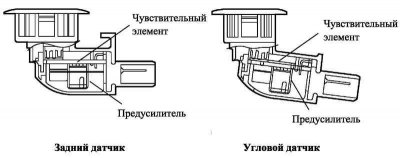
Fig. 1.32. Location of main components
The ultrasonic sensors are located as follows: 2 at the corners of the front bumper, 2 at the corners of the rear bumper, and 2 in the middle of the rear bumper (Fig. 1.32). Each ultrasonic sensor consists of a sensitive element that transmits and receives ultrasonic vibrations, and a preamplifier that amplifies the signals. The ultrasonic sensors transmit input and output signals to the ultrasonic sensor ECU.
Conditions for disabling the system
The vehicle speed at which the sensor is activated (for all sensors): less than 8 km/h – 15 km/h.
The position of the gearshift lever at which the sensor is activated (for all sensors):
Incorrect readings due to a break in the sensor electrical circuit, icing or contamination.
Ultrasonic sensor buzzer
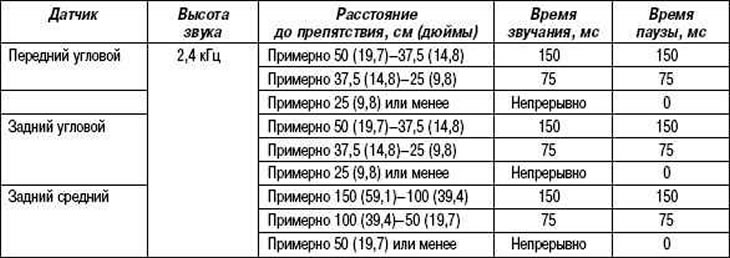
The frequency of the intermittent sound signal of the system depends on the distance to the obstacle (see table 1.14).
The buzzer is installed on the ultrasonic sensor ECU on the bracket.
Table 1.14. Operation of the sound buzzer depending on the distance to the obstacle
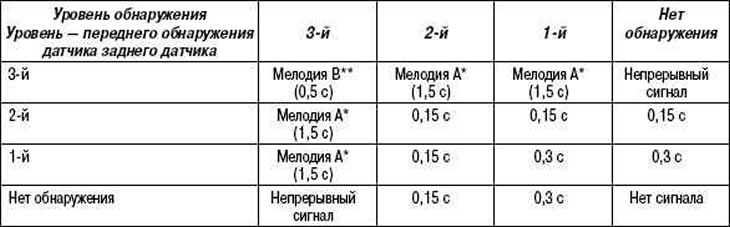
Dependence of the buzzer signal melody on the location of the obstacle
The sensors are combined into two groups: the front one, which includes the front corner sensors, and the rear one, which includes the rear corner and rear middle sensors.
The table below shows how the buzzer tone changes depending on the size of the obstacle.
It also specifies how the buzzer tone changes depending on whether an obstacle is detected by the front or rear sensors.
Table 1.15. Buzzer sounding frequency
Control lamp and switch for ultrasonic sensor system
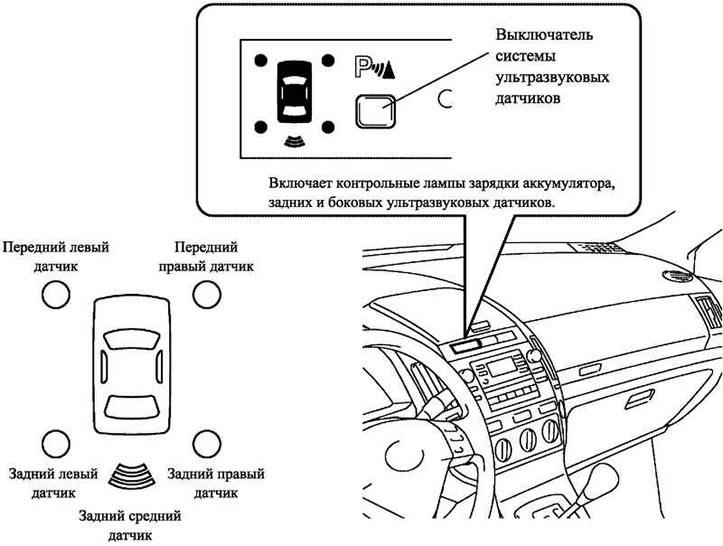
Fig. 1.33. Control lamp and switch of the ultrasonic sensor system
The switch and control lamp for the ultrasonic sensors are installed in the emergency signal switch block (Fig. 1.33).
ECU of ultrasonic sensors
The ultrasonic sensor ECU controls the entire system, including controlling the transmission and reception of ultrasonic signals, processing received signals, detecting the presence of an obstacle, turning on the light and sound alarm, and detecting breaks in the sensor circuits.
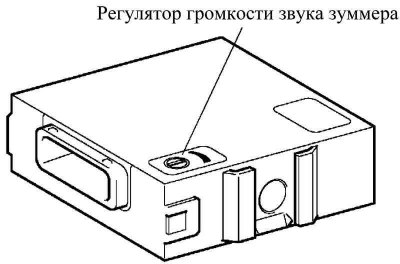
Fig. 1.34. Ultrasonic sensor control unit
The ultrasonic sensor control unit has the ability to adjust the buzzer volume (Fig. 1.34).
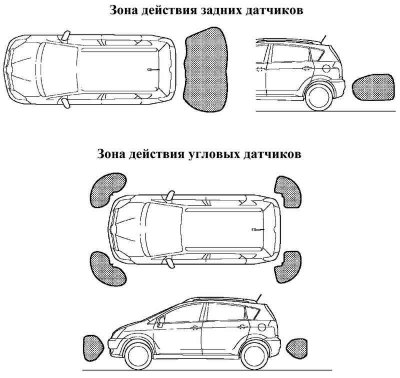
Fig. 1.35. Sensor coverage area
Turning on the system
The system is activated if the engine is running, the ultrasonic sensor system switch is on and the conditions listed in Table 1.16 are met.
Table 1.16. Sensor activation conditions

Initial check ("Self-diagnosis")
After switching on, the Toyota Parking Assist System 1 turns on the indicator lamp and buzzer and checks the functionality of the ultrasonic sensors.
If the system cannot detect obstacles due to a faulty ultrasonic sensor, it informs the driver by intermittently illuminating the indicator lamp corresponding to the faulty sensor and by emitting an audible signal.
Precautions when working with the system
The distance to obstacles may be determined incorrectly under the following conditions:
- if the sensors are covered with ice, snow or dirt, after cleaning they will be fully functional again;
- if the sensor is frozen, after defrosting the sensor will be restored to working order;
- if the sensor is covered by a foreign object, after removing the interference, the sensor's functionality will be restored.
Note: Sometimes the display may show a system malfunction message due to frozen sensors, especially in cold weather.
Note: If the display shows a fault message, the sensors should be checked. If the fault message remains on the display even when there is no dirt, ice or snow on the sensor, the sensor may be faulty.
The sensor's range may be reduced under the following conditions:
- if the sensor is covered, for example, by snow or dirt;
- if the vehicle is operated in the blazing sun or at very low temperatures.
The system may incorrectly determine the distance to obstacles under the following conditions:
- if the vehicle is driven on a bumpy road, a gravel road or on grass;
- if the sensor is affected by sound signals from other cars, engine sound motorcycle, the sound of air brakes of a heavy truck or other ultrasonic vibrations;
- if it's raining or the car is being doused with water;
- if the car is tilted too much;
- if the vehicle is equipped with a radio antenna;
- if the sensors are covered with ice, snow or dirt;
- if the car is moving towards a high curbstone;
- if there is another car with ultrasonic sensors nearby;
- if the vehicle is equipped with a towing hitch.
Some of the objects listed below may not be detected by ultrasonic sensors:
- thin objects such as rope or string;
- objects with a small reflective surface area, such as wire fencing;
- objects that absorb ultrasonic vibrations, such as bales of cotton wool or snowdrifts;
- objects with protruding sharp edges;
- objects too low;
- objects with a high protrusion on top.
Some other reasons:
- objects located directly under the bumpers are not detected. Even if objects located below the sensors or thin bars are detected at some point, as the car approaches these objects further, they may not be detected by the sensors;
- an object may not be detected if it is located too close to the sensors;
- the sensors may not function properly if they are subjected to strong shock, such as from being hit or objects being thrown into them.