



Generator parts (1980-87.)
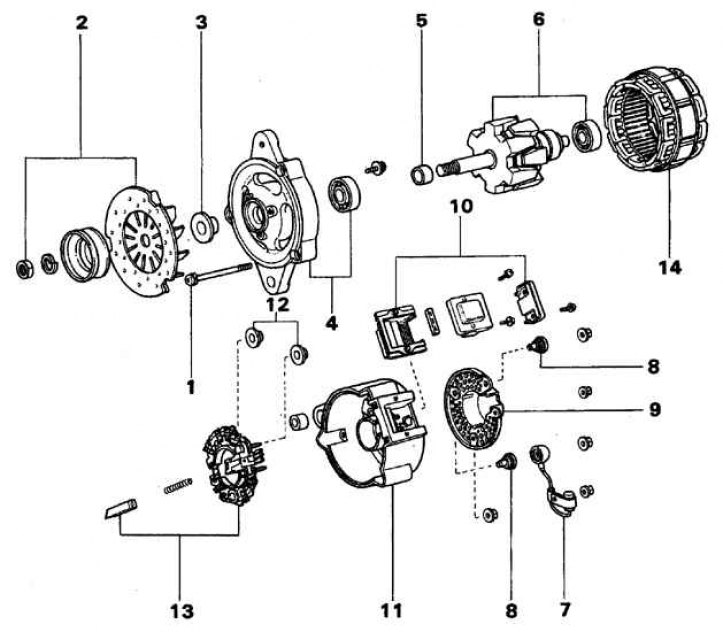
1. Tie bolt; 2. Pulley and impeller; 3. Separator sleeve; 4. Front cover and bearing; 5. Ring; 6. Rotor and bearing; 7. Capacitor; 8, 12. Isolator; 9. Back cover; 10. Regulator; 11. Brush holder housing; 13. Brush holder and rectifier; 14. Stator
Generator parts (1988-92.)
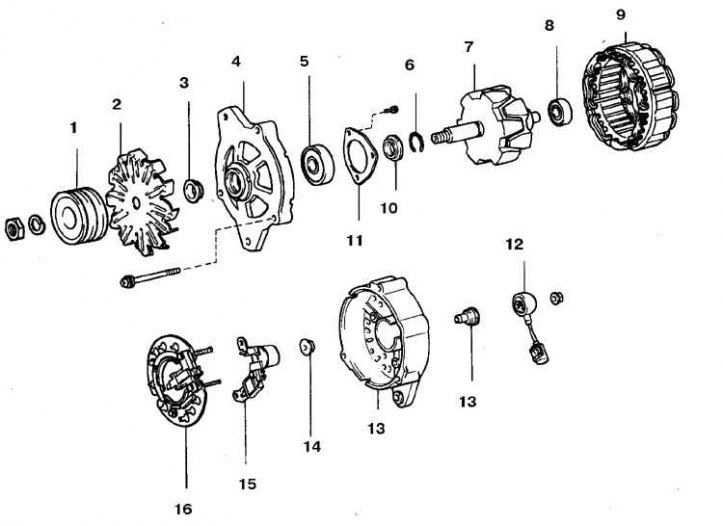
1. Cabinet and impeller; 2. Impeller; 3. Separator sleeve; 4. Front cover; 5, 7. Bearing; 6. Stator; 8. Rotor; 9. Retaining ring; 10. Remote laying; 11. Bearing cover; 12. Capacitor; 13. Rectifier housing; 14. Isolator; 15. Regulator; 16. Rectifier
Generator parts (since 1993)
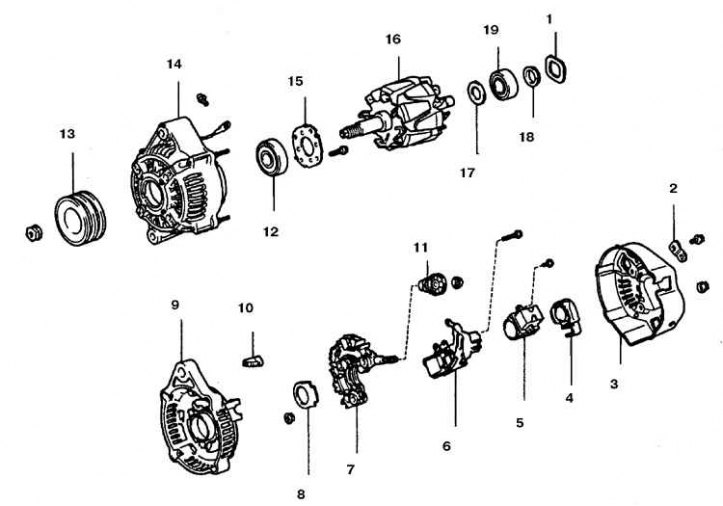
1. Thrust washer; 2. Rectifier plate; 3. Back cover; 4. Brush holder cover; 5. Brush holder; 6. Regulator; 7. Straightener holder; 8. Seal; 9. Rectifier housing; 10. Isolator; 11. Terminal insulator; 12, 19. Bearing; 13. Pulley; 14. Stator; 15. Rear bearing cover; 16. Rotor; 17, 18. Bearing cover
Attention! The generators of the cars under consideration differ only in the layout of the voltage regulator.
Disassembly
1. Remove the generator.
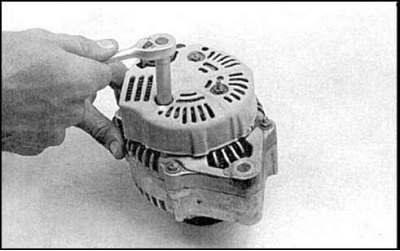 | 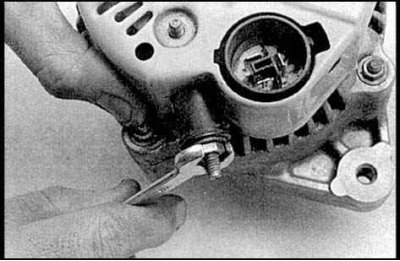 |
2. Unscrew the nuts of the rear cover (photo on the left), generator terminal nut, remove the insulating bushing and the rear cover (photo on the right).
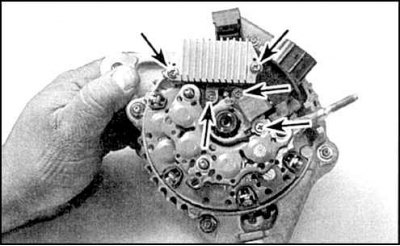
3. Remove the five screws securing the voltage regulator and brush holder (indicated by arrows).
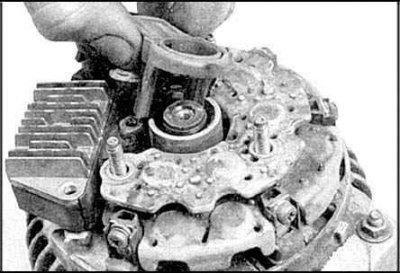
4. Remove the voltage regulator.
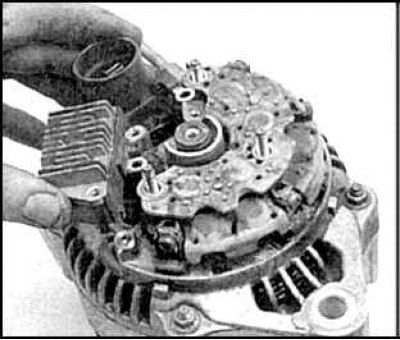
5. Remove the brush holder. If you limit yourself to replacing the voltage regulator, then perform the work according to p. 9, install a new regulator, assemble the generator and install it on the engine. If the brushes are to be changed, follow the next paragraph of the description.
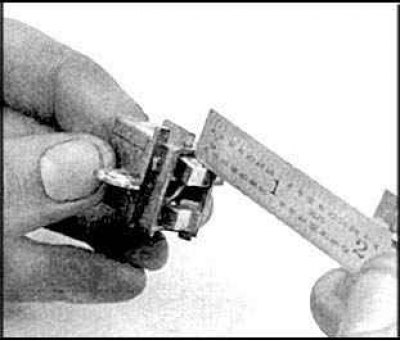
6. Measure the length of the protruding part of the brushes. If the length of the brush is less than the maximum permissible, then replace the brush holder with the brushes. Some cars provide for replacing only the brushes by re-soldering them.
7. Make sure the brushes move freely in the brush holder.
(The original text is posted on: ToyotaMan)
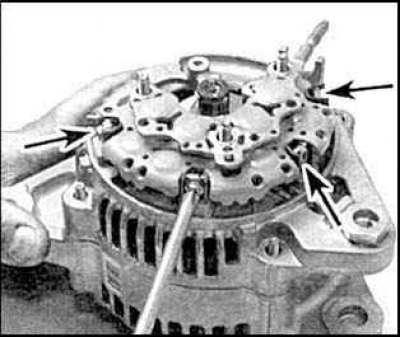
8. Remove the straightener (the rectifier mounting screws are indicated by arrows). Remove the four rubber bumpers and mudguard.
9. Mark the relative orientation of the front and back covers to facilitate assembly.
10. Loosen the pulley mounting nut on the rotor and remove the pulley.
11. Unscrew the four nuts securing the front cover to the rear flange, and disconnect the rear flange from the cover.
12. Remove the thrust washer and remove the rotor from the front cover.
Checking the condition of parts
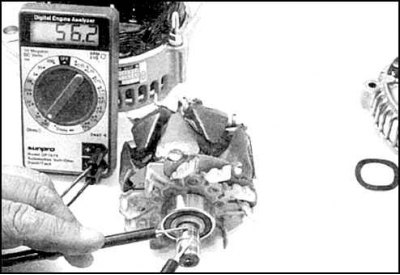 | 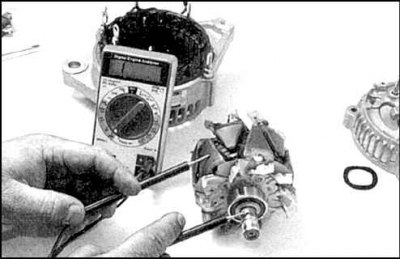 |
1. Check the resistance of the circuit between the two contact rings (photo on the right) which should be within 2–4 ohms. Check the circuit between the rotor shaft and the slip rings (photo on the left). The ohmmeter should show infinite resistance. If the results of both tests are unsatisfactory, or if the rings are excessively worn, replace the rotor.
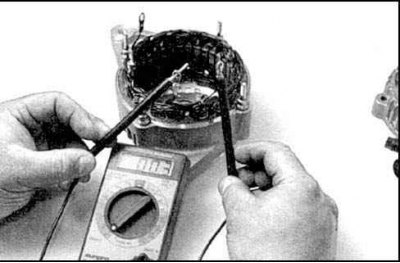
2. Check the resistance between the stator winding terminals. If the resistance is high or the ohmmeter shows a break, the stator must be replaced. Check the short circuit of the stator windings to the housing (core). If the ohmmeter shows a finite resistance between the stator terminals and the housing, the stator is faulty.
3. Check the diodes of the positive and negative branches of the rectifier bridge.
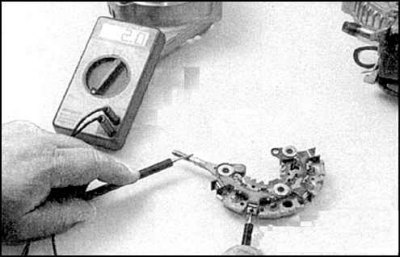 | 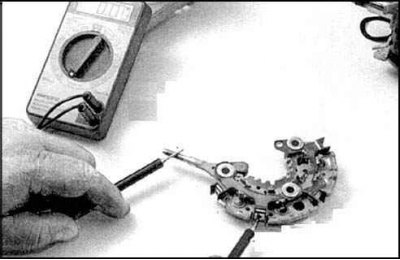 |
4. First, check the diodes of the positive branch of the rectifier bridge by placing the positive probe of the ohmmeter on the output pin and the negative probe on any of the diode terminals shown in the illustration (photo on the left). Then swap the probes and touch the same terminals (photo on the right).
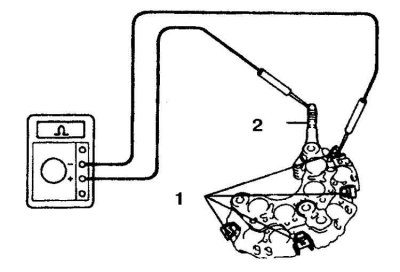
5. The ohmmeter should show a closed circuit when connected for the first time, and an open circuit when connected again. Check the resistance between the other terminals in the same way. If at least one of the diodes fails the tests, the diode branch is considered faulty (1 - rectifier terminals, 2 - positive terminal).
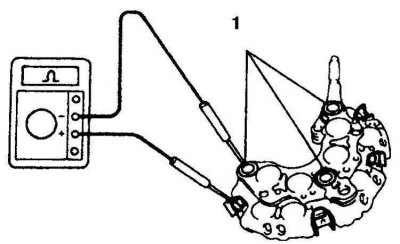
6. Now check the diodes of the negative branch of the rectifier bridge, for which apply the negative probe of the ohmmeter to the negative terminal (1), and the positive probe to any of the terminals of the rectifier. Then swap the probes and touch the same terminals. The ohmmeter should show an open circuit at the first connection, and a closed circuit at the second. Check the resistance between the other terminals in the same way.
7. If at least one of the diodes fails the tests, the diode branch is considered faulty.
Assembly
1. Assembly is carried out in reverse order, observing the following rules.
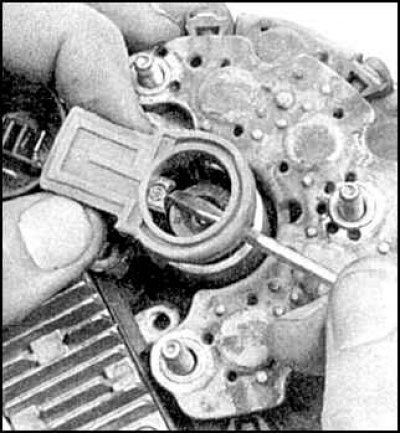
2. When installing the brush holder onto the rotor, press the brushes with a small screwdriver.
3. Screw in the screws securing the voltage regulator and brush holder.
4. Install the back cover and tighten the nuts.
5. Install the pin insulating sleeve, tighten the nut.
6. Install the generator.