



- Direct Drive Starter
- Lightly lubricate the toothed portion of the armature shaft and the pivot bearing of the engagement lever. Lubricate the bearing and gear.
- Place the lug ring onto the anchor shaft with the larger side facing out.
- Insert a locking ring into the groove of the anchor shaft and clamp the shaft with the ring in a vice. Clamp and release the vice again, turn the shaft and repeat the process until the ring fits into the groove along the entire circle (Fig. 284).
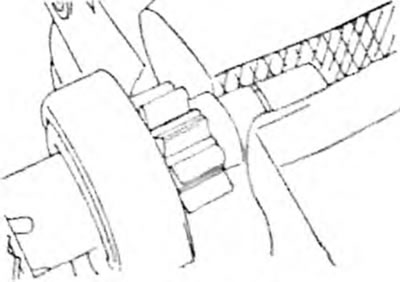
Fig. 284. After installing the retaining ring, press it into the groove in the vice
- Put on the anchor with the shaft and use a screwdriver to push the tide ring down onto the locking ring. Check that the tide ring grips the locking ring.
- Correctly (Fig. 274) install the power lever.
- Insert the rubber seal with the boss into the starter housing.
- Place the brush holder on the armature shaft, pull out the brush springs with a piece of wire and push the brushes into the brush holder. Release the springs and check that they sit well on the brushes.
- After screwing the collector bearing shield, take into account the play determined during disassembly and, if it is greater than 0.10 mm, insert a compensation washer with a thickness of 0.5 mm.
- Fill the lid from the inside with grease and screw it on.
- After assembly, connect the 12 V battery in accordance with Figure 285 and 1 measure the gap between the surface of the drive gear and the drive bearing shield (Fig. 286). If it goes beyond the range of 0.1 mm to 4.0 mm, loosen the fastening of the traction relay push rod nut (to do this, you need to remove the traction relay again) and move the pusher. If the gap is too large, the pusher is screwed in; if the gap is too small, the pusher is unscrewed. If you have an ammeter, you can start the starter without a load. The readings of the device provide information on whether the starter is working with a given current strength and, in addition, whether it is switched on normally (the gear jumps out). Connect the device in accordance with Figure 287. The current strength should be 50 A.
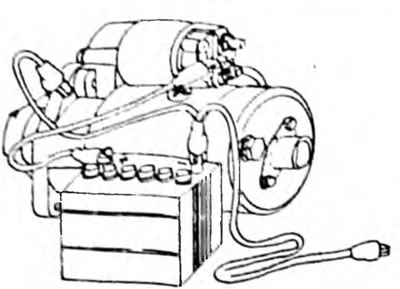
Fig. 285. Connecting the starter when checking the drive gear play
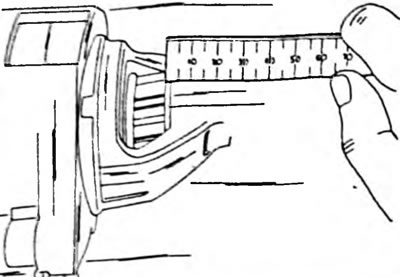
Fig. 286. Measuring the distance between the drive gear surface and the drive bearing shield
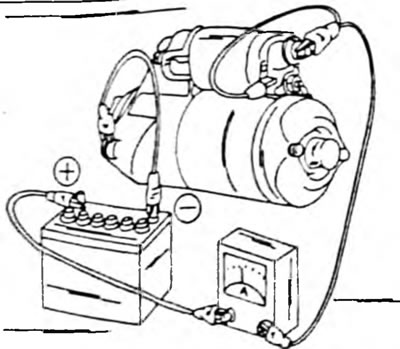
Fig. 287. Starter connection diagram when checking operation
Starter with gearbox
- Lubricate the bearings and gears of the gearbox with heat-resistant grease before assembly.
- Insert the anchor into the starter housing.
- Install the brush holder. Lift the brush springs with a screwdriver and insert four brushes into the brush holder. Release the springs on the brushes. Screw the brush wires to the terminals. Do not allow the positive brush wires to come into contact with the ground.
- Fasten the cover with two bolts. On a 1.4 kW starter, install a sealing ring.
- Lubricate the steel ball and insert it into the shaft hole.
- Install the freewheel clutch and gears. Their location is shown in Figures 288 and 289. First, lubricate the return spring and insert it into the hole in the traction relay. Install the intermediate gear and bearing on a 1.0 kW starter or the intermediate gear, bearing, and second gear on a 1.4 kW starter.
[This material is taken from a resource TOYOTAMAN.ru]
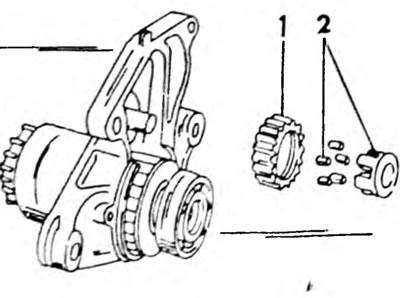
Fig. 288. Pinion with bearing of 1.0 kW starter 1. Reduction gear; 2. Bearing.
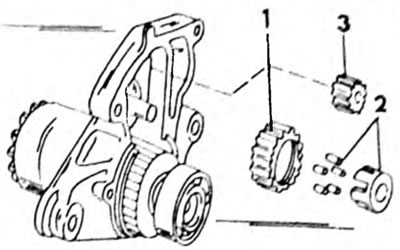
Fig. 289. Pinion with bearing of 1.2 kW starter 1. Intermediate gear; 2. Bearing; 3. Safety gear drive
- Connect the starter housing and the traction relay and tighten the two bolts.
- The remaining work is done in reverse order. In this case, use Figure 277.