



Contents: Brush assembly ↓ Anchor and collector ↓ Stator windings ↓ Bearings ↓ Starter drive ↓ Traction relay ↓
Brush assembly
The brushes should be longer than 10.0 mm. Check whether the brushes move easily in their guides by inserting them and lightly pulling the current leads to move them in both directions. If necessary, wipe the brushes with a rag soaked in gasoline or process them with a thin file. If necessary, replace the brushes.
Anchor and collector
The collector must be smooth over the entire surface, free of burrs and carbon deposits. Wipe the collector with a rag soaked in gasoline while turning the anchor, as shown in Figure 278. If this is not successful, the collector can be processed with a piece of sandpaper, but do not use emery cloth for this. To bore a heavily worn collector, you can install it in a lathe and remove a layer of metal at high speed. Do not remove more than necessary. In this case, the final diameter should not be less than 27.0 mm on a direct-drive starter and 29.0 mm on a geared starter. The collector is measured at the location shown in Figure 279.
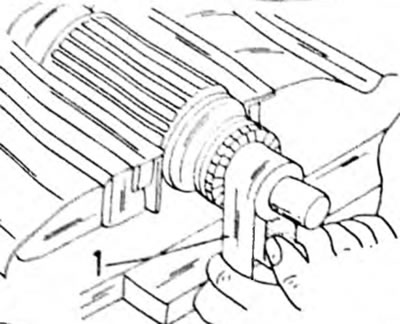
Fig. 278. Clean the collector with a strip of sandpaper (1) To clean around the entire circumference, clamp the anchor in a vice in different places
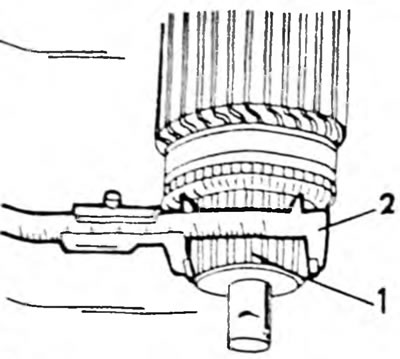
Fig. 279. Measuring the diameter of the collector (1) with a caliper (2)
Finally, saw the lamellar gaps between the commutator segments to a depth of 0.5-0.8 mm with a hacksaw. Then polish the commutator with fine sandpaper until a shiny layer is obtained. Sawing the lamellar gaps between the commutator segments is performed if the depth is less than 2.0 mm. Most often, malfunctions are caused by short circuits in the anchor. A sign is burnt turns of the commutator. On a starter with a direct drive, check the play of the anchor shaft in the bushings by measuring the shaft diameter and the inner diameter of the bushing and calculating the difference between these values. If it exceeds 0.20 mm, the bushings should be replaced. To check the anchor winding, you need a device for checking the anchor, the so-called buzzer. If you do not have a device, you can check the anchor by temporarily installing a new anchor. Do not try to straighten a bent anchor shaft or process the anchor core.
Stator windings
The stator windings can be best checked with an ammeter connected to the winding terminal and ground with the battery connected in the gap (Fig. 280). If there are readings, the winding is shorted to ground. For the second check, connect the ammeter to both brushes (Fig. 281). If there are no readings, there is an open circuit. In both cases, replace the starter housing or windings. The contact bolts are unscrewed with an impact screwdriver, as they are very tight. On a starter with a gearbox, the entire housing is replaced.
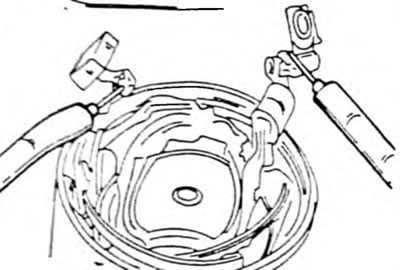
Fig. 280. Checking excitation windings for contact with ground
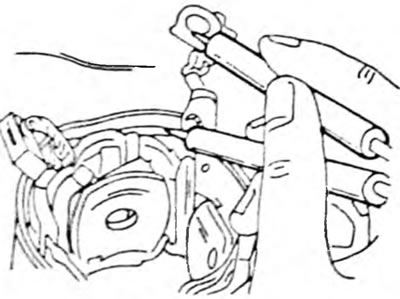
Fig. 281. Checking excitation windings for breakage
Bearings
Bearings that are so damaged that there is lateral play of the anchor shaft must be replaced. | The best way to do this is to measure the outer diameter of the shaft and the inner diameter of the bushings. If the difference exceeds 0.20 mm, the old bushings should be pressed out, new ones should be pressed in, and the bushings should be ground in until the anchor shaft play of 0.035-0.08 mm appears.
Starter drive
Check the condition of the drive gear teeth. The gear should move easily along the threaded portion of the anchor shaft. The freewheel clutch should rotate in only one direction, locking in the opposite direction. If necessary, replace the entire drive, but before ordering spare parts, count the teeth of the drive gear.
If the drive pinion is replaced due to damage to the teeth, be sure to inspect the ring gear.
Traction relay
The traction relay is not repairable. To check the traction relay winding, connect a 12 V battery to terminals "C" and "50". There should be current readings and the drive pinion should jump out. This check confirms the traction winding is in good condition. To check the holding winding, connect as shown in both figures and disconnect the negative wire from terminal "C". The drive pinion should not change its position. If it jumps back, the traction relay should be replaced. Figure 282 shows the terminals of the traction relay of a conventional starter, and Figure 283 shows the terminals of a starter with a reduction gear.
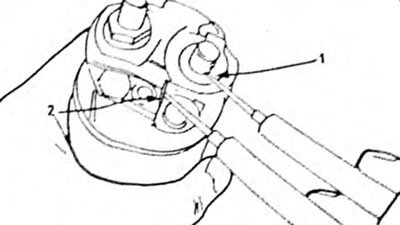
Fig. 282. Checking the traction relay with an ohmmeter (direct drive starter) 1. Terminal "C"; 2. Terminal "50"
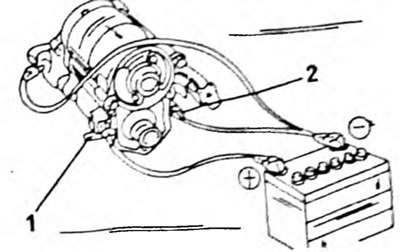
Fig. 283. Checking the starter traction relay with a gearbox1. Terminal "C"; 2. Terminal "50"
The third check should be carried out to check the return of the drive pinion. To do this, disconnect the negative wire from the housing (Fig. 283). The pinion should immediately jump in. If this does not happen, replace the traction relay.