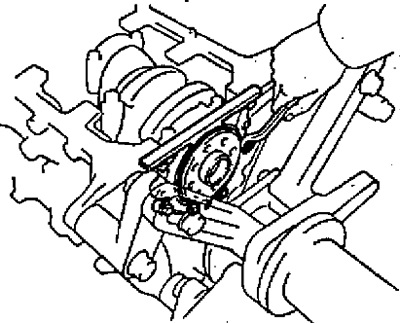
2. (2C, 3S-FE) Remove the oil nozzles.
3. Check the axial clearance of the connecting rod bearing using a dial indicator, moving the connecting rod back and forth along the crankshaft journal.
Standard axial clearance:
- a series engines - 0.150-0.250 mm
- c series engines - 0.080-0.300 mm
- s series engines - 0.160-0.312 mm
Maximum axial clearance:
- a series engines - 0.30 mm
- c series engines - 0.40 mm
- s series motors - 0.35 mm
If the axial clearance is greater than the maximum allowable, replace the connecting rod assembly. If necessary, replace the crankshaft.
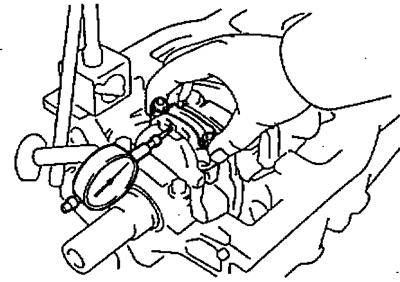
4. Remove the connecting rod cap and check the radial clearance of the connecting rod bearing.
a) Check the alignment of the marks on the connecting rod and connecting rod cap to ensure correct assembly later.
If there are no marks, use a punch to mark them on the caps and connecting rods.
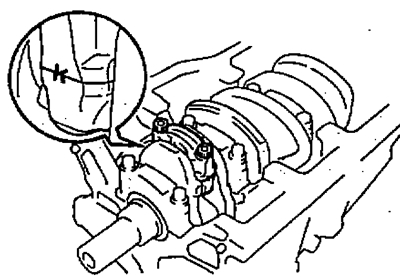
b) unscrew the two nuts (bolts) securing the lower connecting rod cover.
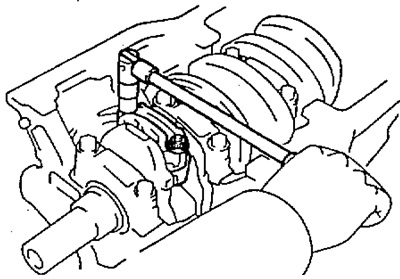
c) Using a plastic-headed hammer, lightly tap the connecting rod bolts and loosen the lower connecting rod cap.
Note: The lower half of the bearing shell should remain in the connecting rod cap.
d) Place pieces of hose on the protruding ends of the bolts to prevent damage to the surface of the crankpin.
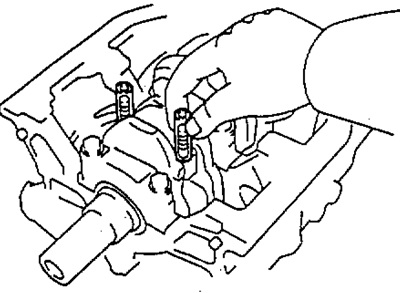
d) Clean the crankpin and bearings.
e) Check the surfaces of the crankpin and bearing for pitting and scratches. If there are any scratches or scoring, replace the bearings. If necessary, regrind the bearings or replace the crankshaft.
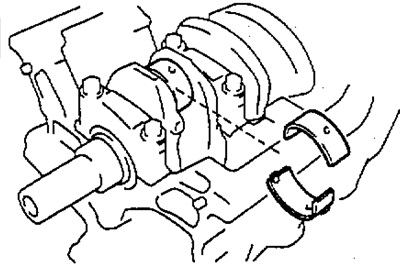
Note: Do not confuse the upper and lower bearing shells.
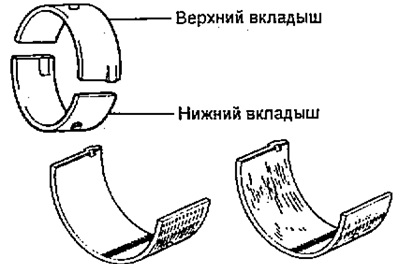
g) Install a plastic gauge to measure clearances in the plain bearings across the crankpin.
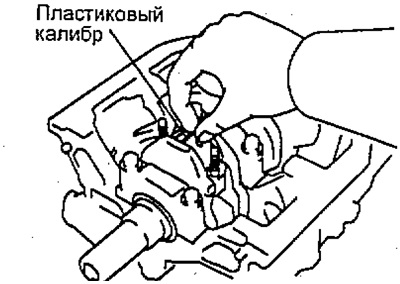
c) Install the lower connecting rod cover, aligning the alignment marks.
Tightening torque:
3S-FE, 4S-FE, 4A-FE, 5A-FE, 7A-FE:
- stage 1 - 25-29 Nm
- stage 2 - turn 90°
4S-FE — 54 Nm
2C - 65 Nm
Note:
- - Do not rotate the crankshaft.
- - Apply a little oil to the threads of the bolts and under the nuts (for bolt heads 7A-FE) before installing them.
i) Remove the lower connecting rod cover by unscrewing the nuts (bolts 7A-FE).
k) Measure the maximum width of the flattened calibration wire, using it to determine the value of the connecting rod bearing clearance.
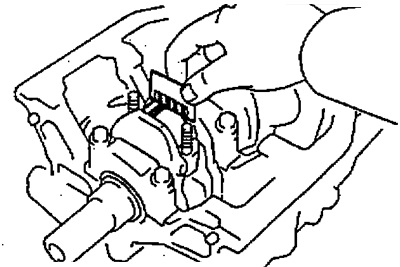
Connecting rod bearing clearance:
Engine 2C:
- nominal - 0.044-0.072 mm
- repair (0.25) — 0.043-0.089 mm
- maximum - 0.10 mm
Engines 3S-FE, 4S-FE:
nominal - 0.024-0.055 mm
repair (0.25):
- 3S-FE — 0.025-0.089 mm
- 4S-FE — 0.023-0.069 mm
maximum - 0.08 mm
Engines 4A-FE, 5A-FE:
- nominal - 0.020-0.051 mm
- repair (0.25) — 0.019-0.065 mm
- maximum - 0.08 mm
Engine 7A-FE:
- nominal - 0.020-0.044 mm
- repair (0.25) — 0.019-0.058 mm
- maximum - 0.08 mm
If the clearance is greater than the maximum, replace the bearings. If necessary, grind or replace the crankshaft. For the nominal and repair dimensions of the crankshaft, see the "Checking and Repairing the Crankshaft" subsection below.
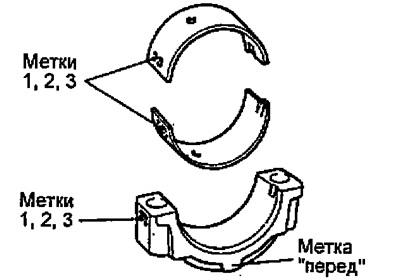
Note: When replacing bearing shells of a nominal size, it is necessary to use shells of the same size group indicated on the bearing cover.
There are size groups of liners, designated "1", "2", "3". In this case, the protrusion (mark "front") on the connecting rod cover should be directed towards the front of the engine (in the direction opposite to the power take-off).
Nominal dimensions of liners by their thickness:
2C engines:
- mark "1" - 1.474-1.478 mm
- mark "2" - 1.478-1.482 mm
- mark "3" - 1.482-1.486 mm
- repair (0.25) - 1.595-1.601 mm
3S-FE engines:
- mark "1" - 1.484-1.488 mm
- mark "2" - 1.488-1.492 mm
- mark "3" - 1.492-1.496 mm
- repair (0.25) - 1.600-1.610 mm
4S-FE engines:
- mark "1" - 1.484-1.488 mm
- mark "2" - 1.488-1.492 mm
- mark "3" - 1.492-1.496 mm
- repair (0.25) - 1.605-1.611 mm
Engines 4A-FE, 5A-FE:
- mark "1" - 1.486-1.490 mm
- mark "2" - 1.490-1.494 mm
- mark "3" - 1.494-1.498 mm
- repair (0.25) - 1.607-1.613 mm
Engine 7A-FE:
- mark "1" - 1.486-1.490 mm
- mark "2" - 1.490-1.494 mm
- mark "3" - 1.494-1.498 mm
- repair (0.25) - 1.607-1.613 mm
l) Remove any remaining calibration wire from the working surfaces of the journal and liner.
5. Remove the piston and connecting rod assembly.
a) Use a reamer to remove carbon deposits from the top of the cylinder as shown in the figure.
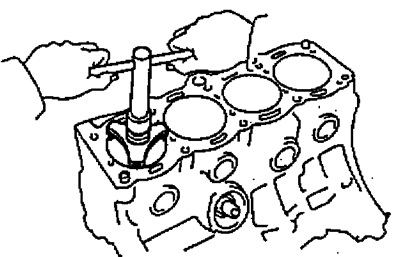
b) Cover the connecting rod bolts with pieces of hose to protect the crankshaft from damage.
c) Remove the piston assembly with the connecting rod and upper bearing shell through the top of the cylinder block.
Note:
- - Keep the bearings, connecting rod and cover together.
- - Arrange the pistons together with the connecting rods and liners in a specific order.
6. Use an indicator to measure the axial clearance of the crankshaft, moving the latter back and forth with a screwdriver.
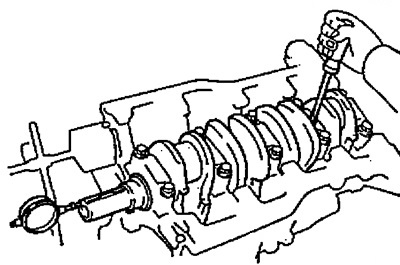
Standard axial clearance:
- 2C - 0.040-0.240 mm
- 3S-FE, 4S-FE, 4A-FE, 5A-FE, 7A-FE - 0.020-0.022 mm
Maximum axial clearance - 0.3 mm
If the axial clearance is greater than the maximum permissible, replace the thrust half rings.
Thickness of thrust half rings:
2C:
- nominal - 2.680-2.730 mm
- repair (0.125) — 2.743-2.793 mm
- repair (0.250) — 2.805-2.855 mm
3S-FE, 4S-FE, 5A-FE, 4A-FE, 7A-FE - 2,440-2,490 mm
7. Remove the main bearing caps and check the radial oil clearances.
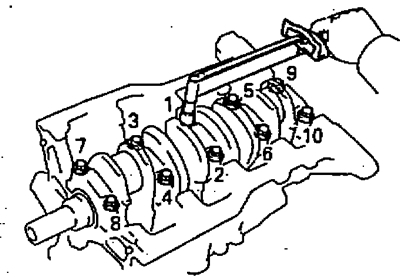
a) Loosen and remove the main bearing cap bolts uniformly in several passes as shown in the figure.
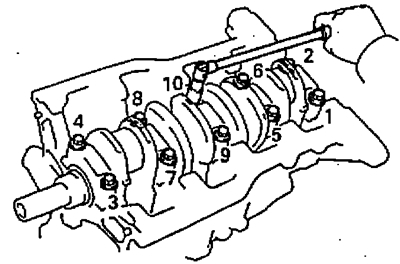
b) By shaking the unscrewed bolts in the holes of the main bearing caps, separate and remove the caps together with the lower liners and lower thrust half rings (the latter are installed only in the area of main bearing No.3).
Note:
- - Keep the main bearing caps together with the lower shells.
- - Arrange the main bearing caps and thrust washers in the correct order.
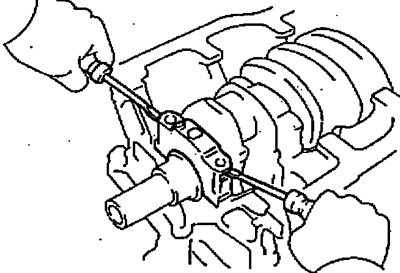
c) Raise the crankshaft.
Note: Leave the upper bearing shells and upper thrust washers in the cylinder block.
d) Clean each main journal and bearings.
d) Check the surface of each main journal and bearing for pitting and scratches.
If the journal or bearing is damaged, replace the bearings. If necessary, regrind or replace the crankshaft.
e) Place the crankshaft into the cylinder block.
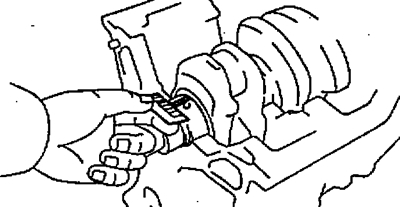
g) Place a plastic bearing clearance gauge on each main journal.
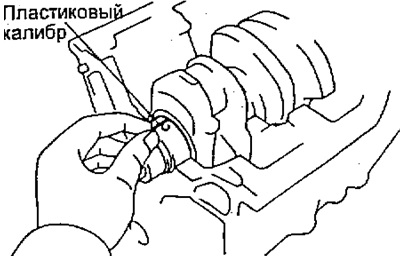
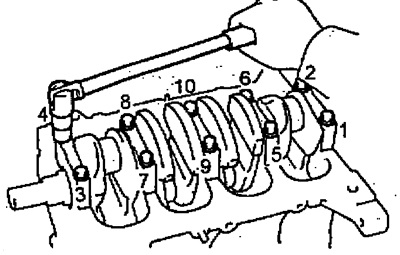
h) Install the main bearing caps and tighten the bolts in the sequence shown in the figure.
Tightening torque:
- 3S-FE, 4S-FE, 4A-FE, 5A-FE, 7A-FE - 59 Nm
- 2C - 103 Nm
Note: Do not rotate the crankshaft.
i) Remove the main bearing caps with the lower liners and thrust half rings (the latter are installed only in the area of main bearing No.3).
k) Measure the maximum width of the flattened calibration wire, using it to determine the value of the radial oil clearance.
Main bearing clearance:
4A-FE, 5A-FE, 7A-FE:
- nominal - 0.015-0.033 mm
- repair (0.25) — 0.015-0.053 mm
- maximum - 0.080 mm
2C:
- nominal - 0.034-0.065 mm
- repair (0.25) — 0.033-0.079 mm
- maximum - 0.100 mm
3S-FE, 4S-FE:
bearing no.3
- standard - 0.025-0.044 mm
- repair (0.25) — 0.027-0.067 mm
rest
- standard - 0.015-0.034 mm
- repair (0.25) — 0.019-0.059 mm
- maximum: - 0.080 mm
If the oil clearance is greater than maximum, replace the bearings.
If necessary, regrind or replace the crankshaft.
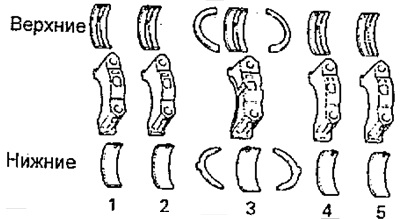
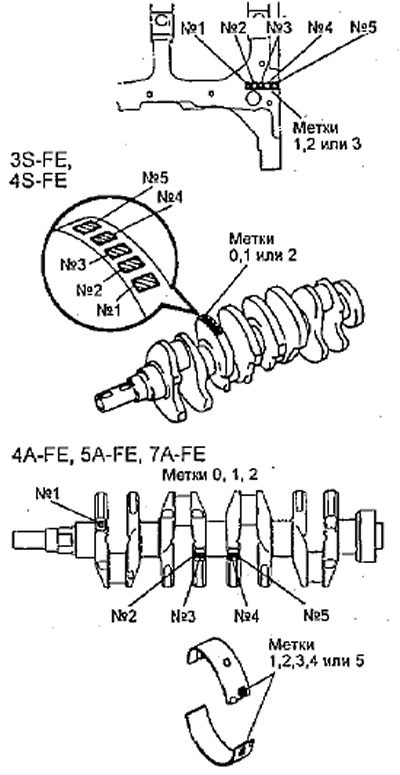
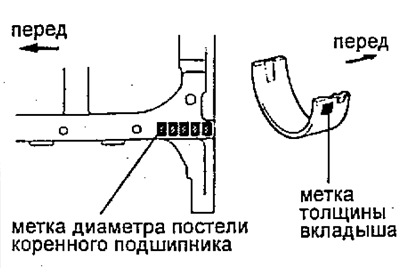
Note: When replacing bearings of the same size, it is necessary to use bearings of the same size group. If the bearing size group number cannot be determined, select the required bearing from the table by adding the cylinder block size group number to the crankshaft size group number. There are five standard bearing size groups, designated "1", "2", "3", "4" and "5" respectively.
20 C
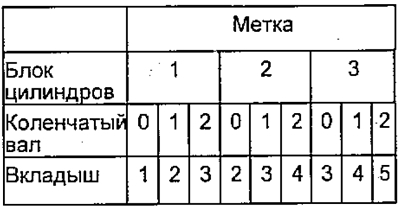
Example: Mark "2" on the cylinder block + mark "1" on the crankshaft = sum of "3" (required bearing liner No.3).
Diameter of the main bearing bed of the cylinder block:
Engines 4A-FE, 5A-FE, 7A-FE:
- mark "1" - 52.025-52.031 mm
- mark "2" - 52.031-52.037 mm
- mark "3" - 52.037-52.043 mm
2C engines:
- mark "1" - 61.000-61.008 mm
- mark "2" - 61.008-61.016 mm
- mark "3" - 61.016-61.024 mm
- rem. (0.25) — 61.000-61.024 mm
Engines 3S-FE, 4S-FE:
- mark "1" - 59.020-59.026 mm
- mark "2" - 59.026-59.032 mm
- mark "3" - 59.032-59.038 mm
- rem. (0.25) — 59.020-59.038 mm
Crankshaft journal diameter:
Engines 4A-FE, 5A-FE, 7A-FE:
- mark "0" - 47.994-48.000 mm
- mark "1" - 47.988-47.994 mm
- mark "2" - 47.982-47.988 mm
- rem. (0.25) — 47.745-47.755 mm
2C engines:
- Nominal - 56.994-57.000 mm
- rem. (0.25) — 56.745-56.755 mm
Engines 3S-FE, 4S-FE:
- mark "0" - 54.998-55.003 mm
- mark "1" - 54.993-54.998 mm
- mark "2" - 54.988-54.993 mm
- rem. (0.25) — 54.745-54.755 mm
Liner wall thickness (in the central part):
Engines 4A-FE, 5A-FE, 7A-FE:
- mark "1" - 2.002-2.005 mm
- mark "2" - 2.005-2.008 mm
- mark "3" - 2.008-2.011 mm
- mark "4" - 2.011-2.014 mm
- mark "5" - 2.014-2.017 mm
- rem. (0.25) — 2.121-2.126 mm
2C engines:
- mark "1" - 1.979-1.983 mm
- mark "2" - 1.983-1.987 mm
- mark "3" - 1.987-1.990mm
- mark "4" - 1.990-1.994 mm
- mark "5" - 1.994-1.998 mm
- rem. (0.25) — 2.100-2.106 mm
Engines 3S-FE, 4S-FE:
Insert #3
- mark "1" - 1.992-1.995 mm
- mark "2" - 1.995-1.998 mm
- mark "3" - 1.999-2.001 mm
- mark "4" - 2.001-2.004 mm
- mark "5" - 2.004-2.007 mm
- rem. (0.25) — 2.113-2.119 mm
Rest
- mark "1" - 1.997-2.000 mm
- mark "2" - 2.000-2.003 mm
- mark "3" - 2.003-2.006 mm
- mark "4" - 2.006-2.009 mm
- mark "5" - 2.009-2.012 mm
- rem. (0.25) — 2.117-2.123 mm
l) Remove the plastic gauges.
8. Remove the crankshaft.
a) Raise the crankshaft.
b) Remove the upper main bearing shells and upper thrust half rings from the cylinder block.
Note: Place the main bearings and thrust washers in the correct order.