



Contents: Removal ↓ Installation ↓
Caution: Wait until the engine has cooled down completely before starting this procedure.
Removal
1. Relieve the pressure in the fuel system (see chapter 4), then disconnect the ground cable from the battery (see paragraph 1 of chapter 5).
2. Remove the suspension strut clamp and remove it from the engine compartment (if available) (see paragraph 3 of chapter 10).
3. Drain the engine coolant (see chapter 1).
4. Disconnect the coolant hoses from the cylinder head (see chapter 3).
5. Remove the drive belt (see chapter 1).
6. Remove the generator (see chapter 5).
7. Remove the intake manifold (see paragraph 8) and the intake manifold support cushion.
8. Remove the cylinder head cover (see paragraph 4)
9. Remove the throttle body, fuel injectors and fuel rail (see chapter 4).
10. Remove the exhaust manifold (see paragraph 9) and exhaust manifold brackets.
11. Remove the timing chain and camshaft sprockets (see paragraph 6).
Note: Instead of supporting the engine from above with a special crossbar or lifting device, it should be supported from below with a jack with a wooden block installed on its head, but only after removing the stamped steel section of the oil pan.
12. Remove the camshafts and tappets (see paragraph 7).
13. Remove the variable valve timing oil control valve (fig. 5.2, b).
14. Label and disconnect the electrical connections on the cylinder head.
15. Using a 12-point 10 mm bit and extension, loosen the cylinder head bolts in stages, ¼ turn at a time, until they can be removed by hand. To avoid distortion and cracking of the cylinder head, loosen the bolts in the reverse order of the recommended tightening sequence (fig. 10.27).
16. Remove the cylinder head from the cylinder block. If it does not come off, very carefully pry its end from the gearbox side of the block with the drive axle, outside the gasket area.
17. Remove all other external components from the cylinder head to allow for a full cleaning and inspection.
Installation
18. When installing the cylinder head, the mating surfaces of the head and cylinder block must be completely clean.
19. Use a scraper to remove all traces of carbon deposits and old gasket material, then clean the mating surfaces with lacquer thinner or acetone. If there is oil on the mating surfaces when the cylinder head is installed, the gasket may not seal properly and leakage will occur. When working on the block, pack the cylinders with clean rags to prevent dirt from getting into them. Use a vacuum cleaner to remove dirt that has gotten into the cylinders
20. Check the mating surfaces of the block and cylinder head for nicks, deep scratches and other damage. If the damage is minor, it can be smoothed out with a file; if it is large, mechanical treatment may be the only option.
21. Using a tap of the correct size, calibrate the threads in the cylinder head bolt holes, then blow out the holes with compressed air. Make sure that nothing remains in the holes.
Caution: Always wear eye protection when working with compressed air.
22. Using a weed brush, clean the threads of each bolt to remove any corrosion and restore the thread profile. Dirt, corrosion products, sealant and thread damage will affect the tightening torque. Measure the length of each bolt from the underside of the head to the end and compare the result with the value given in the Specifications at the beginning of this chapter. Replace any bolts that have been pulled beyond the maximum allowable length. If the bolts are damaged in any way, replace them with new ones.
(The material is republished from an online website: TOYOTAMAN)
23. Install the components that were removed from the cylinder head.
24. Install the new gasket using the dowel pins on the block as a guide, with the "lot number" identification marking facing up. Then apply RTV sealant to the areas on the end of the cylinder head gasket as shown (fig. 6.33, b).
25. Carefully install the cylinder head onto the block without displacing the gasket.
26. Before screwing in the cylinder head bolts, apply a small amount of clean engine oil to the threads and the surface under the bolt heads.
27. Screw in the bolts (with washers) according to the original positions and tighten by hand. Following the recommended sequence, tighten the bolts to the prescribed torque specified in Specifications at the beginning of this chapter (fig. 10.27). Stage 2 tightening requires turning each bolt an additional 90°. If you do not have an angle tightening fixture that fits on a torque wrench, simply paint a mark on one flat of each bolt and tighten the bolts until the mark rotates 90° (¼ turn) from its original position.
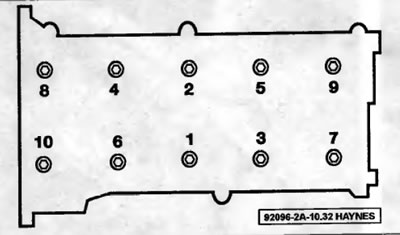
Fig. 10.27. Cylinder head bolt tightening sequence
28. The rest of the installation is carried out in the reverse order of removal.
29. Check and adjust valve clearances if necessary (see chapter 1)
30. Replace engine oil and oil filter (see chapter 1).
31. On all-wheel drive models, fill the transfer case (see chapter 1).
32. Fill the cooling system (see chapter 1), start the engine and check for leaks.