
Company Honda Company Ford Company Skoda Company Kia Company Mazda Company Mercedes Company Renault
English Русский
Български
Беларускі
Український
Српски
Hrvatski
Română
Polski
Slovenský
Magyar
Bookmark Articles Sitemap Contacts
ToyotaMan.ru


Camry Corolla Corona Carina Land Cruiser Highlander 4Runner RAV4 Others
Cruiser 100 (1998-2007) Cruiser 60/80 (1980-1997, petrol) Cruiser 70 (1985-1996, diesel)

Checking the condition of the exhaust system components [Toyota Land Cruiser J100]

  • Main
  • Land Cruiser
  • J100 (1998-2007)
  • General information
  • Maintenance
  • Checking the condition of the exhaust system components
0
1. Wait until the exhaust system has completely cooled down (at least three hours after the engine has stopped), carefully inspect all its components, starting from the flange of the inlet pipe to the exhaust manifold, and ending with the cut of the exhaust pipe. To ensure free access under the car, hang it up using a winch/hydraulic lift, or drive it onto an overpass or inspection pit.

Caution: Remember that the catalytic converter (with appropriate equipment) may remain hot much longer than other components of the exhaust system, use caution!
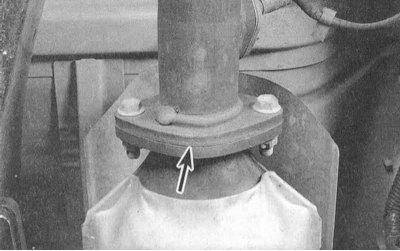


2a. Check the system sections and their joints for signs of developing exhaust gas leaks, traces of corrosion and mechanical damage, make sure that the fasteners are tightened securely (refer to the accompanying illustration).


The original can be viewed on the website [ToyotaMAN]


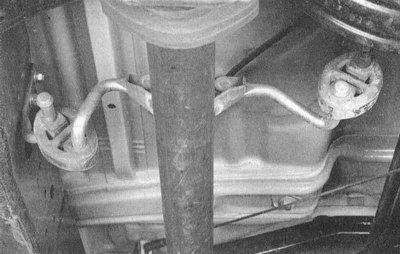
2b. Check the condition and strength of the brackets and rubber suspensions of the system components (refer to the accompanying illustration).

3. At the same time, inspect the underbody of the vehicle for holes, signs of corrosion, weld seams, and other damage that would allow exhaust gases to enter the vehicle interior. Seal any holes found with silicone sealant or regular body filler.

4. Rumble and many other extraneous noises while driving are often the result of loose fastening of exhaust system components or displacement of its sections. Carefully check the condition of the brackets and hangers, tug the pipes, muffler and catalytic converter, checking whether they are in contact with the elements of the bottom or suspension. If necessary, replace the components of the system supports.

5. The appearance of the exhaust pipe cut can be used to assess the overall operating condition of the engine with a high degree of reliability. The consistency and color of the deposits covering the end of the pipe allow you to identify engine adjustment violations. If the pipe is covered with black sooty deposits, or a whitish coating has formed on it, the engine, together with the fuel system, needs to be adjusted.
This article is available at: russian, bulgarian, belarusian, ukrainian, serbian, croatian, romanian, polish, slovak, hungarian
The article material has been checked: Evdokimov Evgeniy
Share information:
◀ Previous
Cruiser 100: Maintenance
Next ▶

Lubrication of chassis components
Checking the condition of the suspension and steering components
Wheel rotation (rearrangement)
Checking the condition and replacing the windshield wipers
Checking the condition and replacing the hoses located in the engine…
Checking the lubrication level in the transfer case
Checking the differential lubrication level
Checking the condition of seat belts
Checking and adjusting idle speed
Checking the condition of the protective covers of the drive shafts
Similar articles on other Toyota models

➥ Exhaust Gas Recirculation (EGR) System Components —… Toyota RAV 4 XA20 (2000-2005)
➥ Checking the exhaust system Toyota Camry XV20 (1996-2001)
➥ Checking the Exhaust Gas Recirculation System (1CD-FTV) Toyota Corolla Verso 3 (2004-2009)
➥ Checking the electrical components of the control system… Toyota Corona T190 (1992-1997)
➥ Checking the electro-pneumatic valve of the exhaust gas… Toyota Carina T190 (1992-1996)
➥ Checking the exhaust system (every 24,000 km or 18 months) Toyota Highlander 1 (2000-2007, petrol)
Link in different formats to this article
Comments and feedback from visitors
No comments yet


Add two numbers 15 + 10


Cruiser 100 (1998-2007) 
  • General information
  • Introduction to the guide
  • Controls and instruments
  • Maintenance
  • Power unit
  • Petrol engines
  • Diesel engines
  • Cooling and heating
  • Power and exhaust systems
  • Engine electrical equipment
  • Engine management systems
  • Transmission
  • Automatic gearbox
  • Transmission line
  • Chassis, running gear
  • Brake system
  • Car suspension
  • Steering
  • Body and interior
  • Exterior (external elements)
  • Interior (internal elements)
  • Doors, locks and windows
  • Electrical equipment
  • Equipment and devices
  • Electrical circuits
Cruiser 60/80 (1980-1997, petrol) 
  • General information
  • User manual
  • Maintenance
  • Power unit
  • Petrol engines 2F and 3F-E
  • Petrol engines 1FZ-FE
  • Engine overhaul
  • Engine electrical equipment
  • Cooling and heating
  • Fuel system (carburetor)
  • Fuel system (injector)
  • Toxicity reduction system
  • Transmission
  • Car gearbox
  • Clutch
  • Transfer case
  • Drive shafts and axles
  • Chassis, running gear
  • Brake system
  • Car suspension
  • Steering
  • Body and interior
  • Exterior and interior
  • Doors, locks and windows
  • Electrical equipment
  • Equipment and devices
  • Electrical circuits
Cruiser 70 (1985-1996, diesel) 
  • General information
  • User manual
  • Maintenance
  • Power unit
  • Engine adjustment
  • Engine repair
  • Fuel system
  • Control system
  • Turbocharging system
  • Cooling and lubrication system
  • Charge and start system
  • Transmission
  • Clutch
  • Mechanical gearbox
  • Automatic gearbox
  • Transfer case
  • Chassis, running gear
  • Car suspension
  • Brake system
  • Steering
  • Body and interior
  • Body elements
  • Heating and air conditioning
  • Electrical equipment
  • Equipment and devices
  • Electrical circuits
ToyotaMan.ru © 2018–2026 • Mobile version • Interesting about Toyota • Administration • Sitemap: EN BG BY UA RS HR RO PL SK HU • Search system • Bookmark
Camry Vista-V40 • Camry XV10 • Camry XV20 • Camry XV30 • Corolla Verso-AR10 • Corolla E80 • Corona T190 • Carina T170 • Carina T190 • Land Cruiser J70 (diesel) • Land Cruiser J60 (petrol) • Land Cruiser J100 • Highlander XU20 (petrol) • 4Runner N120 • RAV4 XA10 • RAV4 XA20 • Duet M100 • Dyna Y50 •
We require cookies to enable some interactive features. Is that ok with you?