
Company Honda Company Ford Company Skoda Company Kia Company Mazda Company Mercedes Company Renault
English Русский
Български
Беларускі
Український
Српски
Hrvatski
Română
Polski
Slovenský
Magyar
Bookmark Articles Sitemap Contacts
ToyotaMan.ru


Camry Corolla Corona Carina Land Cruiser Highlander 4Runner RAV4 Others
Cruiser 100 (1998-2007) Cruiser 60/80 (1980-1997, petrol) Cruiser 70 (1985-1996, diesel)

ABS system units [Toyota Land Cruiser J60]

  • Main
  • Land Cruiser
  • J60 (1980-1997)
  • Chassis, running gear
  • Brake system
  • ABS system units
0
Contents: Actuator ↓ Wheel speed sensors ↓ ABS control unit ↓
FJ80 vehicles have been equipped with an automatic brake release system since 1993 (ABS system), designed to increase the stability of the vehicle under conditions of sudden braking. The pressure in the brake circuit is regulated depending on the speed of rotation of the wheels, registered by sensors.

Location of ABS system units
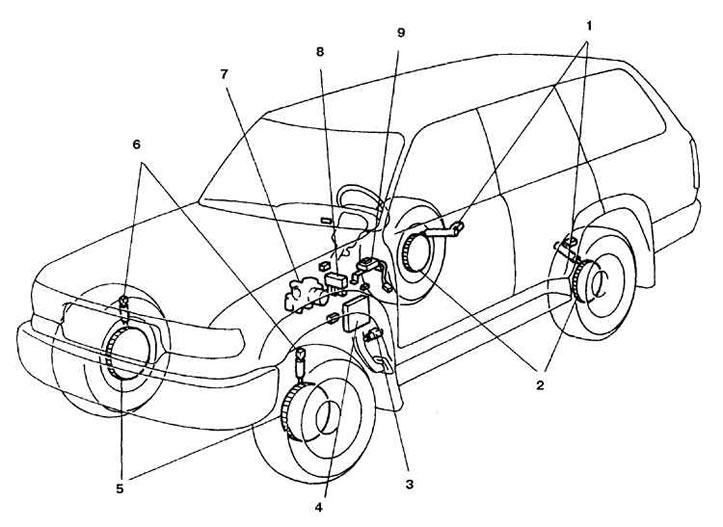


1. Rear speed sensors; 2, 5. Speed sensor rotors; 3. Brake light switch; 4. Control unit; 6. Front speed sensors; 7. Actuator; 8. Relay; 9. Slowdown sensor


Actuator


The actuator consists of a master cylinder, an electro-hydraulic pump and 4 solenoid valves.

The pump is designed to pump fluid into the actuator receivers, through which pressure is supplied to the brake circuit.

The official source is on the portal: toyotaman

The valves control the pressure in the brake circuit when the ABS system is activated; there is 1 valve per wheel.

Wheel speed sensors


Rotary type sensors are mounted on each wheel. Signals from the sensors are sent to the control unit.

The front sensors are mounted on the steering knuckle, next to the toothed rings of the rotors. The rotors are structurally integrated with the front axle shafts.


The rear sensors are mounted on the axle beam, the rotors are part of the rear hub.

ABS control unit


The control unit is mounted under the front bulkhead of the body. The unit receives signals from the brake light switch and the speed sensors of each wheel, on the basis of which the pressure in the hydraulic drive of this wheel is regulated. The control unit also has a self-diagnostic and failure memorization function.

If the system fails, a warning light on the instrument panel lights up and a failure code is stored in the memory, which can be read to determine the nature of the malfunction.
This article is available at: russian, bulgarian, belarusian, ukrainian, serbian, croatian, romanian, polish, slovak, hungarian
The article material has been checked: Evdokimov Evgeniy
Share information:
◀ Previous
Cruiser 60/80: Brake system
Next ▶

Technical characteristics of the brake system
General information about the braking system
Diagnostics and repair of ABS system
Replacing disc brake pads (front or rear)
Brake Caliper — Removal, Disassembly and Installation
Brake disc — inspection, removal and installation
Replacing drum brake shoes
Similar articles on other Toyota models

➥ Location of charging and ignition system units Toyota Camry XV20 (1996-2001)
➥ Ventilation system control Toyota Corolla E80 (1983-1990)
➥ Anti-lock braking system (ABS) Toyota Corona T190 (1992-1997)
➥ Navigation system Toyota Carina T190 (1992-1996)
➥ Engine electrical system Toyota Highlander 1 (2000-2007, petrol)
➥ Immobilizer system (engine start code recognition) Toyota 4Runner N120 (1989-1995)
Link in different formats to this article
Comments and feedback from visitors
No comments yet


Add two numbers 24 + 44


Cruiser 100 (1998-2007) 
  • General information
  • Introduction to the guide
  • Controls and instruments
  • Maintenance
  • Power unit
  • Petrol engines
  • Diesel engines
  • Cooling and heating
  • Power and exhaust systems
  • Engine electrical equipment
  • Engine management systems
  • Transmission
  • Automatic gearbox
  • Transmission line
  • Chassis, running gear
  • Brake system
  • Car suspension
  • Steering
  • Body and interior
  • Exterior (external elements)
  • Interior (internal elements)
  • Doors, locks and windows
  • Electrical equipment
  • Equipment and devices
  • Electrical circuits
Cruiser 60/80 (1980-1997, petrol) 
  • General information
  • User manual
  • Maintenance
  • Power unit
  • Petrol engines 2F and 3F-E
  • Petrol engines 1FZ-FE
  • Engine overhaul
  • Engine electrical equipment
  • Cooling and heating
  • Fuel system (carburetor)
  • Fuel system (injector)
  • Toxicity reduction system
  • Transmission
  • Car gearbox
  • Clutch
  • Transfer case
  • Drive shafts and axles
  • Chassis, running gear
  • Brake system
  • Car suspension
  • Steering
  • Body and interior
  • Exterior and interior
  • Doors, locks and windows
  • Electrical equipment
  • Equipment and devices
  • Electrical circuits
Cruiser 70 (1985-1996, diesel) 
  • General information
  • User manual
  • Maintenance
  • Power unit
  • Engine adjustment
  • Engine repair
  • Fuel system
  • Control system
  • Turbocharging system
  • Cooling and lubrication system
  • Charge and start system
  • Transmission
  • Clutch
  • Mechanical gearbox
  • Automatic gearbox
  • Transfer case
  • Chassis, running gear
  • Car suspension
  • Brake system
  • Steering
  • Body and interior
  • Body elements
  • Heating and air conditioning
  • Electrical equipment
  • Equipment and devices
  • Electrical circuits
ToyotaMan.ru © 2018–2026 • Mobile version • Interesting about Toyota • Administration • Sitemap: EN BG BY UA RS HR RO PL SK HU • Search system • Bookmark
Camry Vista-V40 • Camry XV10 • Camry XV20 • Camry XV30 • Corolla Verso-AR10 • Corolla E80 • Corona T190 • Carina T170 • Carina T190 • Land Cruiser J70 (diesel) • Land Cruiser J60 (petrol) • Land Cruiser J100 • Highlander XU20 (petrol) • 4Runner N120 • RAV4 XA10 • RAV4 XA20 • Duet M100 • Dyna Y50 •
We require cookies to enable some interactive features. Is that ok with you?