
Company Honda Company Ford Company Skoda Company Kia Company Mazda Company Mercedes Company Renault
English Русский
Български
Беларускі
Український
Српски
Hrvatski
Română
Polski
Slovenský
Magyar
Bookmark Articles Sitemap Contacts
ToyotaMan.ru


Camry Corolla Corona Carina Land Cruiser Highlander 4Runner RAV4 Others
Cruiser 100 (1998-2007) Cruiser 60/80 (1980-1997, petrol) Cruiser 70 (1985-1996, diesel)

Replacing drum brake shoes [Toyota Land Cruiser J60]

  • Main
  • Land Cruiser
  • J60 (1980-1997)
  • Chassis, running gear
  • Brake system
  • Replacing drum brake shoes
0

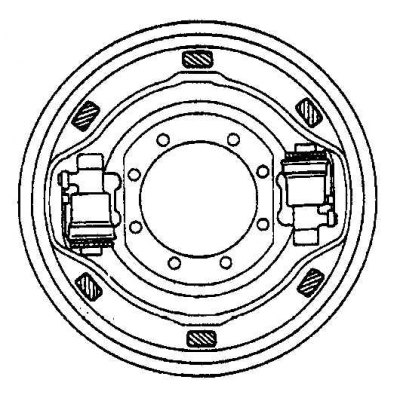
Installing the A-side pad
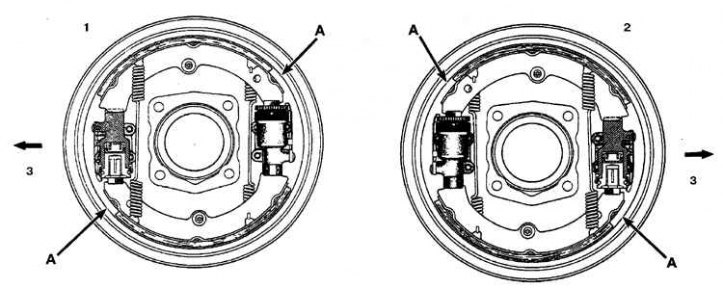


1. Left wheel; 2. Right wheel; 3. To the front of the car


Position of the pads after assembly
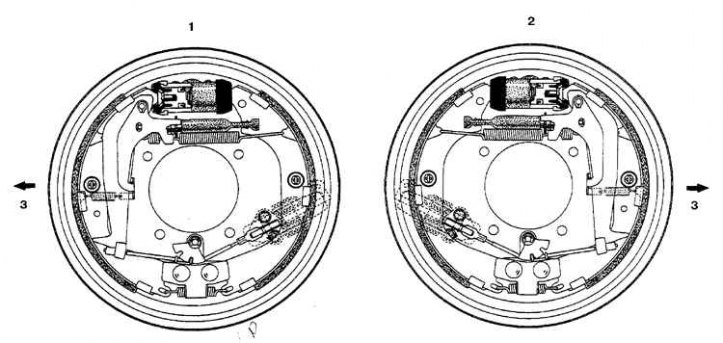


1. Left wheel; 2. Right wheel; 3. To the front of the car


Attention! The pads are changed only as a set for one axle.


Together with the shoes, the tension springs are also changed, which, subjected to periodic thermal loads, gradually lose elasticity and do not provide sufficient removal of the shoe from the drum. As a result, the drum touches the shoes, causing their premature wear.

Replacement


1. Loosen the wheel nuts, lift the rear (or front) part of the car.

2. Remove the wheels.

3. Release the handbrake.
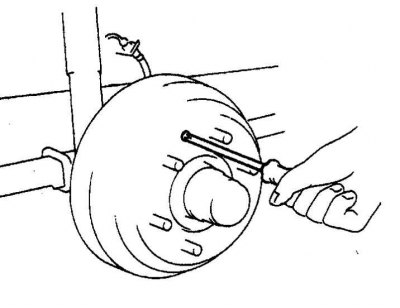


4. Mark the position of the drum, unscrew the screws (if provided) and remove the drum.


5. If the drum cannot be removed, pour penetrating liquid between the axle flange studs and the drum holes and tap the drum from the inside along the contour.

6. If this measure does not produce results, then move the pads together.
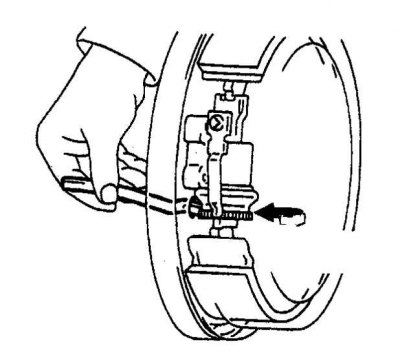


7. To do this, on brakes with horizontal pads, remove the plug from the brake shield and rotate the regulator gear wheel with a screwdriver.
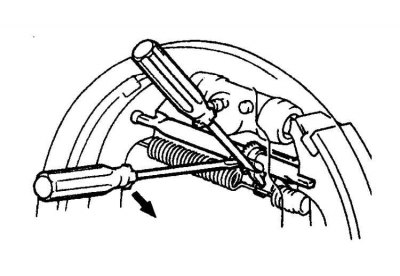


8. On vertical brakes, use a narrow-blade screwdriver to pry the adjuster lever away from the gear wheel and rotate the adjuster gear wheel with another screwdriver.

Brake with horizontally positioned pads
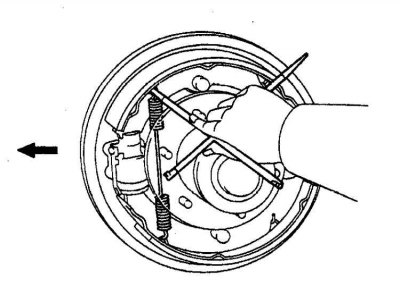


9. Remove the tension spring.
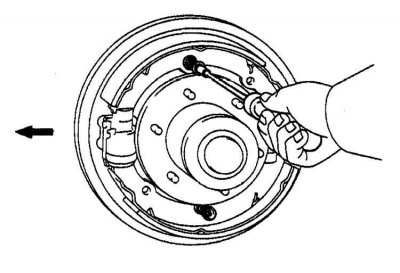


10. Remove the brake shoe pressure springs by pressing on the cup and turning it 90°.
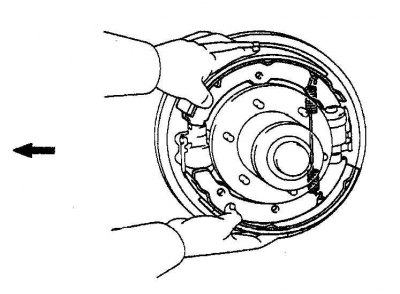


11. Remove the pads together with the lower spring.


12. Lubricate the rubbing surfaces of the pad on the shield side with high-melting grease and install the pads in the reverse order.

13. Install the side of the shoe A in accordance with Fig. Installing the A-side pad.


Brake with vertically positioned pads
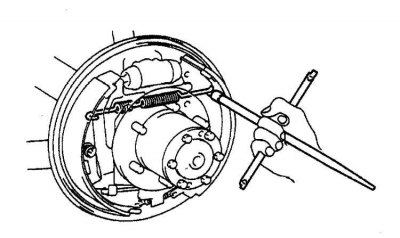


14. Remove the top spring.
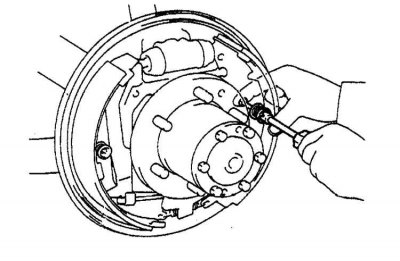


15. Remove the pressure spring by pressing on the cup and turning it 90°, and remove the rear shoe.
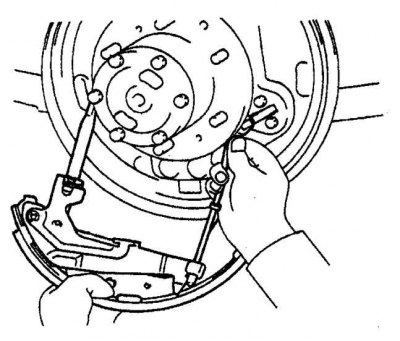


16. Disconnect the pressure spring and remove the front shoe assembly with the regulator. Remove the handbrake cable from the lever with pliers.
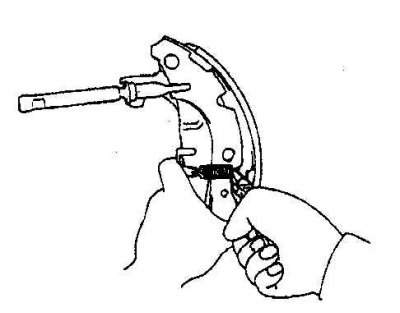


17. Remove the regulator lever spring from the front shoe.
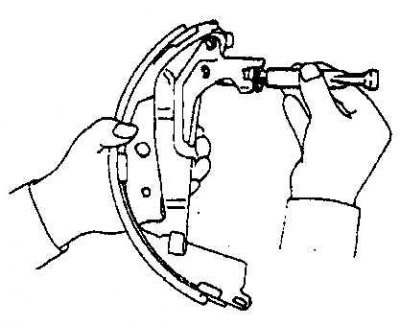


18. Remove the regulator.
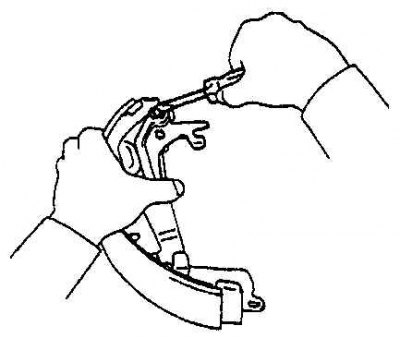


19. Remove the lock washer and take out the regulator lever.
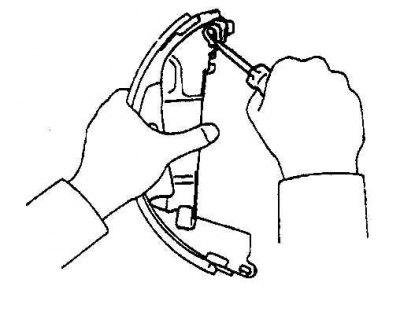


20. Remove the bracket and remove the handbrake lever.
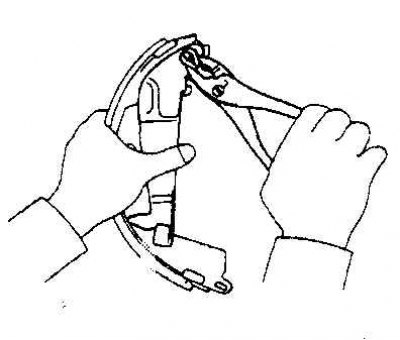


21. Install the handbrake lever onto the new front shoe and tighten the clamp. Install the adjuster lever and split lock washer (replace the washer and bracket).
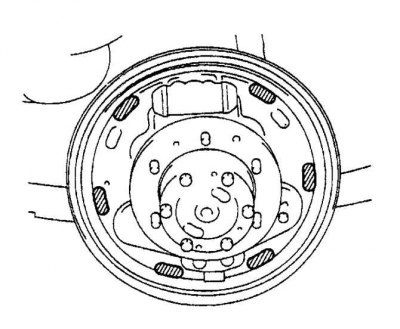


22. Lubricate the rubbing surfaces of the pad on the shield side with high-melting grease.

The text is taken from the specified website: toyotaman.ru
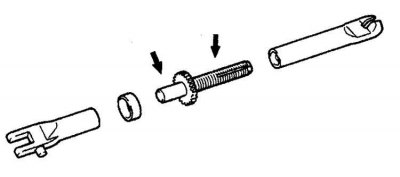


23. Lubricate the regulator parts with high-melting grease and screw the regulator pin into the spacer.


24. Install the pads in reverse order.

25. The position of the pads after assembly should look a certain way (see fig. Position of pads after assembly).

26. Clean the drum and check the surface condition.

27. Check the ovality of the drum; if there is severe damage, grind the drum; small rough spots can be sanded with sandpaper.
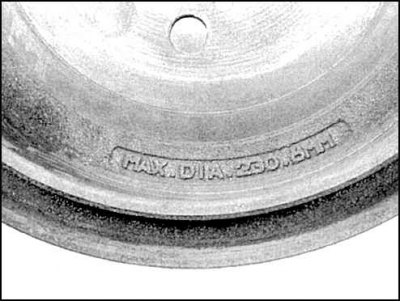


28. If after turning the inner diameter of the drum is greater than the maximum (indicated on the drum), replace the drum.

29. Install the drum and check the brake adjustment.

30. If the gap between the pads and the drum is too large, remove the drum and rotate the wheel stud to spread the pads until they touch the surface of the drum.

31. Move the shoes slightly closer together so that they do not touch the drum (checked by ear).

32. Install the wheel and lower the vehicle.

33. Apply the brakes several times, moving forward and in reverse.

34. Check the operation of the brakes before leaving.
This article is available at: russian, bulgarian, belarusian, ukrainian, serbian, croatian, romanian, polish, slovak, hungarian
The article material has been checked: Evdokimov Evgeniy
Share information:
◀ Previous
Cruiser 60/80: Brake system
Next ▶

Brake disc — inspection, removal and installation
Brake Caliper — Removal, Disassembly and Installation
Replacing disc brake pads (front or rear)
Diagnostics and repair of ABS system
ABS system units
Wheel brake cylinder — removal and disassembly
Brake Master Cylinder — Removal, Disassembly and Installation
Hydraulic Hoses and Tubes — Replacement
Bleeding the brake hydraulic system
Vacuum brake booster — removal, inspection and installation
Similar articles on other Toyota models

➥ Replacing brake shoes for drum brakes Toyota Camry XV10 (1991-1996)
➥ Drum brake shoes — replacement Toyota 4Runner N120 (1989-1995)
➥ Drum brake shoes — removal and installation Toyota RAV 4 XA20 (2000-2005)
➥ Rear wheel drum brake — device Toyota Corolla E80 (1983-1990)
➥ Replacing the front brake pads Toyota Corona T190 (1992-1997)
➥ Replacing brake pads Toyota Carina T190 (1992-1996)
Link in different formats to this article
Comments and feedback from visitors
No comments yet


Add two numbers 41 + 44


Cruiser 100 (1998-2007) 
  • General information
  • Introduction to the guide
  • Controls and instruments
  • Maintenance
  • Power unit
  • Petrol engines
  • Diesel engines
  • Cooling and heating
  • Power and exhaust systems
  • Engine electrical equipment
  • Engine management systems
  • Transmission
  • Automatic gearbox
  • Transmission line
  • Chassis, running gear
  • Brake system
  • Car suspension
  • Steering
  • Body and interior
  • Exterior (external elements)
  • Interior (internal elements)
  • Doors, locks and windows
  • Electrical equipment
  • Equipment and devices
  • Electrical circuits
Cruiser 60/80 (1980-1997, petrol) 
  • General information
  • User manual
  • Maintenance
  • Power unit
  • Petrol engines 2F and 3F-E
  • Petrol engines 1FZ-FE
  • Engine overhaul
  • Engine electrical equipment
  • Cooling and heating
  • Fuel system (carburetor)
  • Fuel system (injector)
  • Toxicity reduction system
  • Transmission
  • Car gearbox
  • Clutch
  • Transfer case
  • Drive shafts and axles
  • Chassis, running gear
  • Brake system
  • Car suspension
  • Steering
  • Body and interior
  • Exterior and interior
  • Doors, locks and windows
  • Electrical equipment
  • Equipment and devices
  • Electrical circuits
Cruiser 70 (1985-1996, diesel) 
  • General information
  • User manual
  • Maintenance
  • Power unit
  • Engine adjustment
  • Engine repair
  • Fuel system
  • Control system
  • Turbocharging system
  • Cooling and lubrication system
  • Charge and start system
  • Transmission
  • Clutch
  • Mechanical gearbox
  • Automatic gearbox
  • Transfer case
  • Chassis, running gear
  • Car suspension
  • Brake system
  • Steering
  • Body and interior
  • Body elements
  • Heating and air conditioning
  • Electrical equipment
  • Equipment and devices
  • Electrical circuits
ToyotaMan.ru © 2018–2026 • Mobile version • Interesting about Toyota • Administration • Sitemap: EN BG BY UA RS HR RO PL SK HU • Search system • Bookmark
Camry Vista-V40 • Camry XV10 • Camry XV20 • Camry XV30 • Corolla Verso-AR10 • Corolla E80 • Corona T190 • Carina T170 • Carina T190 • Land Cruiser J70 (diesel) • Land Cruiser J60 (petrol) • Land Cruiser J100 • Highlander XU20 (petrol) • 4Runner N120 • RAV4 XA10 • RAV4 XA20 • Duet M100 • Dyna Y50 •
We require cookies to enable some interactive features. Is that ok with you?