a) Turn the crankshaft and bring each piston to TDC in turn. Using a scraper, remove carbon deposits from the bottom of each piston.
b) Remove all gasket material from the cylinder block mating surface.
c) Use compressed air to remove any remaining gasket, oil and water from the surfaces and openings of the block.
Warning: Wear safety glasses during this operation.
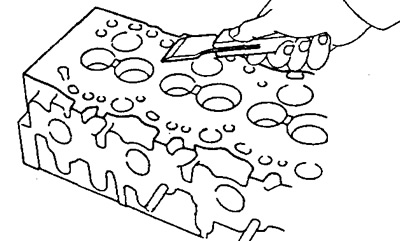
2. Using a scraper, remove all gasket material from the contact surface of the manifold and cylinder head.
Warning: The operation must be performed carefully to avoid scratching the surfaces.
3. Using a wire brush, remove all carbon deposits from the combustion chambers.
Warning: The operation must be performed carefully to avoid scratching the mating surface.
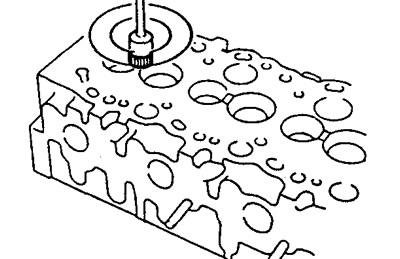
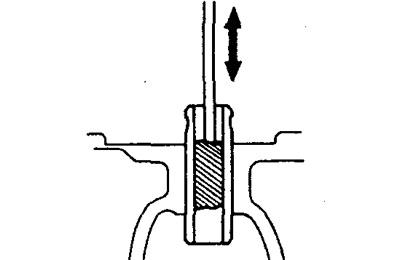
4. Using a valve guide brush and solvent, clean all valve guides.
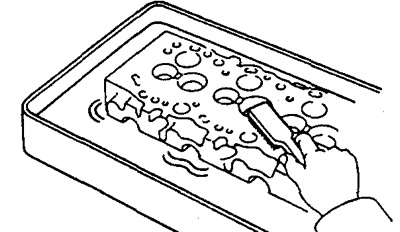
5. Thoroughly clean the cylinder head using a soft brush and solvent.
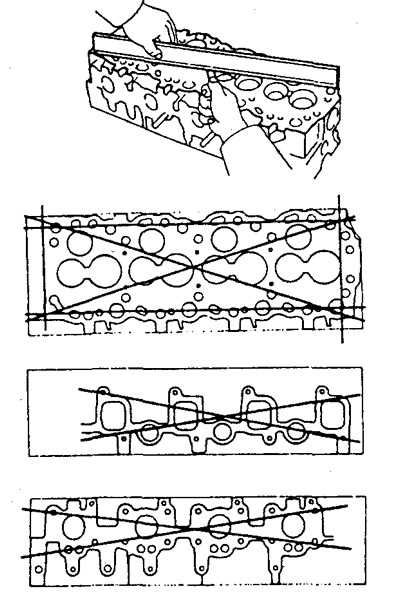
6. Check the cylinder head mating surfaces for warpage using a precision ruler and feeler gauge.
- Maximum permissible flatness is 0.20 mm
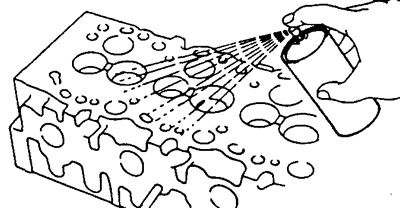
7. Using penetrating dye, inspect the combustion chambers, intake and exhaust ports, top and bottom surfaces of the head for cracks.
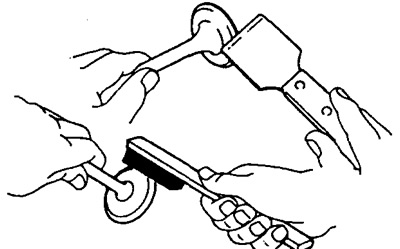
8. Clean the valves.
a) Using a scraper, scrape off any carbon deposits from the valve plate.
b) Using a wire brush, thoroughly clean the valve.
9. Check the condition of the valve stems and guide bushings.
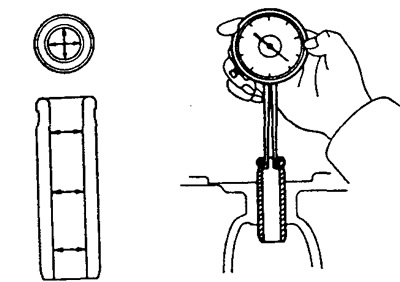
a) Using a bore gauge, measure the inside diameter of the valve guide holes as shown in the figure.
- Inner diameter - 8.01- 8.03 mm
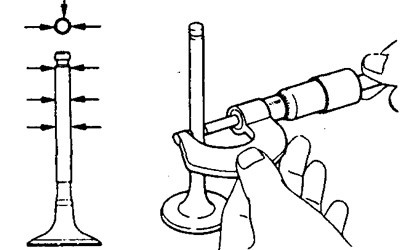
b) Using a micrometer, measure the diameter of the valve stem.
Valve stem diameter:
- Intake - 7.975-7.990 mm
- Exhaust - 7.960-7.975 mm
c) Subtract the valve stem diameter from the measured valve guide bushing bore diameter.
Nominal clearance:
- Inlet valve - 0.020- 0.055mm
- Exhaust valve - 0.035- 0.070 mm
Maximum allowable clearance:
- Inlet valve - 0.08mm
- Exhaust valve - 0.10mm
If the clearance value exceeds the maximum, replace the valves and guide bushings.
10. If necessary, replace the valve guides.
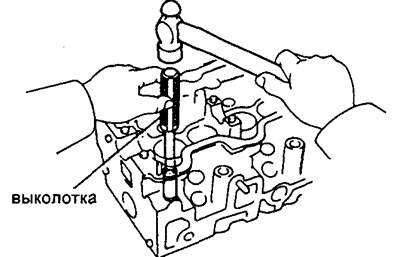
a) Using a punch and hammer, knock out the guide bushings.
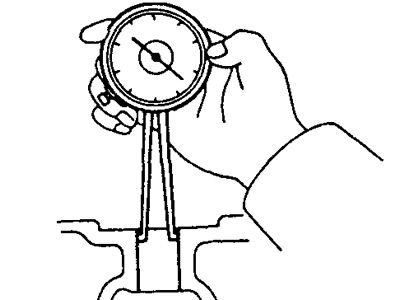
b) Using a bore gauge, measure the hole in the cylinder head for the guide bushing.
c) Select a new guide bushing (nominal or repair size).
If the diameter of the bore for the bushing in the cylinder head exceeds 13.025 mm, machine the bore to the repair size.
- Repair size: 13.054-13.075 mm
If the bore diameter of the cylinder head bushing exceeds 13.075 mm, replace the cylinder head.
d) Using a special tool and a hammer, lightly tap the new guide bushing into place. The bushing should protrude from the cylinder head by 10.8-11.2 mm.
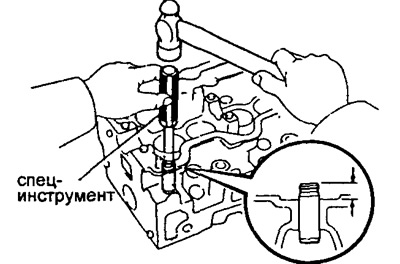
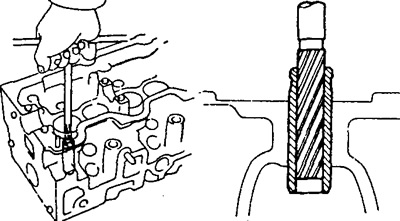
d) Using a reamer (08 mm), machine the inner diameter of the guide bushing until the nominal clearance between the guide bushing and the valve stem is obtained.
11. Checking the condition of the valve chamfers and their restoration.
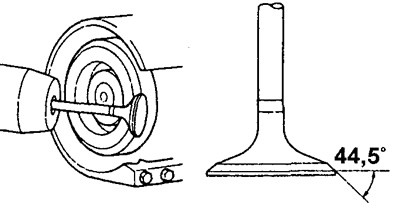
a) Grinding should be sufficient to remove pits and carbon deposits.
b) Check the correctness of the valve cone angle obtained as a result of grinding.
- Nominal angle - 44.5°
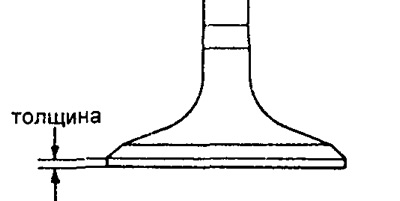
c) Check the thickness of the valve plate.
Nominal thickness:
- Inlet valve - 1.6 mm
- Exhaust valve - 1.7 mm
Minimum thickness:
- Inlet valve - 1.1 mm
- Exhaust valve - 1.2 mm
If the plate thickness is below the minimum acceptable value, replace the valve.
d) Check the overall length of the valve. Nominal length of the valve:
[The material is republished from an online website ToyotaMAN.ru]
- Intake - 103.29 -103.69 mm
- Graduation - 103.14 - 103.54 mm
Minimum valve length:
- Intake - 102.79 mm
- Exhaust - 102.64 mm
If the valve length is shorter, replace the valve.
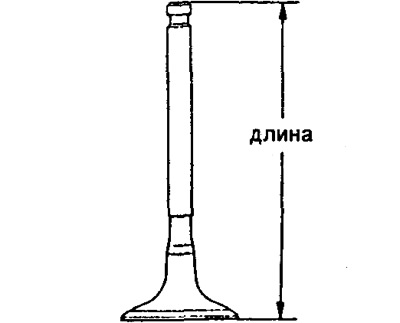
d) Check the valve end for wear. If there are signs of wear, grind the end or replace the valve.
Warning: Grinding must not reduce the minimum allowable overall valve length.
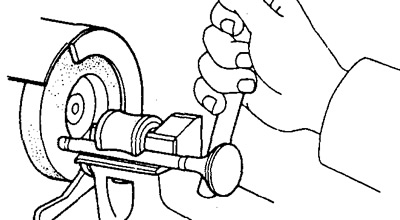
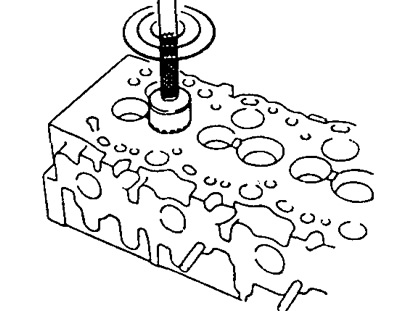
12. Check and clean the valve seats.
a) Use a cutter (45°) to clean the seats.
b) Check the valve fit. Apply a thin layer of white paint to the valve bevel. Press the valve onto the seat. Do not rotate the valve.
c) Check the contact between the valve chamfer and the seat:
- If the paint imprint is evenly distributed around the entire circumference of the valve working chamfer, then the valve axis coincides with the seat axis. If not, replace the valve.
- If the paint imprint is evenly distributed around the entire circumference of the valve seat working chamfer, then the axis of the guide bushing and the seat coincide. If not, mill the seat.
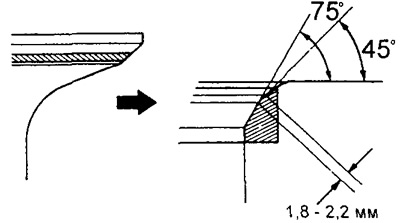
- Make sure the contact patch is located in the center of the valve seat and is 1.8 - 2.2 mm wide.
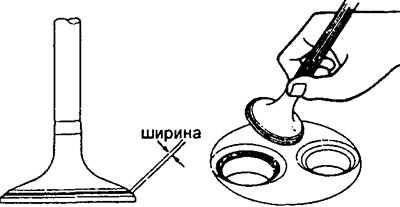
If the contact patch width is outside the specified limits, adjust it as follows:
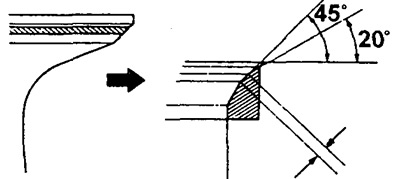
If the contact patch is located too high on the valve seat, use 20° and 45° cutters to correct the seat.
If the contact patch is too low on the valve seat, use the (75°) and (45°) cutters.
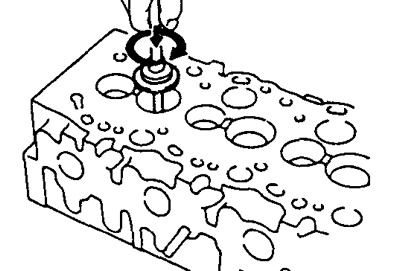
d) Grind the valve to the valve seat with lapping paste.
d) After lapping, clean the valve and valve seat.
13. Check the valve springs.
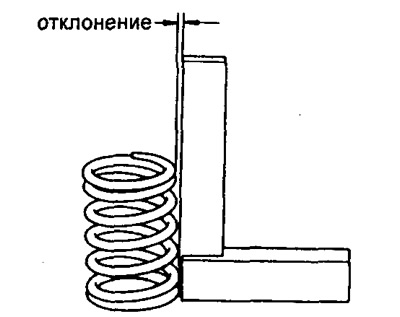
a) Using a precision square, measure the valve spring out-of-squareness.
- Maximum deviation is 2 mm
If the deviation is greater than the permissible limit, replace the valve spring.
b) Use a caliper to measure the length of the spring in its free state:
Spring length:
- With yellow mark - 46.20 mm
- With blue mark - 49.14 mm
If the spring length is not within the standard, replace the spring.
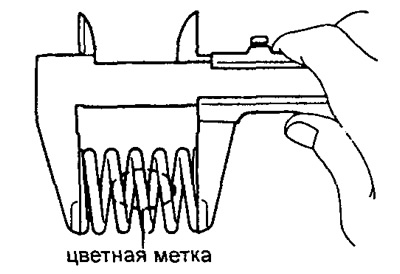
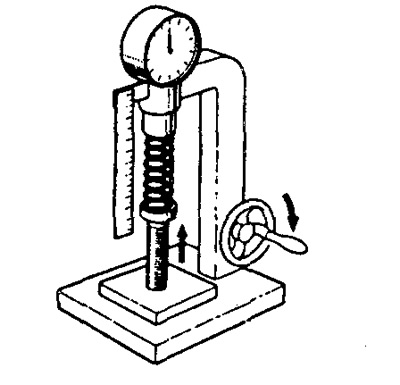
c) Using a spring tester, measure the spring deflection under load.
- Under load - 301 - 332 N
- Spring length - 37.0 mm
If the measurement results are not within the norm, replace the valve spring.
14. Check the camshafts and their bearings.
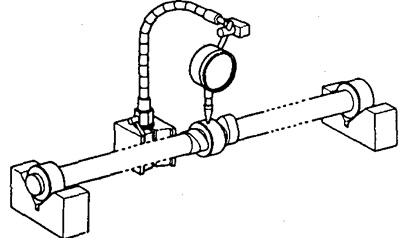
A. Check the camshaft runout:
a) Install the camshaft on the prisms.
b) Using a dial indicator, measure the camshaft runout on the middle bearing journal.
- Maximum permissible runout is 0.10 mm
If the runout is greater than normal, replace the camshaft.
B. Check the cam height:
Nominal cam height:
Intake
- 2L — 53.45 - 53.47 mm
- 3L — 54.29 - 54.31 mm
Graduation - 54.99 - 55.01 mm
Minimum allowable cam height:
Intake
- 2L - 53.35 mm
- 3L - 53.79 mm
Exhaust - 54.49 mm
If the cam lobe height is less than the minimum acceptable value, replace the camshaft.
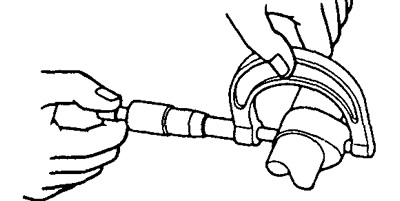
B. Check the camshaft journal diameter using a micrometer.
Nominal size:
- Neck #1 - 34.969 - 34.985 mm
- The rest are 27.969 - 27.985 mm
Repair size No.1:
- Neck #1 - 34.844 - 34.860 mm
- Others - 27.844 - 27.860 mm
Repair size #2:
- Neck #1 - 34.719-34.735 mm
- The rest are 27.719 - 27.735 mm
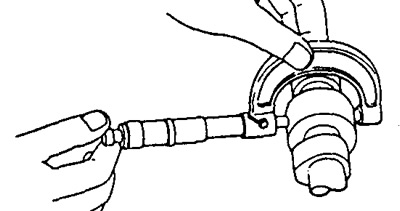
If the journal diameter is not within the standard, measure the clearance between the camshaft journal and the bearing.
D. Check the bearing shells for chipping and scoring. If the shells are damaged, replace them.
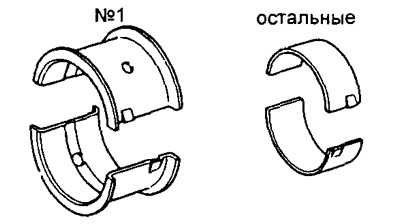
D. Check the camshaft oil clearance.
a) Clean the bearing caps and camshaft journals.
b) Place the camshaft on the bearing surfaces of the cylinder head.
c) Place a plastic gauge on each camshaft bearing journal.
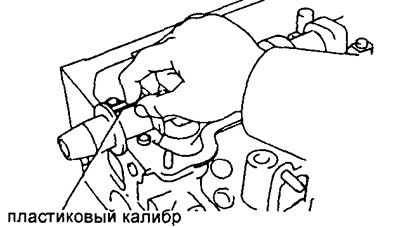
d) Install the bearing caps and tighten the mounting bolts
- Tightening torque - 25 Nm
Recommendation: Do not turn the camshaft.
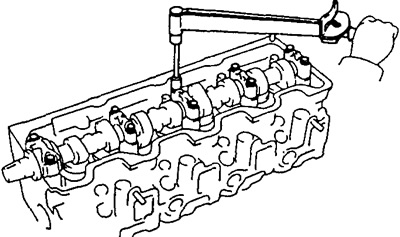
d) Remove the bearing caps.
e) Measure the width of the gauges and determine the gap.
- Nominal clearance - 0.022-0.074 mm
- Maximum gap - 0.10 mm
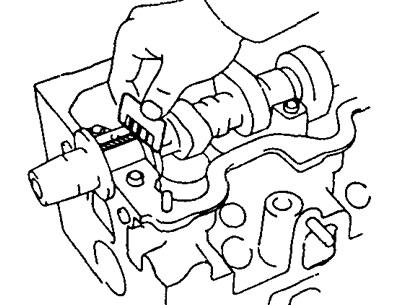
If the oil clearance exceeds the maximum permissible value, replace the bearing shells. If necessary, grind or replace the camshaft.
g) Remove any remaining gauges.
E. If necessary, grind and hone the camshaft journals to repair size. Install new journal bearing shells (repair dimensions).
G. Check the axial clearance of the camshaft.
a) Install the camshaft in place.
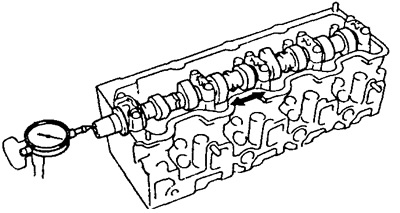
b) Using a dial indicator, measure the axial clearance by moving the camshaft back and forth.
- Nominal axial clearance - 0.080-0.280 mm
- Maximum axial clearance - 0.35 mm
If the axial clearance exceeds the maximum permissible value, replace bearing shell No.1. If necessary, replace the camshaft.
15. Check the condition of the valve tappets and tappet holes.
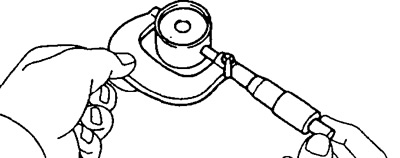
a) Use a micrometer to measure the diameter of the tappet.
- Pushrod diameter: 40.892 - 40.902 mm
b) Using a bore gauge, measure the diameter of the tappet hole in the cylinder head.
- Hole diameter: 40.960 - 40.980 mm
c) Subtract the measured tappet diameter from the measured bore diameter.
- Nominal clearance - 0.058-0.088 mm
- Maximum gap - 0.10 mm
If the clearance exceeds the maximum value, replace the tappet. If necessary, replace the cylinder head.
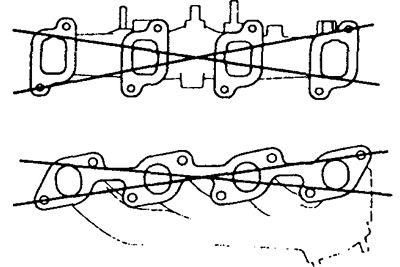
16. Check the intake and exhaust manifolds. Using a precision ruler and feeler gauge, measure the warpage of the contact surfaces of the intake and exhaust manifolds.
- Maximum warpage - 0.4 mm
If the warpage is greater than acceptable, replace the manifold.
17. Check the condition of the cylinder head bolts.
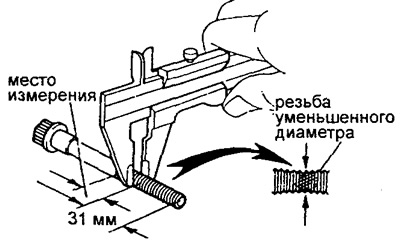
Using a caliper, measure the outside diameter of the thread at the point of smallest diameter.
- Nominal outside diameter - 11.80-12.00 mm
- Minimum outside diameter - 11.60 mm
If the outside diameter is less than the minimum allowable value, replace the bolt.