



Contents: Checking cam wear ↓ Examination ↓
Checking cam wear
1. Remove the cylinder head cover.
2. Set the piston of the 1st cylinder to TDC of the compression stroke.
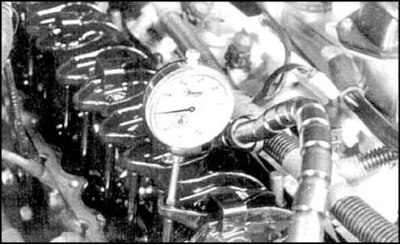
3. Check the wear of the cams on the 1st cylinder. To do this, install the indicator above the first rocker arm so that the indicator leg runs parallel to the rod axis and is located directly above the rod.
(The original version is published on the website: www.ToyotaMAN.ru)
4. Set the indicator to zero, turn the crankshaft in the direction of normal rotation. After the readings stop changing, turn the crankshaft back until the pointer stops. The difference in readings is equal to the cam size.
5. Record the readings and set the piston of the 1st cylinder to TDC of the compression stroke again.
6. Move the indicator to the other rocker arm of the 1st cylinder and repeat the measurements.
7. Repeat the measurements for the remaining cylinders in accordance with the engine firing order (see subsection 3.1.1).
8. Compare the results with the standard. If the reduction in cam size due to wear exceeds the standard, replace the camshaft.
Examination
1. Remove the camshaft and wash it. Check the condition of the journals. If there are signs of wear on the journals, then the camshaft bearings are also worn. In this case, the camshaft and bearings should be replaced.
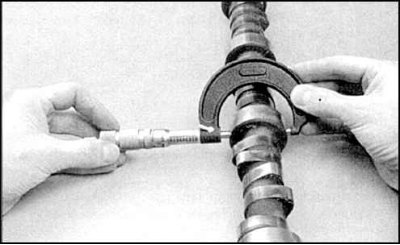
2. If the necks are in satisfactory condition, then check their diameter in several places, determine the taper and ovality.
3. Check the inner diameter of the journal bearings, determine the clearance and compare with the standard. If the clearance exceeds the standard, replace the bearings (performed in a car service).
4. Check the condition of the distributor drive gear. If there are signs of severe wear, replace the camshaft.
5. Check the condition of the cams, the presence of chipping, scoring and deep wear. Check the dimensions of the cams with a micrometer. If the cams are in satisfactory condition and the size is normal, the camshaft can be used further.