



Fuel Pump Power Circuit Parts (1988-90.)
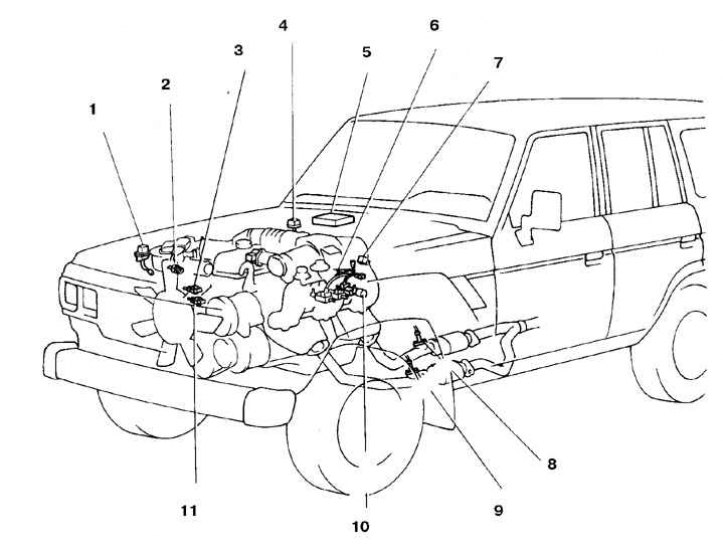
1. Main relay of the injection system; 2. Liquid temperature contact sensor; 3. Starting nozzle; 4. Diagnostic connector; 5. Processor unit; 7. Fuel pump relay; 8, 9. Oxygen sensor; 10. Vacuum valve; 11. Liquid temperature sensor
Fuel Pump Power Circuit Parts (1991-92.)
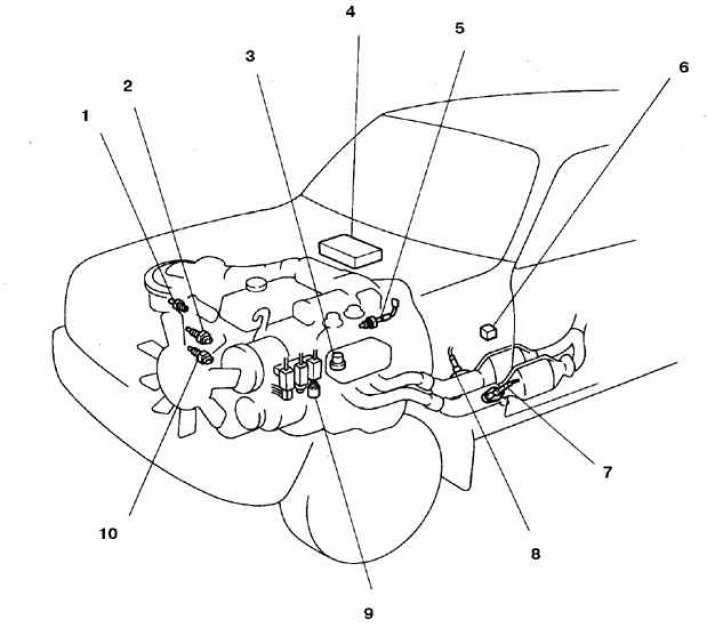
1. Liquid temperature contact sensor; 2. Starting nozzle; 3. Main relay of the injection system; 4. Processor unit; 6. Fuel pump relay; 7, 8. Oxygen sensor; 9. Vacuum valve (with control from the processor unit); 10. Liquid temperature sensor
Layout of fuel pump supply circuit components (since 1993)
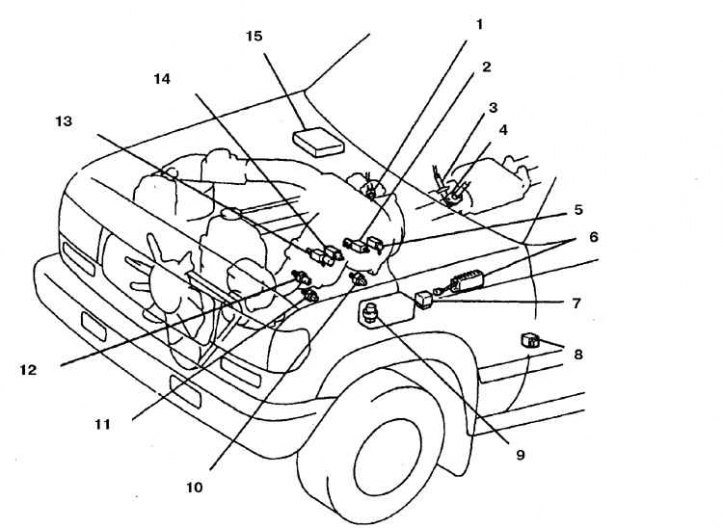
1. Temperature sensor of gases of the recirculation system; 2. Vacuum valve (for pulse air supply system); 3, 4. Heated oxygen sensor 1 and 2; 5. Vacuum valve of the recirculation system; 6. Resistor; 7. Fuel pump relay; 8. Fuel pump circuit relay; 9. Main relay of the injection system; 10, 11. Knock sensor; 12. Temperature sensor; 13. Vacuum valve (with control from the processor unit); 14. Vacuum valve of the gasoline vapor recovery system; 15. Processor unit
Examination
Fuel pump
1. Turn on the ignition (do not start the engine).
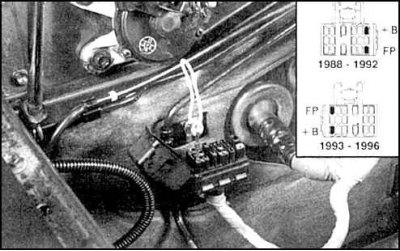
2. Connect the B+ and FP terminals on the diagnostic connector with a jumper.
Attention! On all cars of 1988-1994 the diagnostic connector is different. Follow the connector layout indicated on the plate, which is fixed under the connector.
3. On vehicles manufactured in 1995, the fuel pump is not powered via the diagnostic connector. On these vehicles, the engine must be running to read the fuel pressure.
4. After the above terminals are bridged, voltage is supplied to the fuel pump. The pump should be audible under the rear seat, and fuel pressure should be felt on the hose from the fuel filter.
5. Disconnect the jumper. Install the plug on the diagnostic connector.
6. Turn off the ignition.
7. If the pump does not work, check the 15A fuse for the main fuel injection relay (EFI relay).
8. Check the 30 A ignition key fuse (AM2 fuse, see. subsection 11.3).
9. Check the main fuel injection relay (EFI relay) and the fuel pump relay.
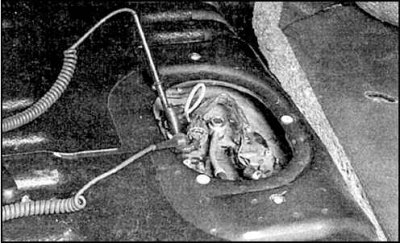
10. Check for voltage at the fuel pump.
The original can be viewed on the website [ToyotaMan.ru]
11. Check the wiring and connectors.
12. Cars after 1993 are additionally equipped with a fuel pump relay, on which the voltage must also be checked.
Fuel pressure
1. To perform the procedure described below, you will need a pressure gauge for a pressure of at least 3 kgf/cm². The hose tip should be of the "banjo" type, i.e. sealed with a bolt with an internal through-hole
2. If you don't have a special pressure gauge, get a ready-made "banjo" type fitting with an internal diameter of 12 mm, to which the hose with the clamp from your pressure gauge fits.
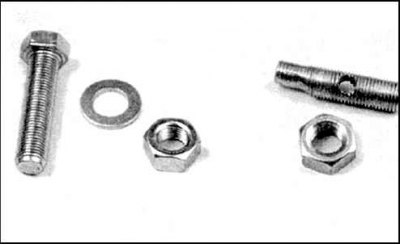
3. If you don't have a ready-made fitting, you can make one from a bolt with an M12x1.25 mm thread. Grind off the bolt head and drill two holes - one through the center of the bolt, and the other - in the center across the bolt, intersecting with the longitudinal hole. Screw on the nut and lock nut, sealing the thread with Teflon tape.
4. Unscrew the filler cap of the tank.
5. Make sure the battery voltage is not less than 12 V.
6. Decompress the fuel system.
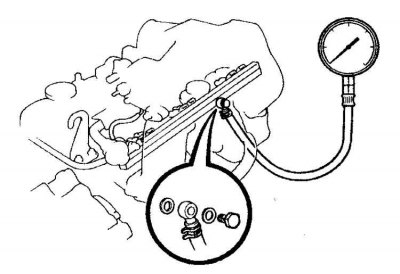
7. If there is an adapter on the pressure gauge, unscrew the bolt on the distributor and screw in the adapter.
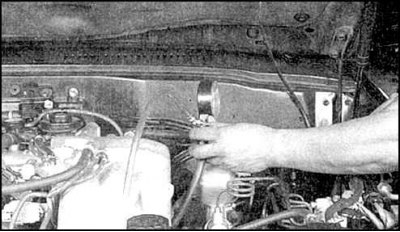
8. Screw in the adapter, made by yourself, as shown in the photo.
9. Connect the pressure gauge in the following order:
- if you have a "standard" pressure gauge, connect it to a special adapter installed on the fuel distributor;
- be sure to install new gaskets on both sides of the adapter;
- screw the self-made adapter into the fuel filter, tighten the lock nut;
- attach the pressure gauge hose and secure with a clamp.
10. Wipe up any spilled gasoline from the fuel distributor or filter.
11. Place the automatic transmission selector lever in Park, or the gear shift lever in Neutral.
12. On all 1988-1994 vehicles, short-circuit the B+ and FP terminals on the diagnostic connector using a special jumper.
Caution! On 1995 vehicles, power to the fuel pump is not provided through the diagnostic connector. On these vehicles, the engine must be running to read the fuel pressure.
13. Turn on the ignition (do not start the engine). Read the pressure reading and compare it with the standard.
14. If the pressure is high, check the return fuel line. If gasoline passes through the fuel line, replace the fuel pressure regulator.
15. If the pressure is low, pinch the return fuel line. If the pressure increases, replace the fuel pressure regulator. If the pressure does not increase, check the fuel supply line, fuel pump and fuel filter.
16. Remove the jumper from the diagnostic connector or from the fuel pump connector.
17. Start the engine.
18. Check the fuel pressure at idle speed and compare the result with the standard.
19. If the pressure differs from the standard, check the vacuum hose and the fuel pressure regulator.
20. Stop the engine and check that the fuel pressure remains at 1.3 kgf/cm² for 5 minutes after stopping. If the pressure drops faster, the cause may be a leak in the fuel pump, pressure regulator or injector.