



- Replace all rubber seals. Repair kits are available and all parts of the repair kit must be used during assembly.
- Disassembly and assembly must be carried out in clean conditions.
- Before installation, soak all rubber seals in clean brake fluid for a while.
- When ordering a repair kit, please indicate the chassis number and model, as the wheel brake cylinders have been modified.
Using Figure 260:
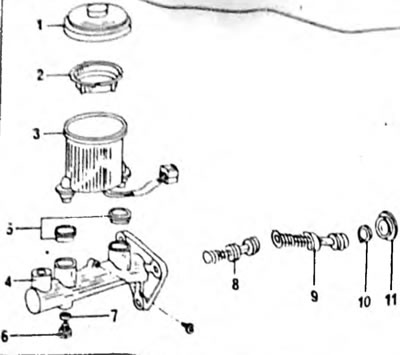
Fig. 260. Assembly drawing of the master brake cylinder. The shape of the reservoir is not the same on all models. 1. Tank lid; 2. Filter mesh; 3. Tank; 4. Cylinder body; 5. Rubber tips; 6. Bolt, 10 Nm; 7. The seal is always replaced; 8. Intermediate piston and spring; 9. Working piston and spring; 10. Retaining ring; 11. Rubber cuff
- Remove the cover (1) and filter (2) and drain the liquid.
- Clamp the cylinder in a vice.
- Remove the dust cap (11).
- Using pliers for retaining rings, remove the retaining ring (10) from the hole. To do this, push the piston slightly inward to relieve the spring force from the ring, i.e. bring both handles of the pliers together, as shown in Figure 261.
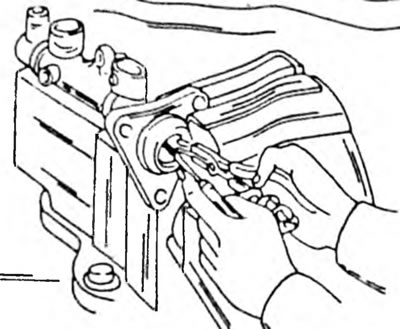
Fig. 261. Removing the retaining ring from the hole when recessing the piston.
- Unscrew the stop bolt from the bottom when pushing the piston into the cylinder, as shown in Figure 262. Do not lose the sealing washer.
(The original can be read on the website ToyotaMan)
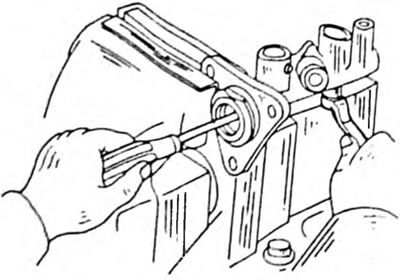
Fig. 262. When turning the stop screw out or in, press the piston into the hole.
- Pull all the internal parts out of the hole. If the parts are stuck tightly, they can be blown out with compressed air. To do this, connect the compressed air hose to one of the cylinder holes, and close the other hole of the tube with your finger. Wrap the cylinder with a rag so that the parts do not fly apart.
- Remove the seals from the pistons with your fingers.
- If further disassembly is required, unscrew the two small bolts and pull the reservoir out of the rubber tips. The rubber tips can be pressed out with a screwdriver. Wash all parts in brake fluid or alcohol. If the cylinder bores or piston still have a good appearance, measure the bore diameter and the outside diameter of the piston with a micrometer. The difference between the two dimensions, i.e. the clearance, should not exceed 0.15 mm. Immerse new piston seals in brake fluid and place them on the pistons. Assemble the cylinder in accordance with the assembly drawing. Using a screwdriver, insert the piston into the bore and screw in the stop bolt (6), without applying much force (Fig. 262). Then release the screwdriver and check whether the piston is held in place. Insert the retaining ring at the end of the cylinder bore. In this case, press the piston into the hole as shown in Figure 261 and insert the ring using pliers for retaining rings. Check that the retaining ring (10) is seated well in the groove. When installing the tank, it should be turned so that the "Max" mark is visible from the front side. Tighten the bolt, pressing the tank down.