



- Lubricate the cylinder bore.
- Lay out all connecting rods by cylinder numbers. The "VORN" mark on the connecting rod and on the piston bottom should be directed towards the engine pulleys.
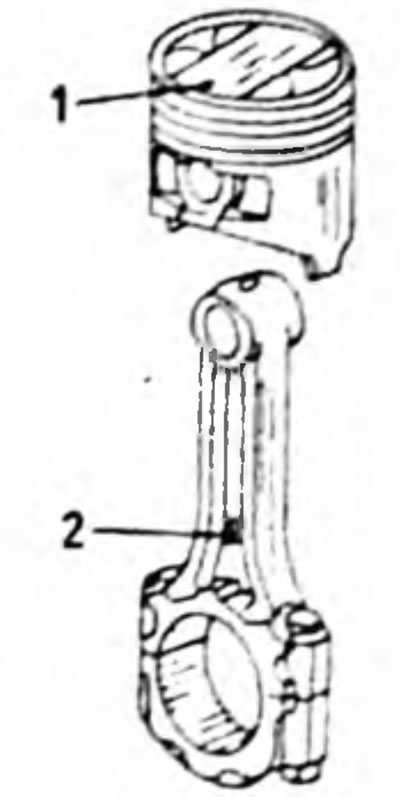
Fig. 96. On a 1.6L engine, the "VORN" mark (1) and the lug on the connecting rod (2) should be on the same side. And on a 2.0L engine, the straight edge of the connecting rod should be facing forward
- Distribute the piston ring locks evenly every 120 along the piston circumference. Figures 97 and 98 show how the locks are offset relative to the piston pins. The arrow points in the direction of travel. It is good to study both figures, since the installation of the side elements of the oil scraper rings is different on both engine types.
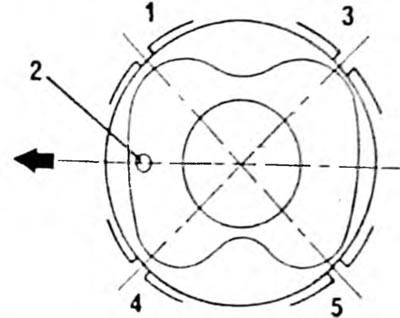
Fig. 97. Location of piston ring locks around the piston circumference on a 1.6 l engine. The arrow points forward. Thermal clearances are located in the following places: 1. Upper side ring; 2. Label "VOPN"; 3. Compression ring No.2; 4. Compression ring No.1 and expansion spring lock; 5. Lower side ring.
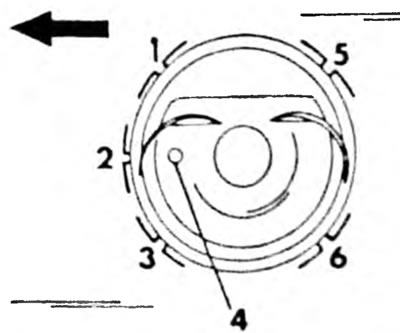
Fig. 98. Location of ring locks around the piston circumference on a 2.0L engine. The arrow points forward. The thermal clearances are located in the following places: 1. Upper side ring; 2. Expansion spring; 3. Compression ring No.2; 4. "Vorn" label; 5. Upper compression ring; 6. Lower side ring
- Apply piston ring tightening tape to the piston ring installation area and press the rings into the grooves. Check that they are properly seated.
- To avoid scratching the cylinder bores, place short pieces of rubber or plastic mass hose on the connecting rod studs. The nuts must be replaced, as nuts installed once will loosen.
- Turn the crankshaft until the two journals of the shaft are set to the lower MT position.
- Push the connecting rod into the hole from above.
- To prevent the connecting rod from scratching the cylinder wall or the crankpin, install the engine on its side. The connecting rod bearing shells should be in the connecting rod, with the protrusion in the cutout.
- When pulling out, check again that the mark is directed as shown in Figure 99.
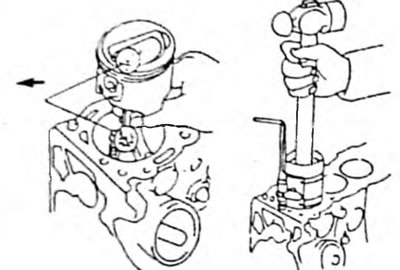
Fig. 99. After the piston has been inserted as shown on the left side of the figure (marked "Vorn" on the front side), insert it together with the piston ring tightening tape into the cylinder.
- Push the piston forward until the piston rings are sequentially inserted into the cylinder and the connecting rod leg is seated on the shaft journal.
- Insert the second bearing shell into the bearing cap and lubricate it. Put the cap on the connecting rod studs and tap it lightly. The pieces of rubber hose should be removed beforehand. Make sure that the marks on the connecting rods and bearing caps are on the same side, as a mistake can be made at the last moment.
- Lubricate the surfaces of the nuts on the connecting rod bearing caps.
- Tighten the new connecting rod nuts alternately to a torque of 50 Nm.
- After installing the connecting rod, turn the crankshaft several times to immediately detect jamming.
- Turn the crankshaft so that the other two journals are positioned at the bottom and install the remaining pistons and connecting rods in the same way.
- Check the position of all marks again and check that the pistons are installed correctly.
- Install, as shown in Figure 21, a dial indicator on the cylinder block and between the side surfaces of the connecting rod and crankshaft, moving the connecting rod bearing on the shaft journal in both directions by hand. The axial play of the connecting rod bearing should not exceed 0.30 mm (1.6 l engine.) or 0.35 mm (2.0L engine).
The original article is on the portal ToyotaMan.ru