



Contents: Removal ↓ Installation ↓
Petrol engine with a working volume of 1.3 l up to 7/84 of production, petrol engine with a working volume of 1.6 l, designated 4A-L, 4A-F, 4A-FE
Caution: Removing the diesel timing belt, look here.
Removal
Remove the cover on the right wheel housing.
Remove the spark plugs.
Remove the V-belt.
Turn the crankshaft until the marking on the camshaft wheel aligns with the "0" marking on the timing cover, see Fig. G-1018.
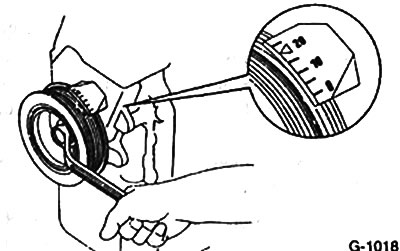
To turn the crankshaft, engage fifth gear and move the car on a level surface. You can also turn the crankshaft differently. To do this, lift one of the front wheels, engage fifth gear and turn the wheel by hand.
Loosen the cylinder head cover mounting bolts and remove the cover.
Check whether the rocker arms of the valves of the first cylinder are pressed by the camshaft cams. If they are pressed, the crankshaft must be turned a full revolution.
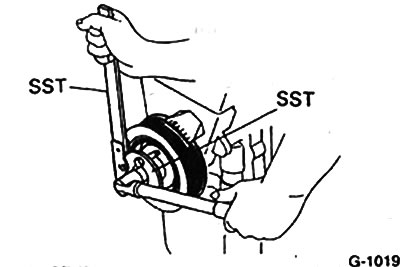
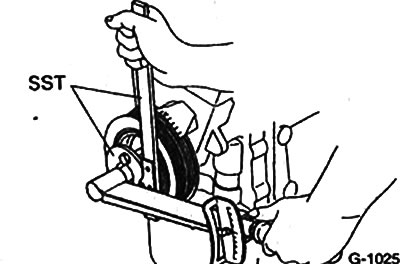
Loosen the crankshaft pulley screws. To prevent the crankshaft from turning, use tools SST 09213-14010 and SST 09330-00020. If these tools are not available, engage first gear and, with the help of an assistant, press the brake pedal, thus blocking the engine.
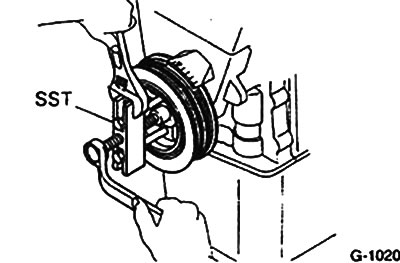
Remove the crankshaft pulley. For this purpose, you can use the special tool SST 09213-31021. If you do not have this tool, you can remove the pulley with a universal puller, for example, HAZET 787N-16.
Caution: Before removing the pulley, set the gearbox to neutral and check again whether the markings on the crankshaft pulley and cover match. If the markings match, do not change the position of the crankshaft any more.
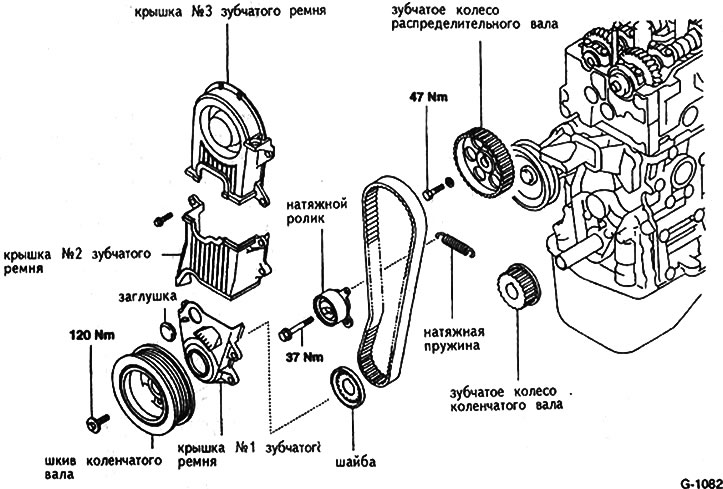
Remove the upper, middle and lower timing belt covers.
Remove the crankshaft timing gear guide.
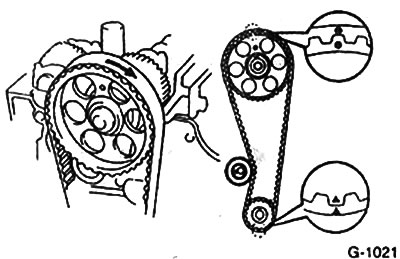
If the old belt is to be used, it must be marked as shown in the figure. To do this, an arrow indicating the direction of rotation of the belt is applied to the belt, for example with a felt-tip pen. The engine rotates clockwise. Markings are also applied to the toothed wheels of the crankshaft and camshaft and at the corresponding points of the toothed belt, as shown in the figure.
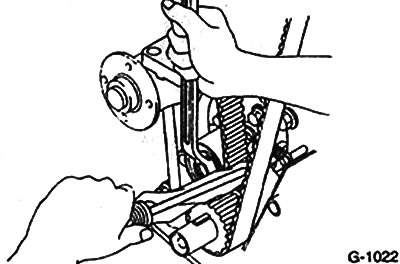
Loosen the tension roller mounting bolt. Press tension roller 1 until it stops in the direction of the arrow and tighten the bolt again.
Remove the timing belt, but do not change the position of the gears.
Installation
Attention: Do not bend or twist the toothed belt. It is better to replace a dirty or damaged belt. Check the tension roller for ease and uniformity of movement.
Caution: If the camshaft is turned with the timing belt removed, make sure that the pistons are not in the UMT. Otherwise, it may cause damage to the pistons and valves.
If it becomes necessary to turn the camshaft, first set the pistons to the middle height position. To do this, apply a chalk mark on the top of the crankshaft wheel (the piston of the first cylinder must be set to TDC). Then turn the crankshaft wheel to the right or left by 1/2 turn. The marking will point to the right or left.
Put on the toothed belt. If you are installing an old belt, you must take into account the direction of its rotation.
Caution: When installing the timing belt, do not change the position of the crankshaft and camshaft. Otherwise, this may cause serious damage to the engine or loss of engine power.
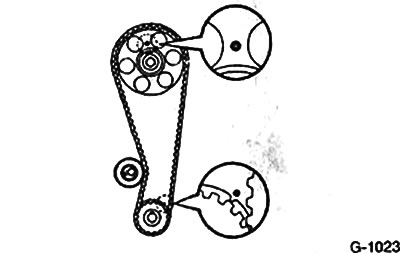
Check whether the camshaft is in the position corresponding to the TDC of the piston of the first cylinder. To do this, the hole in the camshaft wheel must coincide with the marking on the bearing cover.
At the same time, the marking on the crankshaft gear must match the marking on the oil pump housing. In this case, the piston of the first cylinder is at TDC.
Loosen the tension roller mounting bolt 1 and press it against the toothed belt.
Turn the crankshaft twice in the direction of engine rotation and check the alignment of the markings again.
Tighten the tension roller mounting bolt to 37 Nm.
Turn the crankshaft twice in the direction of engine rotation and check the adjustment again.
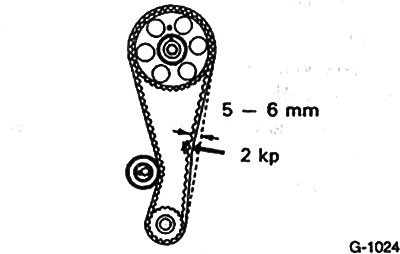
If the timing belt tension is adjusted correctly, the belt should deflect by 5-6 mm between the timing and crankshaft gears under a force of 20 N (about 2 kg), which corresponds to light pressure from the thumb.
Install the crankshaft wheel guide into place.
Install the timing cover in place and secure it with bolts.
Install the key on the crankshaft. To facilitate installation of the pulley, install the key so that it is recessed slightly more at the front than at the rear.
Lubricate the head and threads of the pulley mounting bolt with a thin layer of engine oil.
Install the crankshaft pulley, using a pipe to push it in if necessary. Clamp the pulley with the SST 09213-14010 tool and tighten the bolt to 120 Nm. If these tools are not available, engage first gear and, with the help of an assistant, press the brake pedal, thus blocking the engine.
Install the cylinder head cover.
Put on the V-belt and tighten it.
Install the spark plugs in place.
Secure the cover to the right wheel housing with bolts.