



The following wearing parts are required:
- Fuel injected engine: two copper gaskets.
- Filter for the corresponding engine. When buying a filter, keep in mind the year of manufacture and model of the car.
Diesel
Draining sediment from the fuel filter and replacing it
To collect the drained sludge, an appropriate container is required.
Caution: If diesel fuel gets on rubber parts, they must be wiped off immediately. Diesel fuel destroys rubber over time.
Draining water
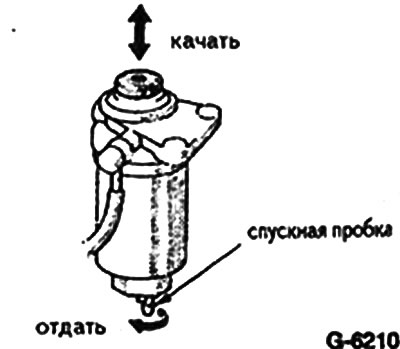
Place a container under the drain plug.
Loosen the drain plug 2-2.5 turns.
Pump with a hand pump until only clean fuel flows out of the filter.
Tighten the drain plug by hand.
Changing the filter
Drain all liquid from the filter as described in the section "Draining Sediment".
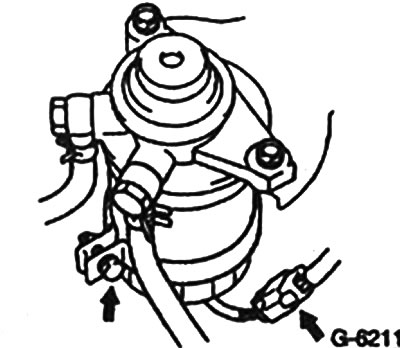
Disconnect the plug connection of the water presence sensor, if there is one.
Remove the filter mounting clamp bolt (arrow in Fig. G-6211).
Disconnect the filter from the holder using a special key and remove the filter.
If there is a water presence sensor, move it to the new filter.
Fill the new filter with fuel to the brim, moisten the gasket with fuel and close it.
Bleed air from the fuel system.
After a test drive, check the fuel system for leaks.
Bleeding air from the fuel system
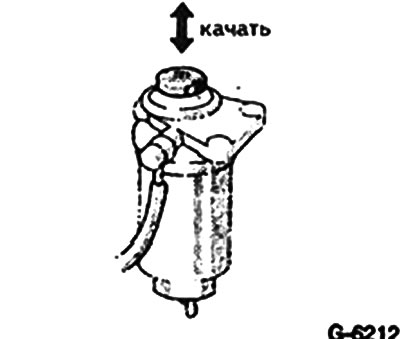
Pump the filter with the hand pump until resistance is felt.
Warm up the engine and start it.
If the engine does not start, repeat the air bleeding procedure.
Visually check the fuel system for leaks, especially in the filter connection area.
Carburetor engine
The fuel filter is located in the engine compartment in the fuel supply line.
Removal
Warning: Do not use open flames. There is a risk of fire!
Disconnect the ground (-) cable from the battery.
Note: This will erase the entries in the trip computer memory. In particular, the entries of faults and the radio receiver code. Before disconnecting the battery, it is necessary to read the contents of the section "Removing and installing the battery".**
Clamp the hoses to prevent fuel leakage.
Disconnect the hoses from the filter.
Installation
Place the hoses on the new filter and secure them with clamps. The arrow on the filter body indicates the direction of fuel flow.
Remove the hose clamps.
Connect the ground (-) cable to the battery.
Set the time to an hour, if any, and enter the radio receiver code.
After a test drive, check the fuel system for leaks.
Fuel Injected Engines
Removal
Warning: Do not use open flames. There is a risk of fire!
Disconnect the ground (-) cable from the battery.
Note: This will erase the entries in the trip computer memory. In particular, the entries for faults and the radio receiver code. Before disconnecting the battery, please read the section "Removal and installation the battery".
Place a container under the filter to collect the fuel.
Unscrew the lower hose fastening and slowly remove it. Close the pipeline with a plug.
Drain the fuel into a container.
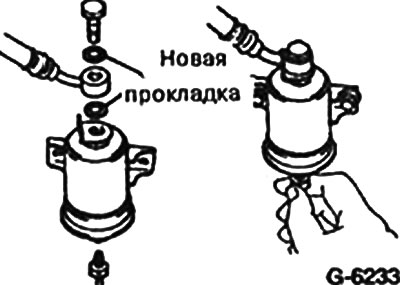
Unscrew the upper fitting and remove the fuel line with two gaskets.
Installation
Install the fuel filter in place and secure it.
The original can be read on the website: toyotaman
Install the top screw with two new gaskets and tighten it to 30 Nm.
Remove the plug from the lower pipe and connect it to the filter.
Tighten the lower pipe to 30 Nm.
Connect the ground (-) cable to the battery.
Set the time on the clock, if there is one. Enter the code into the radio receiver.
After a test drive, check the tightness of the fuel line connections.